One chain from the air to the muscle: how blood is redirected in exercise, why the brain always gets the same, what changes after a meal, and which systems work harder in a run.
Step 1 of 6 · One chain
Step 1 of 6
One chain
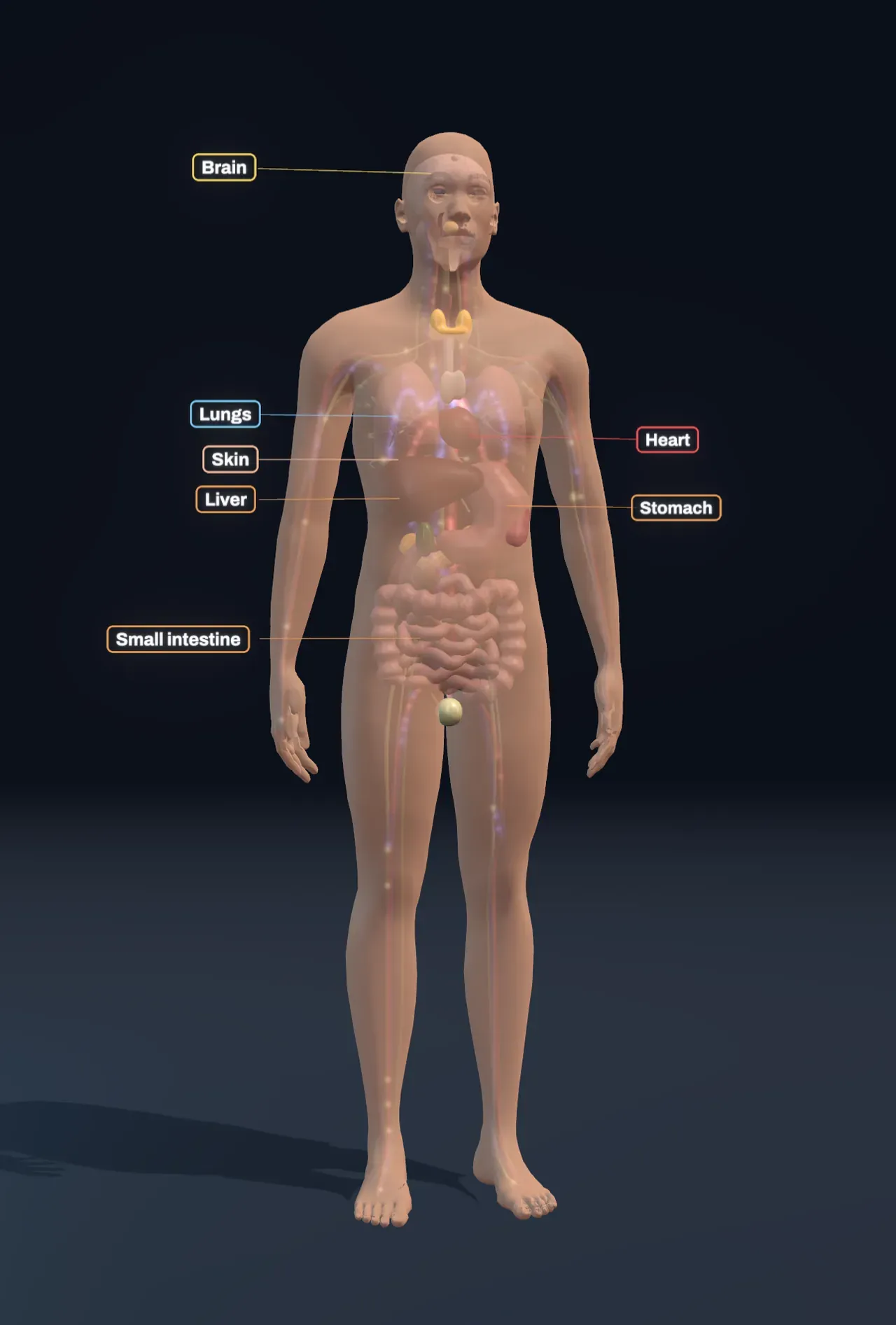
In the earlier Lessons you met three systems one at a time: the digestive system takes food in, the breathing system takes oxygen in, and circulation shares both out. But none of them works alone. For a leg muscle to get oxygen takes a whole chain: the diaphragm, the air sacs, the haemoglobin, the heart, the arteries and the capillaries inside the muscle.
Peel back the layers is at Organs. With Light up a system you can light up each system on its own. Try a few, and think about which one reaches everywhere in the body.
Step 2 of 6
Blood goes where it is needed
In exercise the heart does not only pump more blood: the body also redirects it. Small muscles in the walls of the small arteries widen the vessels in the organs that are working and narrow them in organs that can wait. The chart shows each minute’s blood as one bar, split by organ, over the same bar at rest, dashed. Time since eating is fixed, and Exercise effort is yours.
Step 4 of 6
Half the blood
At rest the muscles get about a fifth of the blood, though they are nearly half the body’s weight. As the effort grows, so does their share. Find the effort at which they get exactly half.
Step 5 of 6
After a meal
The digestive system can ask for blood too. Time since eating now stands at six hours, and the gut is almost at rest. Exercise effort is fixed at rest.
Step 6 of 6
All at once
Exercise effort stands at 75%: a fast run. Light up the systems one by one and compare them on the chart with the dashed bar at rest. Some systems step up their work, and some give it up until the exercise is over.
Loading the interactive version…
Loading the interactive version…
Each step sets up the Scene for you, and a control marked “fixed” stays put for that step.
Practice · Choose
The lungs take oxygen into the body, but the leg muscles are far from them. Which system brings the oxygen to the muscles? Light it up in the Scene.
Practice · Choose
The lungs take oxygen into the body, but the leg muscles are far from them. Which system brings the oxygen to the muscles? Light it up in the Scene.
Practice · Predict, then look
At rest the brain gets about 0.75 L of blood a minute. What will happen to that when Exercise effort rises to 50% and the heart pumps two and a half times as much?
Practice · Predict, then look
At rest the brain gets about 0.75 L of blood a minute. What will happen to that when Exercise effort rises to 50% and the heart pumps two and a half times as much?
Practice · Reach the target
Change Exercise effort until the muscles get half of all the blood the heart pumps, and press Check.
Practice · Reach the target
Change Exercise effort until the muscles get half of all the blood the heart pumps, and press Check.
Practice · Predict, then look
Sitting at rest. What will happen to the blood flowing to the gut and the liver half an hour after a meal?
Practice · Predict, then look
Sitting at rest. What will happen to the blood flowing to the gut and the liver half an hour after a meal?
Practice · Choose
At 75% Exercise effort, which systems work harder than at rest? Choose all of them. Light each one up in the Scene and check on the chart.
Practice · Choose
At 75% Exercise effort, which systems work harder than at rest? Choose all of them. Light each one up in the Scene and check on the chart.
Lesson complete. Every practice question here is done.