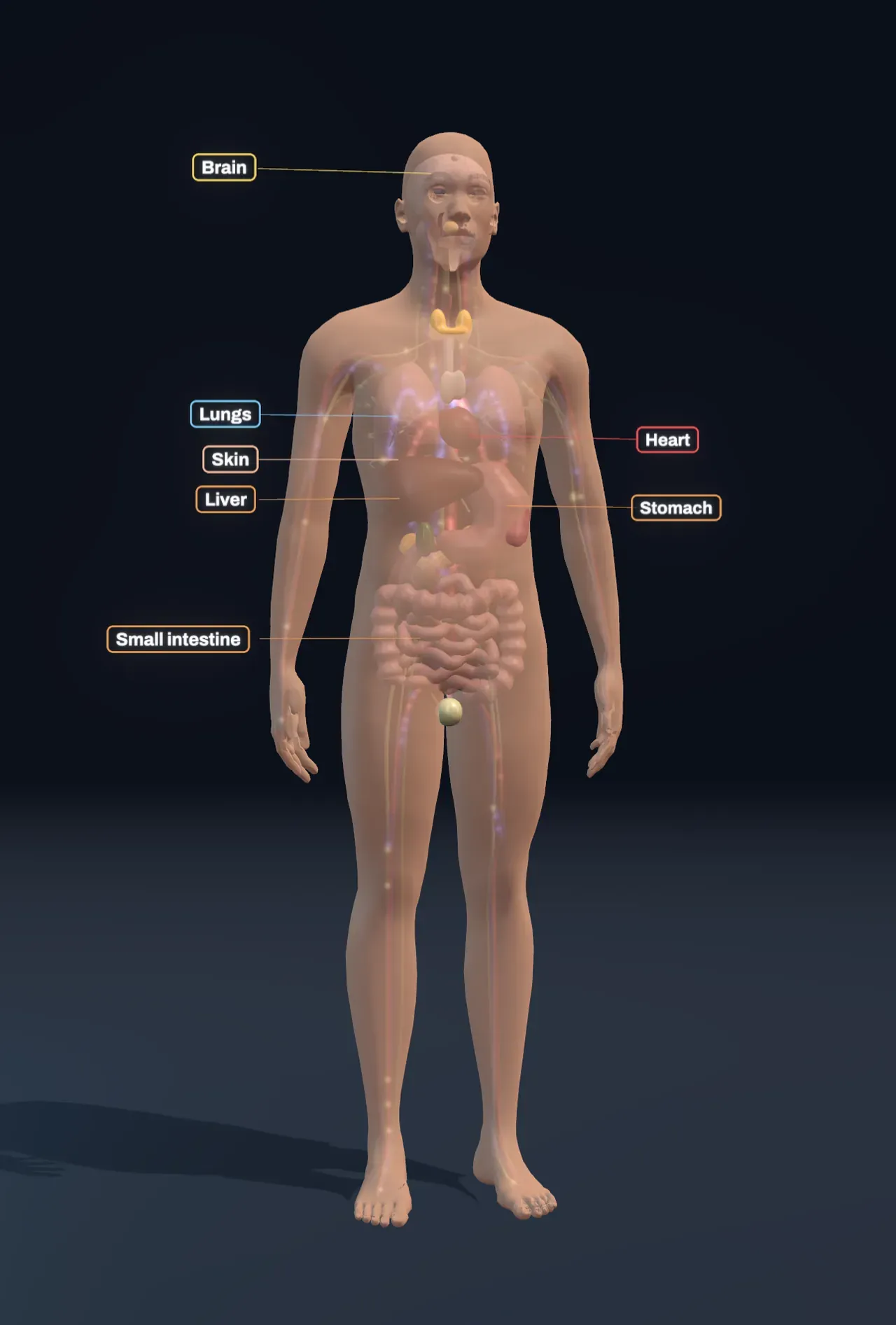
One body, eleven systems
You are made of about 37 trillion cells, and almost none of them can survive on their own. Cells of one kind work together as a tissue: muscle, nerve, the lining of the gut, bone. Several tissues make an organ, such as the heart or a kidney, and organs that share a job make an organ system.
Biologists usually count eleven. The skin wraps everything. The skeleton holds the body up and the muscles move it. The nervous system and the endocrine system (the glands that make hormones) carry messages. The circulatory system, the heart and blood vessels, delivers supplies. The respiratory system brings in oxygen, the digestive system brings in fuel, and the urinary system clears out waste. The lymphatic and immune system defends the body, and the reproductive system makes the next generation; it is the one system a body can live without, and the Scene leaves it out.
The cells Article looks at the smallest level. This one looks at the whole: how the systems split the work, and why each needs the others.
Peeling back the layers
From outside, a body is skin: about two square metres of it, weighing around four kilograms, the largest organ there is. Under it lie the skeletal muscles, more than 600 of them, about a third of an adult’s weight, each pulling on the bones it is fixed to (movement and muscles). Inside the trunk sit the organs, packed in two cavities: the chest, with the heart and lungs, and the belly, with the stomach, liver, intestines and kidneys. The brain sits apart in the skull. Holding it all up, and guarding the softest parts, are the 206 bones of the skeleton.
Try it: step Peel back the layers from Skin through Muscles and Organs to Skeleton. Each layer appears before the one above it has gone, so you can see where the next one sits. Drag the body round to see the ribs curving from the spine, and the kidneys tucked against the back wall of the belly.
Supply lines: lungs, gut and blood
Every cell needs a steady supply of oxygen and fuel, and none of them can fetch it. Three systems do it together.
The lungs take in air about twelve times a minute at rest, half a litre each time. Inside them the air reaches hundreds of millions of tiny sacs whose walls are a single cell thick, where oxygen crosses into the blood and carbon dioxide crosses out (breathing and gas exchange). The gut breaks food down into sugars, fats and amino acids small enough to cross its wall into the blood, which carries them to the liver first (digestion).
The heart joins them up. At rest it pumps about five litres of blood a minute, nearly all the blood in the body, round two loops: through the lungs to pick up oxygen, then out to every other organ to deliver it (circulation). That is about 7,000 litres a day, through vessels which, laid end to end, would stretch more than twice round the Earth.
Try it: light up Circulation. Every speck passes through the lungs on each lap: red in the vessels leaving them, full of oxygen, and blue in the vessels returning from the organs that have used it.
Clearing out the waste
Using fuel makes waste, and the blood carries that away too. Carbon dioxide, the waste from burning sugar and fat, leaves through the lungs with every breath out. The kidneys filter the blood: about 180 litres of fluid a day pass out of their tiny filters, and they take back almost all of it, keeping the water and salts the body needs and sending about one and a half litres a day, with urea and other waste, down the ureters to the bladder. The liver breaks down old red blood cells, used hormones, alcohol and drugs, and sends some of what is left out with the bile.
Try it: light up Kidneys. Then press Jogging and watch the kidneys’ share on the chart fall: in exercise, filtering waste can wait while the muscles need the blood.
Two ways to send a message
Systems that share work have to be coordinated, and the body has two ways of doing it. The nervous system is wiring: the brain and the spinal cord collect signals from the senses, such as vision and hearing, decide, and send signals down nerves to muscles and glands in a few thousandths of a second. The vagus nerve, running from the brainstem to the heart, lungs and gut, slows the heart and keeps digestion going when the body is at rest.
The endocrine system is broadcasting: glands such as the pituitary, the thyroid and the adrenal glands release hormones into the blood, which carries them to every cell in about a minute, and only the cells with the right receptor answer (hormones). Adrenaline speeds the heart within seconds of a fright; insulin from the pancreas tells the liver and muscles to store sugar after a meal; thyroid hormone sets the pace of the whole body over weeks.
Try it: light up Nerves and press Flat out. The signals to the legs and arms crowd the nerves; press Resting and set Time since eating to 60 min, and the busiest nerve is the vagus, keeping the gut at work.
Keeping out invaders
The skin is the first line of defence: a dry, acid, constantly shedding wall that most germs cannot cross. The linings of the airways and the gut are a second, with mucus, acid and their own guard cells. What does get through meets the immune system (immune system and vaccines). Its white blood cells are made in the red marrow inside bones, trained partly in the thymus behind the breastbone, and gathered in about 600 lymph nodes and in the spleen, where they meet the germs that the lymph vessels drain in from the tissues.
So even defence crosses systems: the skeleton makes the defenders, the blood carries them, and the lymph vessels, which also return leaked fluid to the blood, bring them the evidence.
Try it: light up Immune, then Skeleton. The glowing marrow in the hips, spine and breastbone makes about two million new red blood cells every second, and white cells too.
Sharing out the blood
The heart cannot supply every organ at full flow at once, so the body shares the blood out according to need, by widening the small arteries of the organs that are working and narrowing the rest. At rest, about a quarter goes to the gut and liver, a fifth to the kidneys, a fifth to the muscles and about a seventh to the brain, which uses a fifth of the body’s oxygen though it is only 2% of its weight.
Exercise changes everything. The working muscles need many times more oxygen, so the heart beats faster and harder, pumping up to about 20 litres a minute in a fit adult, and breathing rises from 6 to over 100 litres of air a minute. The muscles’ small arteries open wide and take over four fifths of the blood; the gut and kidneys give some of theirs up. The skin first takes more, to shed heat, then less again when the muscles need everything. The brain keeps its 0.75 litres a minute whatever happens.
A meal shifts the balance the other way: blood to the gut and liver rises by more than half for an hour or two while they digest and absorb it, and the heart pumps a little more to supply it. That is one reason hard exercise straight after a big meal feels so bad: two systems are asking for the same blood.
Try it: press Walking, Jogging and Flat out in turn and watch the bar on the chart stretch from 5 litres to 20, with the muscles’ share growing from a fifth to over four fifths. Then press Resting and slide Time since eating down to 0, and the gut’s share grows instead.
Everything depends on everything
Because the work is shared, a failure in one system soon reaches the others. If the heart stops, the brain, with no store of oxygen, loses consciousness within seconds and starts to be damaged within minutes. If the kidneys fail, waste and potassium build up until the heart beats wrongly. If the lungs cannot take in enough oxygen, every muscle, including the heart, weakens. Even the skeleton, which looks like scaffolding, stores the body’s calcium, which nerves and muscles need to work at all.
Holding all this in balance, keeping the blood’s oxygen, sugar, salt, water and temperature within narrow limits whatever the body is doing, is called homeostasis. It is the job no single system has and all of them share. One example, holding body temperature near 37 °C, is followed step by step in Homeostasis.
What this model leaves out
The numbers come from simple formulas with round textbook values for a moderately fit adult of about 70 kg: oxygen use, heart rate, breathing and the share of blood each organ gets at rest, during digestion and at each level of effort. Real bodies differ with age, fitness, size, heat and health, and a trained athlete’s heart can pump twice as much. Exercise here means effort from rest to the body’s maximum, but the figure keeps standing; the shares are for whole-body exercise like running, and the “other” share lumps together fat, bone and everything else.
The body is a stylised figure. The organs are about the right size and in about the right place, but only the main vessels, nerves and lymph vessels are drawn, the glands are drawn larger than life, and the blood specks are vastly larger and slower than real blood cells. The reproductive system, the eyes and ears, and most small organs are left out.