Two lenses and a screen
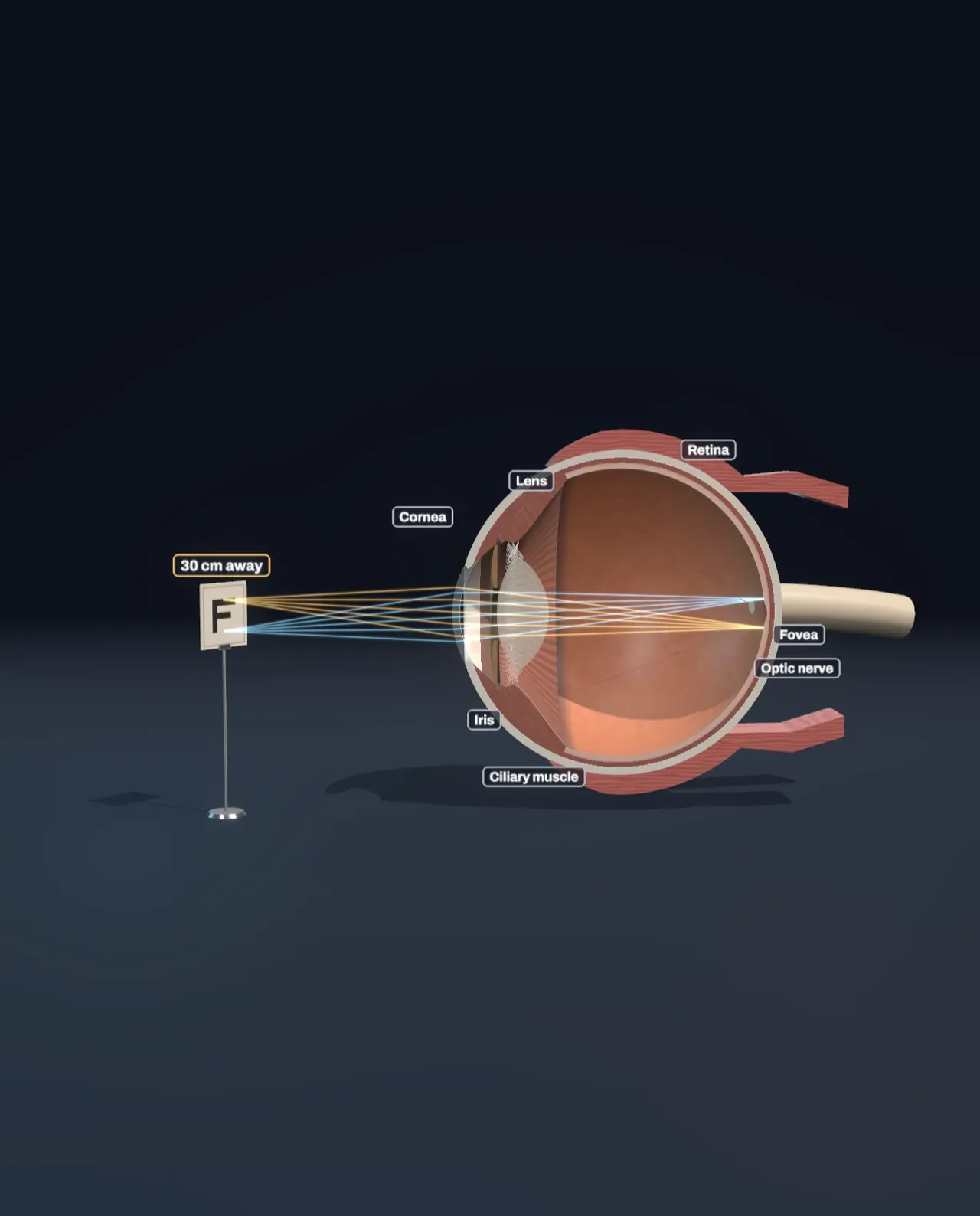
An eye is a ball of clear jelly about 24 millimetres across, a little smaller than a ping-pong ball, with a lens system at the front and a light-sensitive screen lining the back. The Scene cuts one in half through its centre, so you are looking at the eye from the side, with the card in front of it on the left.
Light from the card first meets the cornea, the clear dome at the front. Its curved surface does about two-thirds of the bending, because light slows down sharply as it passes from air into the eye (the same effect that bends a straw in a glass of water; see refraction). Behind the cornea, the coloured iris opens or closes the pupil, the hole in its middle, to let in more or less light. Then comes the lens, a clear, flexible disc that does the rest of the bending and, unlike the cornea, can change how much.
Together they bring the light from each point of the card back to a point on the retina, the thin layer lining the back of the eye. That is a lens doing what a magnifying glass does when it throws a picture of a window onto a wall, and what a camera lens does on its sensor.
The power of a lens is measured in dioptres: one over its focal length in metres. The cornea and lens together are about 60 dioptres, which means they would bring parallel light to a focus about 17 millimetres behind them, or about 22 millimetres inside the eye’s jelly, where light travels more slowly. The retina is right there.
Focusing near and far
Light from a distant object arrives almost parallel. Light from something close spreads out more as it reaches the eye, and needs more bending to come back to a point at the same distance. A camera moves its lens; the eye changes the lens’s shape.
A ring of muscle, the ciliary muscle, surrounds the lens, which hangs from it on hundreds of fine fibres. When the muscle relaxes, the ring is wide, the fibres pull tight and stretch the lens flat: the eye is set for far away. When the muscle contracts, the ring narrows, the fibres go slack, and the elastic lens springs into a rounder shape that bends light more. This is accommodation. Each dioptre it adds brings the focus closer: 3 dioptres for a book at a third of a metre, 10 for a finger 10 centimetres away.
There is a limit. The closest point an eye can focus on is its near point. A ten-year-old’s lens can add about 14 dioptres, enough to focus on something 7 centimetres away; at 30 it is about 7 dioptres, a near point of 14 centimetres. Closer than that, the light would come to a point behind the retina, and the card blurs.
Try it: with the Normal eye, press Far away 6 m, then Reading 30 cm, and watch the lens bulge and the ciliary muscle darken as it tightens. Then drag Card distance down to 0.1 m: the lens is at its roundest, and the light still meets behind the retina.
The picture is upside down
Follow the amber light from the top of the letter and the blue light from the bottom. They cross inside the eye, so the top of the card lands at the bottom of the retina, and the left of the card on the right. Every image on the retina is upside down.
Nothing turns it the right way up. The brain never sees the retina; it receives signals from it and builds our sense of where things are from them, together with what we touch and how we move. In 1897 the psychologist George Stratton wore a lens that turned the world upside down for eight days. At first he groped and stumbled; within days he could move about easily, and by the end the world at times even seemed the right way up.
Short sight and long sight
An eye sees sharply only if the light meets on the retina: a millimetre either way makes all the difference. Most eyes that need glasses have optics that work perfectly well; they are just the wrong length for them.
A short-sighted eye (myopia) is too long. A relaxed lens brings light from far away to a point in front of the retina, and by the time the light reaches the retina it has spread into a blur. Only things close up are sharp: the Scene’s short-sighted eye, 1.1 millimetres too long, sees sharply only nearer than about 35 centimetres, and closer than a normal eye can. It needs glasses with a diverging lens, thinner in the middle than at the edge, which spread the light a little before it enters the eye: here −3 dioptres. Short sight usually starts in childhood as the eye grows, and has become much more common; children who spend more time outdoors are less likely to develop it.
A long-sighted eye (hyperopia) is too short. Even light from far away would meet behind the retina, unless the lens focuses. A young long-sighted eye does just that, all day, which can tire it; it then runs out of focusing for close work first. The Scene’s long-sighted eye, 1.6 millimetres too short, has to use more than half its focusing to see the far wall, and cannot get a book closer than about 45 centimetres into focus. It needs a converging lens, thicker in the middle, which starts the bending before the light enters the eye: here +4.5 dioptres.
Glasses are labelled by their power in dioptres, negative for short sight and positive for long sight. An optician finds the power by putting lenses in front of your eye until the bottom lines of the chart are sharpest.
Try it: choose Short-sighted and press Far away 6 m. The light meets in front of the retina and the eye chart beside the Scene is a blur. Turn Glasses on. Then choose Long-sighted, press Reading 30 cm, and see the dashed light that would meet behind the retina.
Why everyone ends up with reading glasses
The lens keeps growing all our lives, adding layers like an onion, and grows stiffer as it does. Each decade the ciliary muscle can squeeze less focusing out of it. Somewhere in our forties the near point moves out towards arm’s length, and small print starts to need a bright lamp and a long arm. This is presbyopia, and it happens to everyone, whatever their eyes were like before.
The Scene’s ageing eye is a normal eye at 60 that can add only a little over one dioptre: it sees the far wall perfectly, but nothing closer than about 80 centimetres. Reading glasses of +2.5 dioptres do the focusing the lens can no longer do, and bring a page at 30 centimetres into focus, but now the eye can see sharply only between about 28 and 41 centimetres. That is why people peer over the top of their reading glasses, and why bifocal and varifocal lenses put a stronger part at the bottom, where we look down to read.
Try it: choose Ageing, 60 years and press Reading 30 cm, then turn Glasses on. Now press Across the room 3 m with the glasses still on, and compare the two bars in the chart.
Rods and cones
Step Zoom to the retina to Image on the retina. The letter on the card, the size of one on the bottom line of an eye chart, makes an image only a few hundredths of a millimetre across on the fovea, a small pit in the middle of the retina where our sight is sharpest. It is upside down, sharp or blurred depending on the focus.
Step on to Rods and cones. The retina is covered in light-sensitive cells of two kinds. About 6 million cones work in good light and come in three types, most sensitive to red, green or blue light; comparing their signals gives us colour. In the fovea they are packed tightly, about two and a half thousandths of a millimetre apart, so the image of the letter covers about ten of them across, and each reports only the light on its own tip. That is what makes detail: a blurred image lights all the cones alike, and the letter is lost. About 100 million rods, outside the fovea, are far more sensitive, see only in shades of grey, and take over in dim light; in daylight they are swamped.
The retina is wired back to front. Light has to pass through layers of nerve cells before it reaches the rods and cones at the very back. In the fovea those layers are pushed aside, which is what makes the pit, so light reaches the cones there undisturbed. The nerve cells gather the signals of the rods and cones into about a million fibres, which leave the eye together as the optic nerve, carrying impulses like those in the nervous system. Where they leave there is no room for rods or cones, so each eye has a blind spot, about 15 degrees to the side of the centre, which we never notice because the brain fills it in. How the brain turns those signals into the scene in front of us, and how the other senses work, are stories for later Articles.
What this model leaves out
The eye in the Scene is a simple model: one bending surface of about 60 dioptres in front of a jelly, a lens that adds focusing up to a fixed limit, a pupil always 4 millimetres wide, and sharp focus within a quarter of a dioptre either way. Real eyes have bending surfaces that are not perfect spheres, a lens whose density varies from its middle to its edge, and a pupil that narrows in bright light and when we look at something close, which helps a little to keep near things sharp.
The short- and long-sighted eyes are wrong only in length; some eyes are short- or long-sighted because their cornea or lens bends too much or too little, and many have a cornea curved more in one direction than another (astigmatism), which blurs lines in one direction more than others. The eye chart beside the Scene blurs with a smooth spread instead of the sharp-edged disc a real out-of-focus pupil makes, and leaves out the brain, which is good at reading a blurred letter it expects.
The rays outside the eye come from a card drawn much closer than it is, and the eye, the image and every difference between the eyes are drawn larger than life so they can be seen. The patch of retina is drawn not to scale: in a real fovea the centre without rods is wider than the whole patch, and the cones there are thinner.