How the eye focuses: power in dioptres, the near point, the ageing eye, short sight and the far point, and which glasses correct each eye.
Step 1 of 7 · Focusing
Step 1 of 7
Focusing
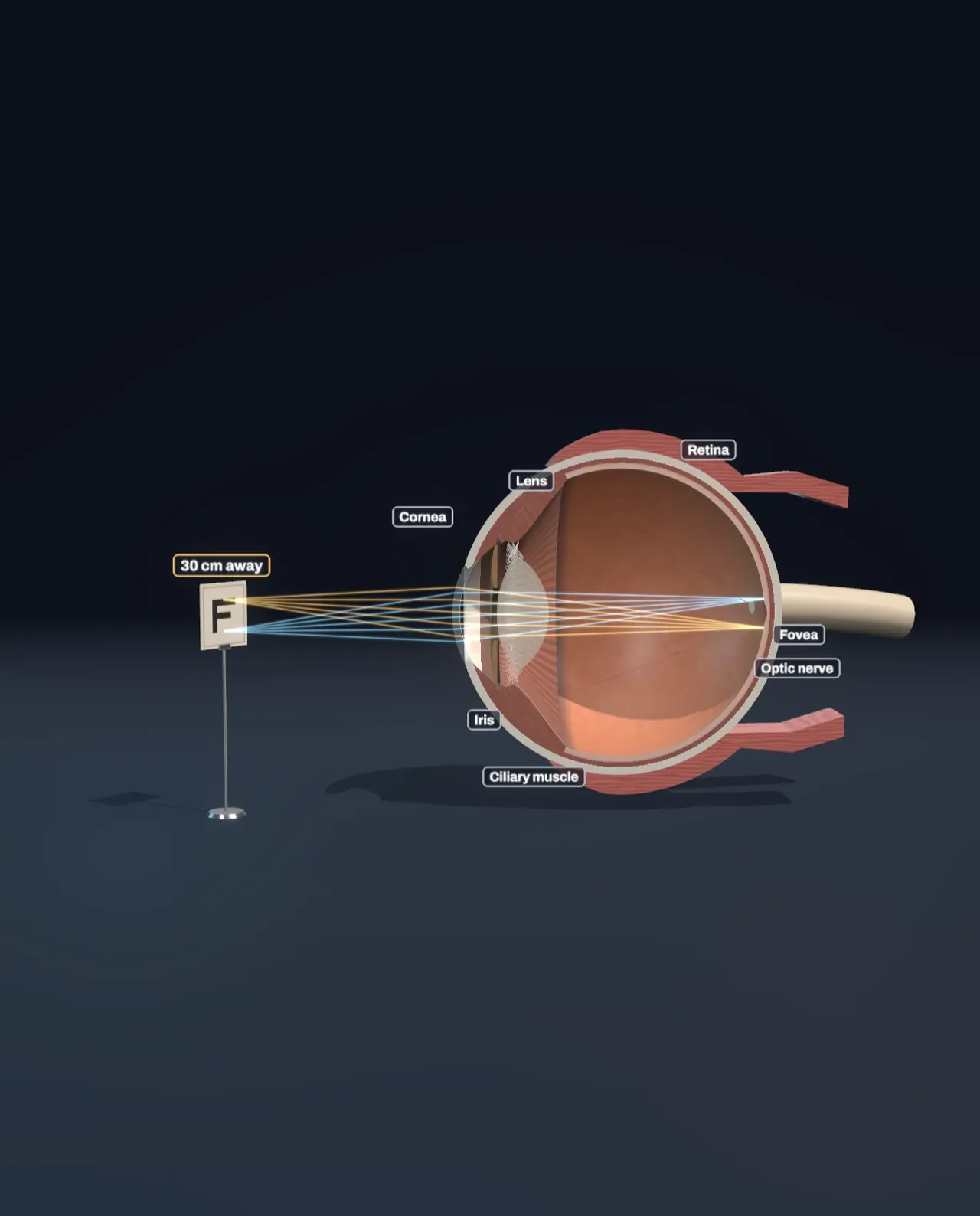
The eye is a sense organ: it turns light into nerve signals. Light enters through the cornea, passes the pupil and the lens, and lands on the retina at the back, where rods and cones turn it into impulses that leave along the optic nerve to the brain. For the image to be sharp, the light from each point of an object has to come to one point on the retina.
The cornea does most of the work, but only the lens can change its power. A lens’s power is measured in dioptres: one over the distance in metres at which it focuses. To focus on an object at a distance , the lens has to add dioptres.
Step 2 of 7
The near point
When you look far away, the lens is relaxed and flat. When you look close up, a ring of muscle around it contracts and it rounds up. But there is a limit to how far it can round up, so there is a distance closer than which nothing looks sharp: the near point. Move Card distance and watch the range of sharp sight on the chart.
Step 3 of 7
The ageing eye
Zoom to the retina is at Image on the retina. Over the years the lens stiffens and loses its spring, and it no longer rounds up as it used to.
Step 4 of 7
Short sight
Some eyes are a little too long for their power. A millimetre is enough: the light from a distant object comes to a focus in front of the retina, and by the time it reaches the retina it has spread into a blur again. Eye is fixed at Short-sighted.
Step 5 of 7
Near or far
The name “short sight” confuses many people. Think about what you found in the last Step: at what distance did this eye see sharply?
Step 6 of 7
Glasses
Glasses are an extra lens in front of the eye that changes the total power. Card distance is fixed at 6 m. Switch Glasses on and off and compare the image on the retina.
Step 7 of 7
Reading glasses
The ageing eye lacks power only up close. Reading Glasses add a fixed power to it, and the card at 30 cm is sharp again.
Loading the interactive version…
Loading the interactive version…
Each step sets up the Scene for you, and a control marked “fixed” stays put for that step.
Practice · Calculate
A normal eye reads a card 0.25 m away. To focus on it the lens has to add a power of dioptres, with in metres. How many dioptres?
Practice · Calculate
A normal eye reads a card 0.25 m away. To focus on it the lens has to add a power of dioptres, with in metres. How many dioptres?
Practice · Calculate
The lens of a normal thirty-year-old eye can add up to 7 dioptres. What is the closest distance this eye sees sharply? Answer in centimetres.
Practice · Calculate
The lens of a normal thirty-year-old eye can add up to 7 dioptres. What is the closest distance this eye sees sharply? Answer in centimetres.
Practice · Predict, then look
A normal eye reads a card at 30 cm sharply. What will happen when Eye switches to Ageing, 60 years, whose lens has stiffened?
Practice · Predict, then look
A normal eye reads a card at 30 cm sharply. What will happen when Eye switches to Ageing, 60 years, whose lens has stiffened?
Practice · Reach the target
Eye is fixed at Short-sighted, without Glasses. The card is far, at 6 m, and blurred. Move Card distance until the eye sees it sharply, and press Check.
Practice · Reach the target
Eye is fixed at Short-sighted, without Glasses. The card is far, at 6 m, and blurred. Move Card distance until the eye sees it sharply, and press Check.
Practice · Choose
A person is short-sighted. What do they see sharply without glasses?
Practice · Choose
A person is short-sighted. What do they see sharply without glasses?
Practice · Choose
Which glasses correct the short-sighted eye? Switch on Glasses with the card at 6 m.
Practice · Choose
Which glasses correct the short-sighted eye? Switch on Glasses with the card at 6 m.
Practice · Predict, then look
The ageing eye reads sharply at 30 cm with reading Glasses of +2.5 D. What will happen when it looks through the same glasses at a card 6 m away?
Practice · Predict, then look
The ageing eye reads sharply at 30 cm with reading Glasses of +2.5 D. What will happen when it looks through the same glasses at a card 6 m away?
Lesson complete. Every practice question here is done.