The air is full of nitrogen that plants cannot use. Bacteria in clover’s nodules fix it, the decomposers free it from dead leaves, other bacteria turn it into nitrate, and the rain washes some away: a cycle that leaks, and what happens when rot is too slow or too fast.
Step 1 of 5 · Air full of nitrogen
Step 1 of 5
Air full of nitrogen
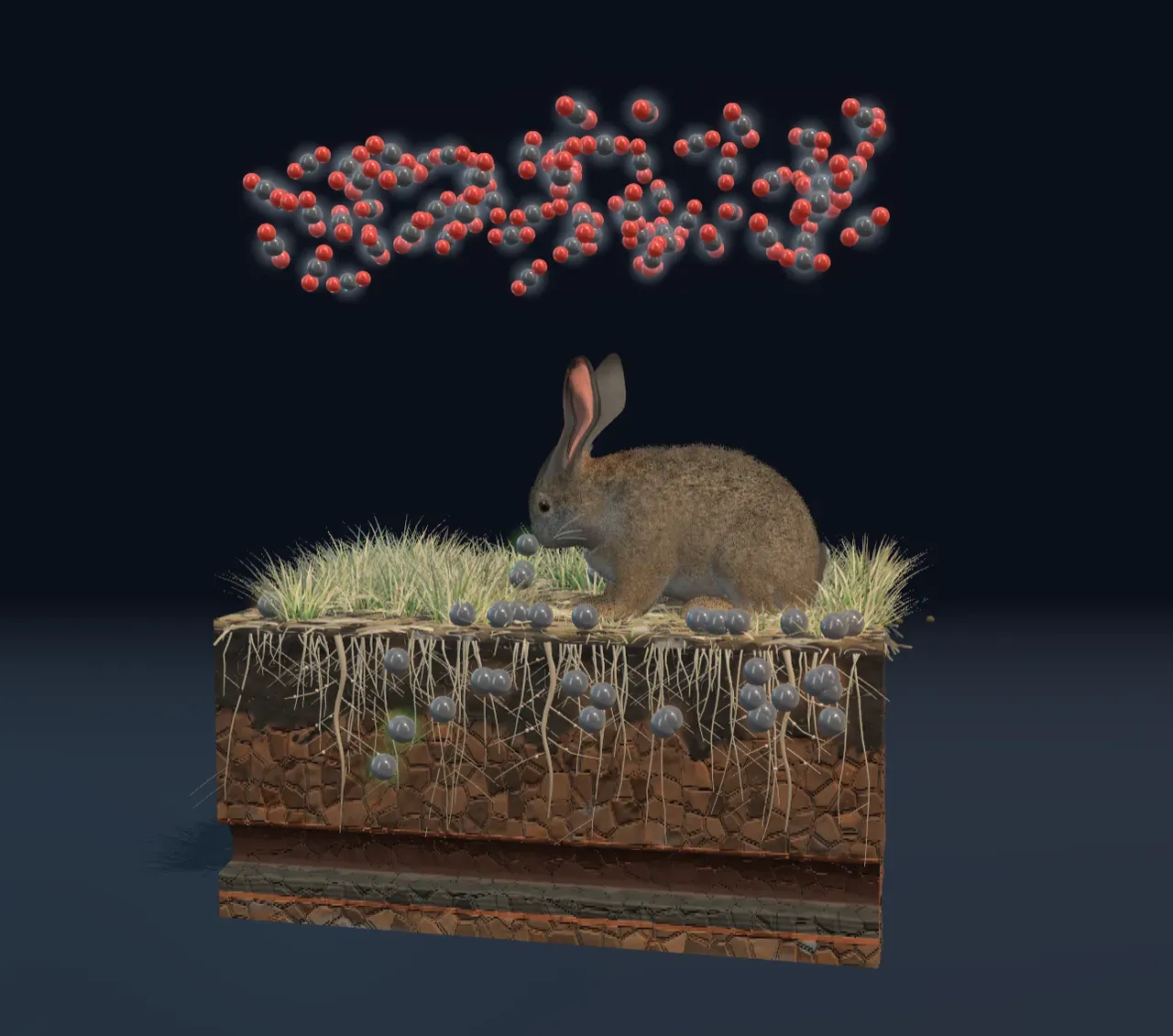
Follow is now fixed on Nitrogen, and each atom in the Scene stands for one gram of nitrogen. Every protein and every DNA molecule is built with nitrogen, so a plant short of it turns pale and stops growing. Look at the clover’s roots: the pink lumps are nodules.
Step 2 of 5
In and out
In a normal year a whole cycle runs inside the meadow:
- To the plants. The roots take up nitrate and ammonium from the water in the soil, and build proteins from them.
- Through the rabbit. It eats leaves and returns most of their nitrogen in its urine.
- To the ground. Dead leaves fall with the nitrogen left in them.
- In the rot. The decomposers free the nitrogen in the dead leaves as ammonium.
But the cycle is not quite closed: some nitrogen comes in from outside, and some leaves. Through the year is at A year on.
Step 3 of 5
No rot
Decomposers is fixed at 0%, and Through the year is locked at 1 March. In early spring the soil still holds ammonium and nitrate from last year. Predict how things will be by the end of summer, and the Scene will run the time on.
Step 4 of 5
From ammonium to nitrate
Through the year is at the start of summer, when the rabbit eats leaves and returns their nitrogen in its urine, as ammonium. In the soil the ammonium does not stay as it is. Afterwards, drag Through the year into the winter and follow the atoms.
Step 5 of 5
Too much rot
Nitrate dissolves easily and the soil does not hold on to it, so what the grass does not take up is washed by the winter rain into the drain. Today people fix more nitrogen than all the natural nitrogen fixers on land together, by the Haber–Bosch process, for fertiliser. Fertiliser the crop does not take up leaks the same way. Here Decomposers is free.
Loading the interactive version…
Loading the interactive version…
Each step sets up the Scene for you, and a control marked “fixed” stays put for that step.
Practice · Choose
Four fifths of the air is nitrogen gas, about eight tonnes over each square metre. Yet grass is often short of nitrogen. Why?
Practice · Choose
Four fifths of the air is nitrogen gas, about eight tonnes over each square metre. Yet grass is often short of nitrogen. Why?
Practice · Calculate
A normal year, Decomposers at 100%: every store of nitrogen ends the year with what it held. Over the year the clover fixed from the air, less what bacteria returned to the air as nitrogen gas, about 2.8 g of nitrogen a square metre. How many grams of nitrogen were washed out of the meadow to the drain?
Practice · Predict, then look
Follow is on Nitrogen, and Decomposers is at 0%. The grass has light, water and carbon dioxide as usual. What happens to it by the end of summer?
Practice · Predict, then look
Follow is on Nitrogen, and Decomposers is at 0%. The grass has light, water and carbon dioxide as usual. What happens to it by the end of summer?
Practice · Choose
The rabbit’s urine and the rotting dead leaves release nitrogen into the soil as ammonium, . What turns it into nitrate, ?
Practice · Choose
The rabbit’s urine and the rotting dead leaves release nitrogen into the soil as ammonium, . What turns it into nitrate, ?
Practice · Reach the target
Through the year is at A year on, and Follow is on Nitrogen. When the decomposers are too fast, they free more nitrate than the grass can take up, and the surplus washes away. Change Decomposers until the meadow ends the year about 2.1 g of nitrogen a square metre poorer, then press Check.
Lesson complete. Every practice question here is done.