The same atoms, again and again
Every atom in your body has been somewhere else first. The carbon in your muscles was in a wheat field or a cow a year ago, and in the air before that. The nitrogen in your hair may once have been in a dinosaur. Living things do not make new atoms; they borrow them from the air, water and soil, build them into their bodies for a while, and give them back when they breathe, excrete or die. The routes those atoms take round and round, through living things and the world around them, are the cycles of matter.
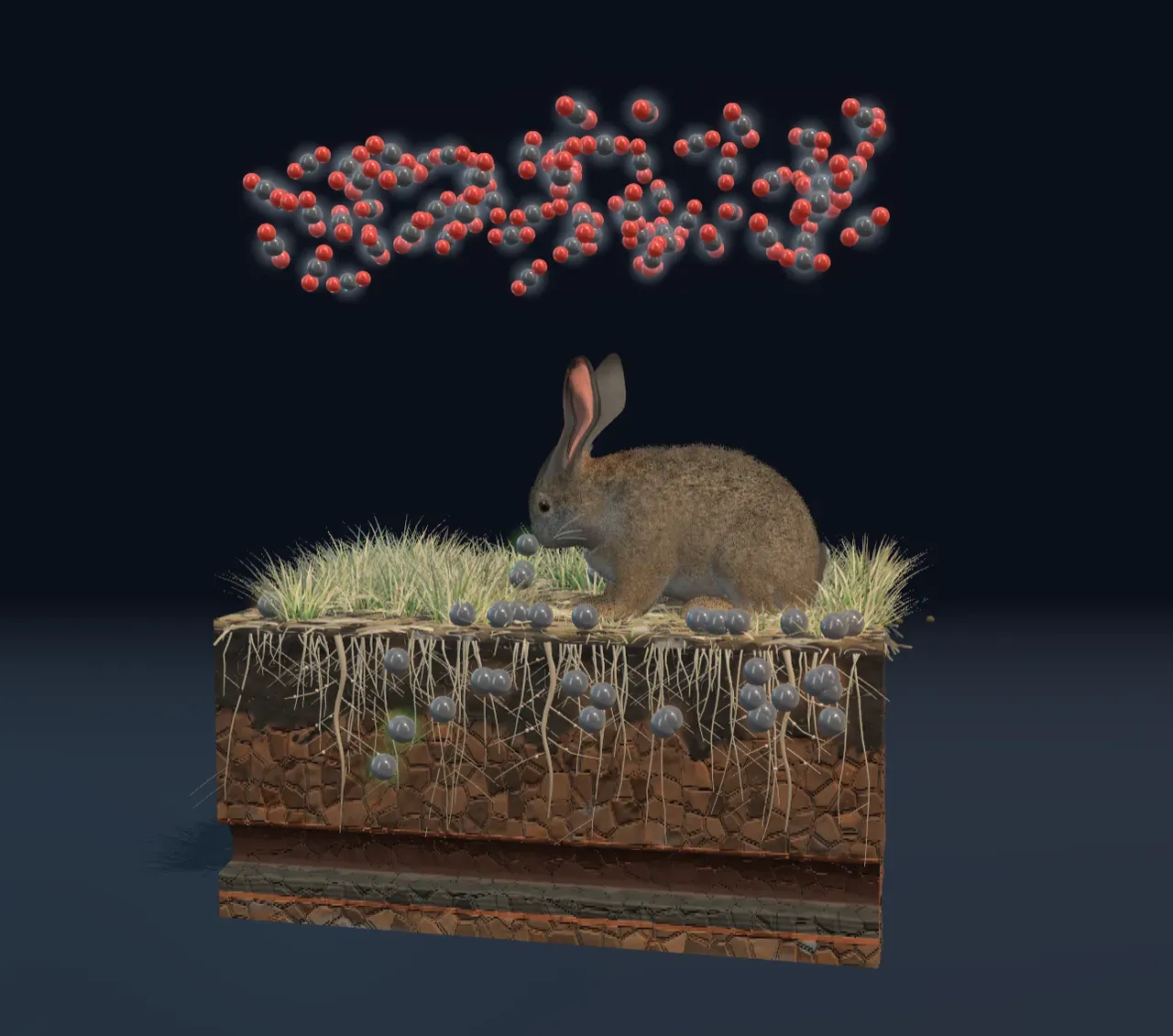
The Scene follows two of the most important elements of life through one square metre of meadow for a year. Carbon is the backbone of every sugar, fat, protein and strand of DNA. Nitrogen is in every protein and every gene. Both cycle through the air, but in very different forms, and the meadow has to work in very different ways to get hold of them.
Try it: watch one year, from 1 March round to the next. In spring the atoms rain down out of the air into the grass; in autumn they fall to the ground as the grass dies back; through the winter they rise back into the air. Press Pause motion to hold a season.
Carbon: out of the air and back
Each grey atom in the air is the carbon of a molecule of carbon dioxide, wearing its two red oxygen atoms. There are 72 of them, because the whole height of air above one square metre, up to the edge of space, holds about 1.8 kg of carbon this way, at about 420 parts per million.
In spring and summer the leaves take carbon dioxide in through tiny pores and use the energy of sunlight to build it into sugar, by photosynthesis. Watch an atom drop into the grass: it sheds its oxygens on the way. In a year this meadow takes about 1 kg of carbon out of the air above each square metre, more than half of all there is over it. If nothing gave it back, the meadow would strip its own air of carbon dioxide within two years.
Something does give it back, starting at once. Plants burn about half of the sugar they make to power their own cells, by cellular respiration, and breathe that carbon straight back out. The rest builds leaves and roots. The rabbit eats some of the leaves and breathes most of their carbon out too; a little leaves it as droppings. In autumn the grass dies back, and the carbon in its leaves falls to the ground as dead leaves.
Decomposers close the loop
A dead leaf is food. Fungi, bacteria, earthworms, springtails and mites eat it, and like every other living thing they breathe out most of its carbon as carbon dioxide. These are the decomposers, and they do most of their work in the wet months, when warmth allows. In the Scene about 70% of the carbon they eat goes back to the air, and the rest becomes humus, the dark, crumbly matter that colours the top of the soil, which they eat in turn, more slowly. Fungi shows how the threads of a fungus take a leaf apart.
By the end of the year, the books balance. The meadow took about 1 kg of carbon out of the air over each square metre and gave the same amount back, through the leaves, the rabbit and the decomposers. Every store, plants, dead leaves and humus, holds what it held a year before. They are not the same atoms, though: the carbon now in the grass came out of the air this year, and last year’s has gone back up.
Try it: slide Decomposers down to 0 % and watch the year to its end. The grass still grows and dies, but nothing rots. The dead leaves pile up, almost twice as deep, and a third of a kilogram of carbon taken from the air never comes back. Now slide Decomposers up to 200 %: the decomposers eat into the humus too, and the soil gives the air more carbon than the grass took in.
This is how peat bogs and the deep, springy floors of cold forests store carbon: where rot is slower than growth, dead matter piles up. The fossil fuels we burn are the same thing on a vast scale, the remains of plants and plankton buried before they could rot, and burning them sends their carbon back into the air in a few centuries instead of millions of years. That extra carbon dioxide is what is warming the climate.
Nitrogen: everywhere, and hard to get
Switch Follow to Nitrogen. Four-fifths of the air is nitrogen gas, about 8 tonnes of it over every square metre, far more than could be drawn. Yet plants cannot use any of it directly. Each molecule is two nitrogen atoms held by a triple bond, one of the strongest in chemistry, and no plant or animal can break it.
Only some bacteria can. In the Scene they live in the pink root nodules of the white clover (1 to 3 mm across, drawn about three times that so they show), where the clover feeds them sugar and they turn nitrogen gas into ammonia the plant can use. This is nitrogen fixation, and it is why farmers sow clover, beans and peas to feed their soil. Here it brings in about 5 g a square metre a year.
Most of the nitrogen the grass uses, though, comes round again from inside the meadow:
- Into plants. Roots take up nitrate, a nitrogen atom with three oxygens, and ammonium, one with four hydrogens, dissolved in the water in the soil, and build them into proteins.
- Through the rabbit. It eats leaves, keeps a little of their nitrogen and passes most of it in its urine, which the soil turns back into ammonium.
- Down to the ground. Before a leaf dies, the plant draws back about 40% of its nitrogen to use again in spring; the rest falls with the dead leaves.
- Freed again by rot. Decomposers eat the dead leaves and release their nitrogen as ammonium, keeping more of it in the humus than they keep of the carbon.
- Changed by bacteria. Other bacteria take the hydrogens off ammonium and add oxygens, making nitrate. In wet soil a third kind does the opposite of the clover’s bacteria and turns nitrate back into nitrogen gas.
Nitrate dissolves easily and is not held by the soil, so winter rain washes some of it down through the soil to the drains, rivers and sea. In the steady year the clover fixes just as much as escapes this way and back into the air.
Try it: with Follow on Nitrogen, slide Decomposers down to 0 % and watch the summer. With nothing rotting, no ammonium is freed; by midsummer the soil has run out, and the grass turns pale and stops growing early, still short of its usual height. The nitrogen it needs is locked in last year’s dead leaves.
Too much of a good thing
People now fix more nitrogen than all the world’s natural nitrogen fixers on land put together. Since the early 20th century the Haber–Bosch process has made ammonia from the nitrogen in the air at high temperature and pressure, for fertiliser. It feeds about half the people alive today. But nitrate that crops do not take up washes into rivers and the sea, where it feeds blooms of algae that rot and use up the oxygen, and some escapes as nitrous oxide, a strong greenhouse gas.
Try it: slide Decomposers up to 200 %. Rot frees more nitrate than the grass can use, and the extra washes out to the stream, almost twice as much as in a normal year. A field given more fertiliser than its crop needs leaks the same way.
The bigger loops
The meadow’s loops take a year. The full cycles reach much further and run far slower. Carbon dissolves in the oceans, which hold about fifty times as much as the air; sinks in the shells of plankton; and is locked for millions of years in limestone and coal before volcanoes and weathering bring it back. Water, which carries the nitrate away, has its own cycle, followed in the water cycle. The same idea runs through them all: on Earth, matter is not used up, only moved, and life depends on the parts of each loop that bring it back.
What this model leaves out
The meadow is one square metre with one rabbit, the same weather every year, and flows set by simple rates: photosynthesis follows the growing season, decomposers work twice as fast for every 10 °C warmer, and nitrate washes out with winter rain. The rates are typical for a temperate grassland, not measured in one field. The Decomposers slider changes only how fast dead matter and humus rot; the bacteria that make and unmake nitrate keep their normal pace, and it does not show what would happen over many years, as the soil slowly settled to a new balance. Each time round, the Scene starts again from the same 1 March, so it shows that one year again, not the years that would follow.
The Scene shows only the part of the humus that turns over within a few years. A real meadow has twenty or more times as much carbon in its soil, most of it locked up for decades or centuries. The air is drawn as if its carbon dioxide stayed above the meadow; in reality wind mixes it with the air over the whole planet within a year or two. Real meadows also lose and gain small amounts in other ways: nitrogen from lightning and from pollution in rain, carbon dissolved in water draining away.
Each atom stands for a great many: one grey carbon atom for 25 g of carbon, about 10²⁴ real atoms, and one blue nitrogen atom for 1 g of nitrogen. They are drawn in their partners’ places for the store they are in, but in the plants, the rabbit, dead leaves and humus a real atom sits inside a much larger molecule, a sugar, a protein or the dark tangle of humus, which the Scene does not draw.