A fruit on a hidden body
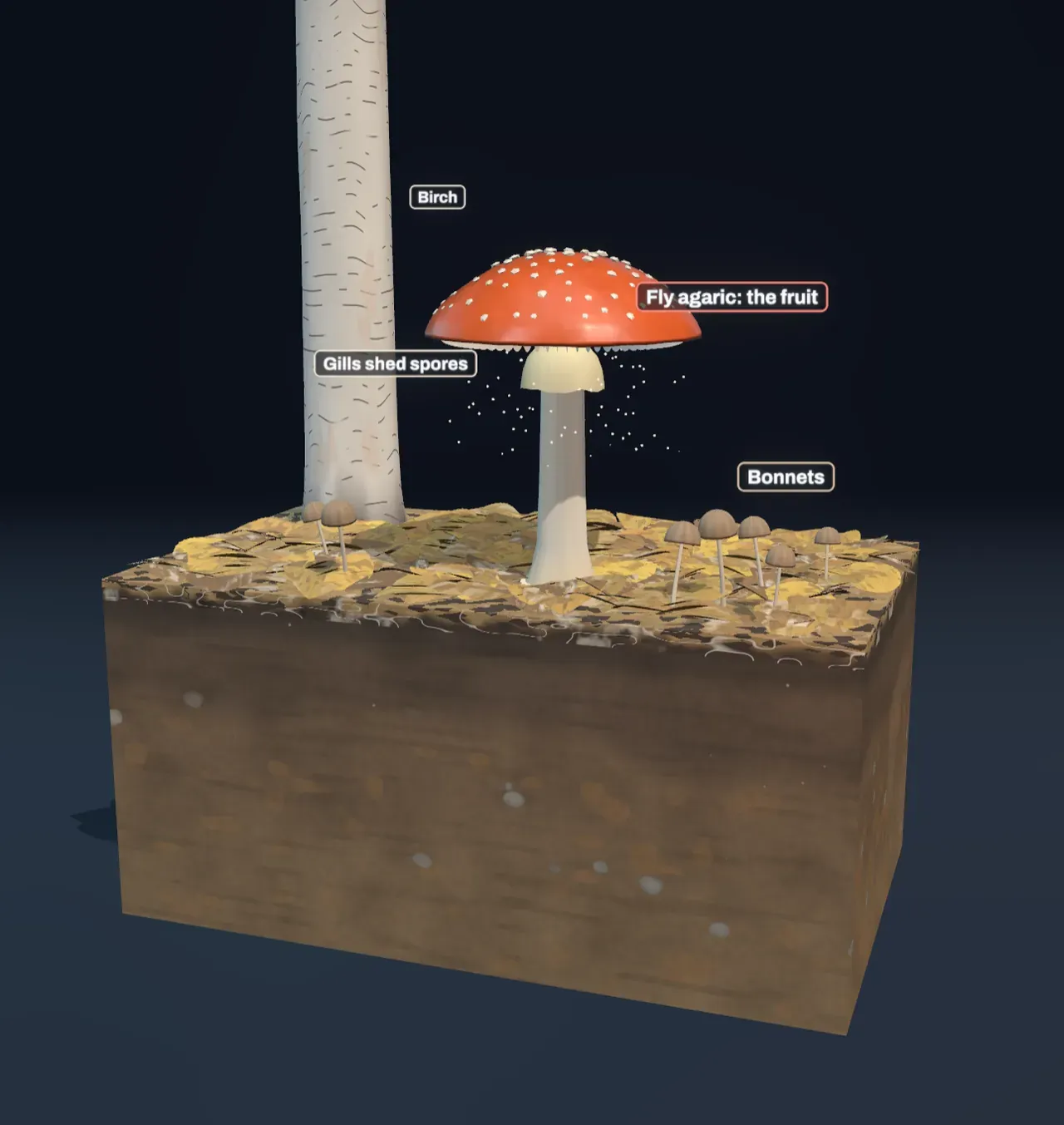
The red, white-spotted mushroom in the Scene is a fly agaric. What you see above the ground is not the whole fungus, any more than an apple is the whole apple tree. It is a fruit body, built for a few days to scatter spores. The fungus itself lives in the soil as a web of threads called hyphae, each a few thousandths of a millimetre wide, far finer than a hair. Together they make a mycelium, which grows at the tips of its threads, branches and spreads through the soil for years. A gram of forest soil can hold many metres of hyphae, and one honey fungus in the mountains of Oregon spreads under almost ten square kilometres of forest.
Fungi are neither plants nor animals. They have no chlorophyll and cannot make food from light, as plants do in photosynthesis. Their cell walls are made of chitin, the same tough material as an insect’s shell, and their cells have a nucleus like ours. In the tree of life they sit closer to animals than to plants.
A fungus also eats in its own way. It cannot swallow anything. Instead its threads grow into their food, pour out enzymes that break it down outside the body, and soak up the small pieces that dissolve. Everything a fungus does, from rotting a leaf to feeding a tree, follows from that.
Why mushrooms appear overnight
For weeks or months the mycelium gathers food. When the conditions are right, usually wet soil and in many species a cooler spell, it gathers into small knots that grow into buttons just under the surface. The last step is fast because it is mostly water: the cells of the button are already made, and they swell as they fill with it, the way a dry sponge swells in a bowl. A mushroom is about nine-tenths water, and after a night of rain it can push up through the litter by morning.
A young fly agaric is wrapped in a white skin, the veil. As the cap swells the veil tears, leaving white warts on the red cap and a ragged cup around the swollen base; a second, thinner veil that covered the gills hangs from the stem as a ring. Under the cap the gills, thin blades packed side by side, release spores into the air below: a single mushroom sheds many millions of them. Most land nowhere useful. The few that land somewhere damp germinate into new threads.
Try it: slide Soil moisture down to 10%. The fly agaric dries out, its cap margin curls up and fades, and it stops shedding spores; the bonnets on the litter do not come up at all. Slide it back to 60% and they come back.
Do not eat the fly agaric, or any wild mushroom someone with expert knowledge has not identified. Several deadly species look much like edible ones.
Rotting the leaves
Each autumn a birch wood drops about 3.5 tonnes of leaves on every hectare, a third of a kilogram on each square metre. Without something to break them down, the floor would bury itself in a few decades. The small bonnets in the Scene are decomposers: their threads spread through the litter, grow into the fallen leaves and digest them.
Leaves are hard to eat. Most of their dry mass is cellulose and lignin, the tough, glue-like material that stiffens the walls of plant cells. Fungi are the main living things that can take lignin apart, and the threads leave a leaf they have digested bleached and pale. Bacteria and small soil animals help with the rest. Choose Underground under Look underground and look at the litter. The top leaves fell this year; those underneath are older, darker and full of holes, with their veins lasting longest, and at the bottom they have crumbled into dark humus.
Rot is how a forest recycles. The fungi breathe out most of the carbon in the leaves as carbon dioxide, by cellular respiration, just as we do. The nitrogen, phosphorus and other nutrients the leaves held stay in the soil, where roots can take them up again. Following those atoms around the whole forest, through air, soil and living things, is the work of the cycles of matter.
Wet, warm and the pace of rot
Fungi need water. Their enzymes and the food they absorb travel through thin films of water around the grains of soil. In dry soil the films break apart, and the threads shut down and wait; the finest of them die back. But they also need air. Hyphae breathe oxygen as we do, and when water fills every space between the grains, oxygen runs out and the rot slows almost to a stop. Soil life works best between the two, with about 60% of the spaces filled with water. The top curve in the chart shows this hump.
Warmth speeds them up. Like most chemistry, their work roughly doubles with every 10 °C, up to about 30 °C, and stops when the water in the soil freezes.
How much litter lies on the floor is a balance. Leaves fall at a steady rate, and each year the fungi rot a share of whatever is lying there. Litter builds up until the two match, at
where is the leaves falling on each square metre in a year. A leaf loses half its mass in years. At the Scene’s start, moist soil at 10 °C, that is about a year and a half, and about 0.8 kg of litter lies on each square metre, a little over a centimetre deep.
Try it: press Tropics under Soil temperature. Half of each leaf is gone within five months, and the floor is left almost bare, as it is in a rainforest. Now press Frost, or slide Soil moisture up to 95%: leaves rot far more slowly, and the litter piles up. That is how the deep, springy floors of northern pine forests build up, and how peat bogs keep leaves, and even bodies, for thousands of years.
Trading with trees
Many fungi do not feed on the dead at all. They live in partnership with living roots, in a mycorrhiza, which means “fungus root”. Most land plants have such partners. Trees of cool forests, birch, pine, oak and beech among them, have the kind the Scene shows: the fungus wraps the youngest tips of the tree’s fine roots in a sheath of threads and grows between their outer cells. The tips stop growing hairs of their own, swell and branch, and the fungus’s threads reach out from them into the soil far beyond where any root could.
The two trade. The threads are much finer than roots and reach into tiny pores, so they gather water, phosphorus and nitrogen that the tree could not get by itself, and pass them into the root. In return the tree pays with sugar it makes in its leaves, often a tenth or more of all it makes. The fly agaric is a partner of birch and pine, which is why it only grows near them: its mushrooms are built from the birch’s sugar.
Try it: with Look underground at Underground, watch the specks. Amber sugar runs out of the root tips along the threads and up to the fly agaric; sky-blue water and nutrients run the other way, into the roots. Slide Soil moisture down to 25% and the trade slows down.
The threads of one fungus can join the roots of several trees, and experiments that label the carbon in one tree have found a little of it in its neighbours. How much passes this way, and whether trees use it to help each other, as is sometimes said of a “wood wide web”, is still argued over by the scientists who study it.
Moulds, medicines and food
Not every fungus makes mushrooms. Moulds spread their threads over bread or fruit and grow their spores in powdery tufts. Yeasts live as single cells; they make bread rise and turn sugar into alcohol. Some fungi cause disease, in crops and in people, from athlete’s foot to the rusts and smuts that ruin harvests of wheat.
Fungi also fight. A mould and the bacteria around it compete for the same food, and many moulds make chemicals that kill bacteria. In 1928 Alexander Fleming noticed a mould on one of his dishes that had cleared a ring of bacteria around it. It made penicillin, the first antibiotic, and the race between such drugs and antibiotic resistance has run ever since.
What this model leaves out
The Scene shows two fungi. A real handful of forest soil holds hundreds of species, and bacteria, mites, springtails and earthworms all help rot the leaves. The pace of the fungi follows general curves for soil life against moisture and temperature, not measurements of one wood, and the leaves fall at a fixed 0.35 kg per square metre a year. In life, birch leaves rot faster than oak leaves or pine needles, snow keeps the soil from freezing, and sunlight bleaches leaves in dry places.
Each setting is held all year round, and the litter is drawn as deep as it would become if the conditions lasted, up to 7 cm; in drought, frost or waterlogged soil the model would pile up far more. Mushrooms come up here inside one simple window of moisture and temperature; each real species fruits in its own season, often after a cold snap, and only when its partner tree has sugar to spare.
The washing-away of the soil is a way of seeing, not something that could happen: real threads would collapse with the soil. They are drawn thousands of times thicker than life and far fewer than there are, the root tips and spores are drawn larger, and the specks of sugar and nutrients stand for molecules far too small to see.