Medicine that stops working
In the 1940s penicillin cured infections that had killed people for all of history: wounds that turned bad, pneumonia, blood poisoning after childbirth. Within a few years doctors in hospitals were finding Staphylococcus it could no longer touch. The same thing has happened since with every antibiotic in wide use. Today some strains of E. coli, Klebsiella and the tuberculosis germ shrug off almost every drug there is, and infections with bacteria that resist antibiotics are thought to have killed over a million people in 2019 alone.
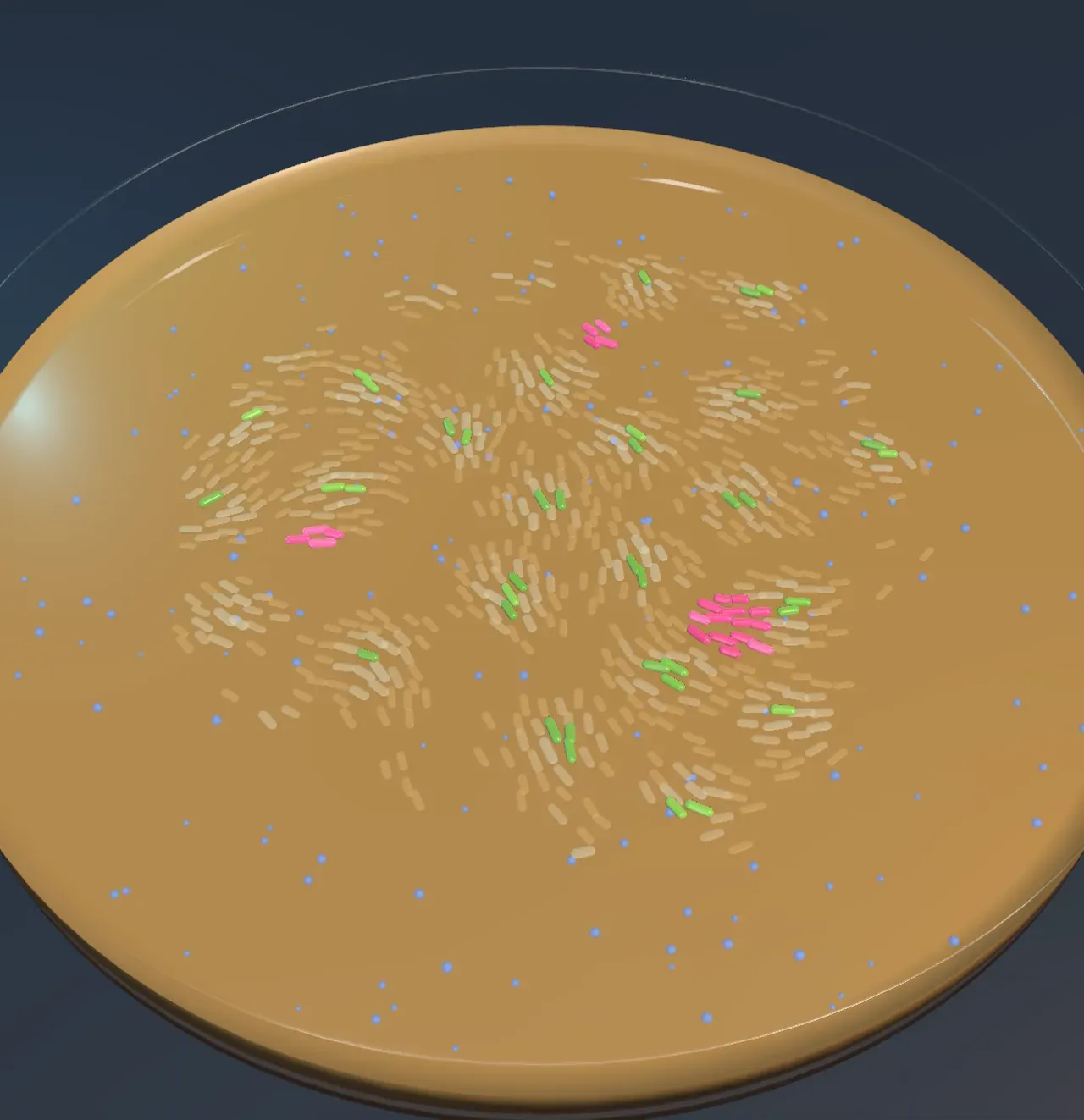
Nothing about the drugs changed. The bacteria did. The Scene shows how fast: a single colony on a dish, given a drug, and the two weeks that follow.
The few that were already there
A colony on a dish can hold a billion cells, all descended from one. Each time a bacterium copies its 4.6 million letters of DNA it makes a mistake less than once in a billion letters, but a growing colony copies a great many letters, so somewhere among its cells almost every letter of the chromosome has been changed. A few of those changes alter the very protein a drug is aimed at, just enough that the drug no longer grips it. In the Scene about a hundred cells, one in ten million, carry such a mutation before any drug is added.
The drug does not make these mutants. In 1943 Salvador Luria and Max Delbrück showed, with bacteria and a virus that attacks them, that resistant cells arise by chance mutations while a culture grows, before it meets what they resist: the numbers found in parallel cultures varied wildly, as they would if each depended on when a mutation happened to occur. Joshua and Esther Lederberg then found resistant cells in colonies that had never seen the drug, by printing the colonies onto a second dish that contained it.
Try it: with Days after the drug at Drug added, find the pink cells among the green. Then press None under Drug level and scrub to Two weeks on: with no drug, the resistant few stay a few.
Natural selection in days
Now add the drug. It bursts the ordinary green cells, which leave their empty envelopes on the agar, and barely touches the pink ones. Freed of the billion neighbours that were eating the food, the resistant cells divide and divide again, and within a few days the dish is a colony of pink. It is natural selection, the same process that darkened England’s peppered moths, but a bacterium can divide every few hours, so a lifetime of human history is a few weeks for them.
Try it: keep In the window under Drug level and scrub Days after the drug slowly. The green colony collapses within three days; by day five the pink cells fill most of the dish. The chart beside the Scene shows the same thing on a log scale, where a fall of a millionfold is a short drop.
Resistance works in a handful of ways. A cell can change the drug’s target, as the Scene’s mutants do; it can pump the drug out faster than it seeps in; it can close the pores it enters by; or it can make an enzyme that breaks the drug apart, as many bacteria do to penicillins (the Bacteria Article shows what penicillin does to a cell that has no such defence). Genes for those enzymes often sit on plasmids, small rings of DNA that bacteria copy and hand to one another, sometimes across species. A gene that arose in one germ can end up in many.
The selection window
How much drug matters as much as whether there is drug. The MIC, the minimum inhibitory concentration, is the lowest level of a drug that stops a population growing. The mutants in the Scene have an MIC sixteen times higher than the ordinary cells. Between the two lies the mutant selection window: drug levels strong enough to kill the ordinary cells, too weak to touch the mutants. Inside it, the drug clears away the competition for exactly the cells it cannot kill.
Try it: press Above the window. Now the drug kills the pink cells too, only more slowly, and the dish is empty in under three days. Then press Below the MIC: the colony hardly notices, yet the pink cells creep up a little every day, because even a weak drug slows the ordinary cells more than the mutants.
Doctors choose doses to stay above the window where they can, and combine two drugs when a germ is known to resist easily, as with tuberculosis: a cell would need two separate lucky mutations to survive both, and that happens about as often as two lottery wins.
How long the course runs
Set a strong dose and shorten the Course, and something else happens. With the Course at 2 days a few hundred ordinary cells are still alive when the drug is washed out, and they grow back into a full colony that the drug could still kill. Stopping early let the infection return, but it did not make it resistant. At 5 days the dish is clear and stays clear.
Try it: press Above the window, then slide Course down to 2 days, and scrub to Two weeks on. Then slide Course up to 5 days.
For decades patients were told to finish every course, in case stopping early bred resistance. The Scene shows why that is not quite the reason. A dish has no defences, so here every surviving cell grows back. A body has an immune system that mops up the last few bacteria once a drug has knocked most of them down, and trials for many common infections have found that shorter courses cure as well as longer ones. Meanwhile every extra day of an antibiotic selects for resistance among the trillions of bacteria that live in your gut, which are dosed along with the germ. So the advice now is to take antibiotics only when they are needed and exactly as prescribed, for the length your doctor sets, and never to save leftovers or take them for a cold: colds are caused by viruses, which antibiotics cannot touch.
What this model leaves out
The Scene draws a billion cells as about a thousand, with the number drawn growing as the cube root of the real number: a thousand times more cells shows ten times as many. The few resistant cells are therefore drawn far more numerous than they are, so you can find them. The cells are drawn thousands of times larger than life and the dish holds one colony.
The model has two kinds of cell competing for the same food, an ordinary kind and one mutant kind that grows a tenth more slowly, which is the usual price of resistance. Killing follows a standard dose–response curve, the same for both kinds except that the mutants need sixteen times more drug. Nothing new mutates during the two weeks, a strain dies out once fewer than half a cell is expected, and the drug is held at a steady level and then washed out, where a body’s drug level rises and falls with every dose. Real infections also have an immune system, cells that survive a drug by resting rather than resisting it, and bacteria that swap resistance genes. The growth rate of a doubling every four or five hours and the killing rates are chosen to show the story in days, not measured for one drug and one germ.