Natural selection within days: a few resistant mutants among a billion bacteria, a selection window that picks them out, why you finish the course, and why a low dose is dangerous.
Step 1 of 6 · A few mutants
Step 1 of 6
A few mutants
In Alexander Fleming found that a mould in a lab dish killed bacteria, and from that mould came penicillin, the first antibiotic. As early as , in his Nobel Prize lecture, Fleming warned that bacteria could become resistant to it. Today resistant bacteria kill more than a million people a year.
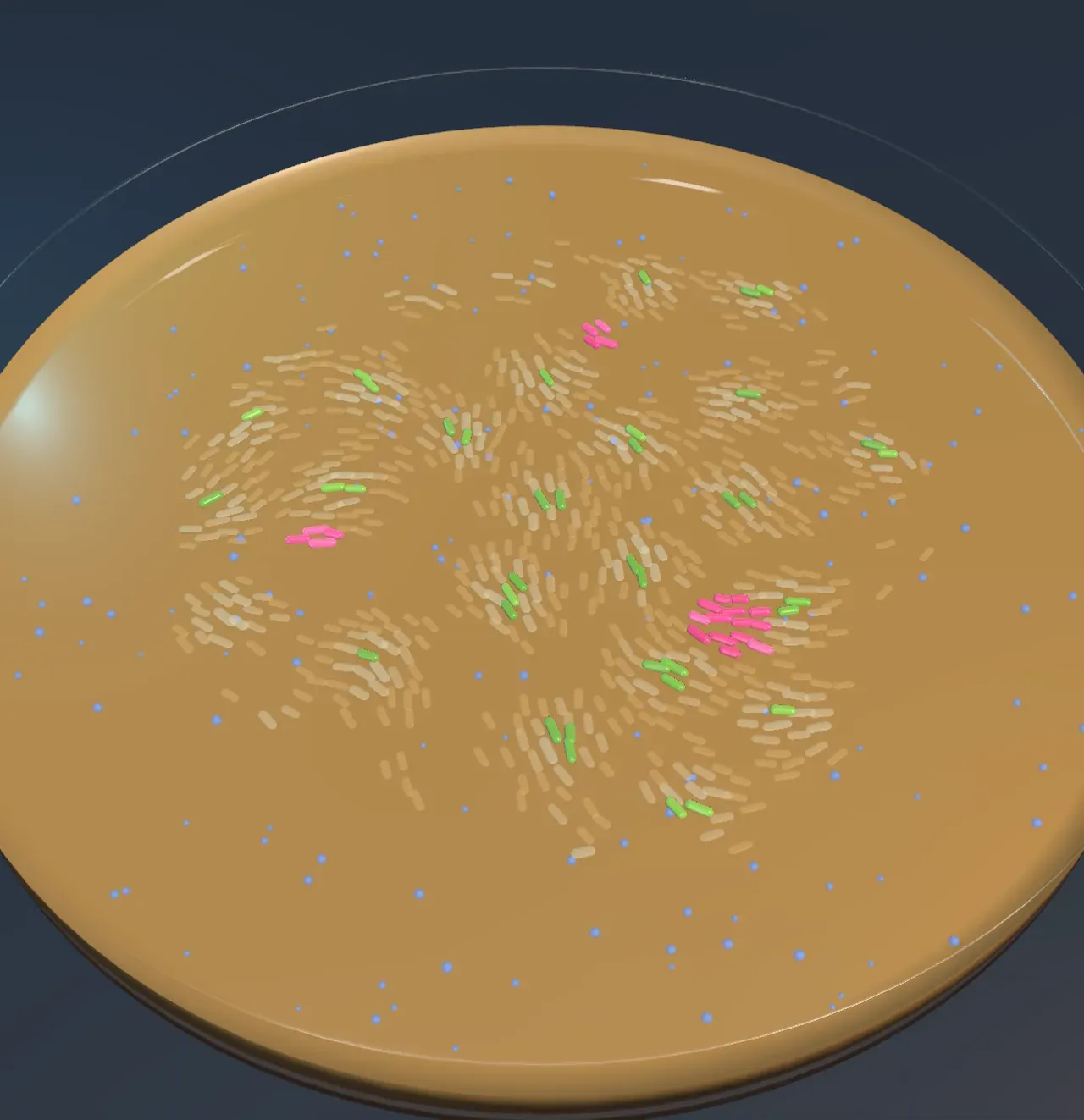
The Scene shows a dish with a colony of bacteria, drawn far larger than life. The green ones are ordinary. Days after the drug is fixed at Drug added.
Step 2 of 6
The selection window
Drug level is measured in units of MIC, the minimum inhibitory concentration: the lowest level that stops the ordinary bacteria growing. The resistant bacteria have an MIC of their own, much higher. Between the two values lies a selection window.
Drug level and Course are fixed, and Days after the drug will run two weeks ahead once you choose an answer.
Step 3 of 6
How fast
Beside the Scene is a chart on a logarithmic scale: the top line is the drug level against the window, and below it the two kinds of bacteria over two weeks. On a scale like that each equal step up is a multiplication by the same factor, so a hundred cells and a billion fit on the same chart.
Step 4 of 6
Finishing the course
Now the drug is above the window, and can wipe out the whole colony. The question is how long it needs.
Step 5 of 6
Below the MIC
Even a level that kills nothing does something. Drugs reach colonies of bacteria in many ways: antibiotics in farm animals’ feed, traces in sewage, and pills forgotten halfway through a course.
Step 6 of 6
Bacteria, not viruses
What you saw here is natural selection, as with the moths, only thousands of times faster, because a bacterium divides every few hours. Every use of an antibiotic selects resistant bacteria, even when it is needed. That is why it is used only where it can help.
Loading the interactive version…
Loading the interactive version…
Each step sets up the Scene for you, and a control marked “fixed” stays put for that step.
Practice · Calculate
The dish holds a billion bacteria, and about one in every ten million happens to carry a mutation that protects it from the drug. How many resistant bacteria are in the dish before the drug is added?
Practice · Calculate
The dish holds a billion bacteria, and about one in every ten million happens to carry a mutation that protects it from the drug. How many resistant bacteria are in the dish before the drug is added?
Practice · Predict, then look
The drug level is times the MIC: enough to kill the ordinary bacteria, but not the resistant ones, whose MIC is times higher. The course lasts seven days. What will the dish look like after two weeks?
Practice · Predict, then look
The drug level is times the MIC: enough to kill the ordinary bacteria, but not the resistant ones, whose MIC is times higher. The course lasts seven days. What will the dish look like after two weeks?
Practice · Predict, then look
In the same course, after how many days will the resistant bacteria be more than half the living cells? Look at the chart beside the Scene.
Practice · Predict, then look
In the same course, after how many days will the resistant bacteria be more than half the living cells? Look at the chart beside the Scene.
Practice · Reach the target
Now the drug level is times the MIC, above the window: it kills the resistant cells too. But the course lasts only two days, and the bacteria grow back. Change Course until the dish is completely empty after two weeks, then press Check.
Practice · Reach the target
Now the drug level is times the MIC, above the window: it kills the resistant cells too. But the course lasts only two days, and the bacteria grow back. Change Course until the dish is completely empty after two weeks, then press Check.
Practice · Predict, then look
The drug level is half the MIC, for ten days: too little to kill the bacteria. What will happen to the resistant bacteria?
Practice · Predict, then look
The drug level is half the MIC, for ten days: too little to kill the bacteria. What will happen to the resistant bacteria?
Practice · Choose
Why do doctors not give antibiotics for flu?
Practice · Choose
Why do doctors not give antibiotics for flu?
Lesson complete. Every practice question here is done.