Why most living things never become fossils, which conditions keep even the soft parts, and how rock layers and dated ash beds tell how old a fossil is.
Step 1 of 5 · A rare event
Step 1 of 5
A rare event
A fossil is a remnant of a living thing, or a mark it left, kept in rock: a bone turned to stone, a shell, the imprint of a leaf, footprints. Fossils are the only direct evidence of what lived on Earth millions of years ago, and they show creatures that no longer exist and in-between stages between groups.
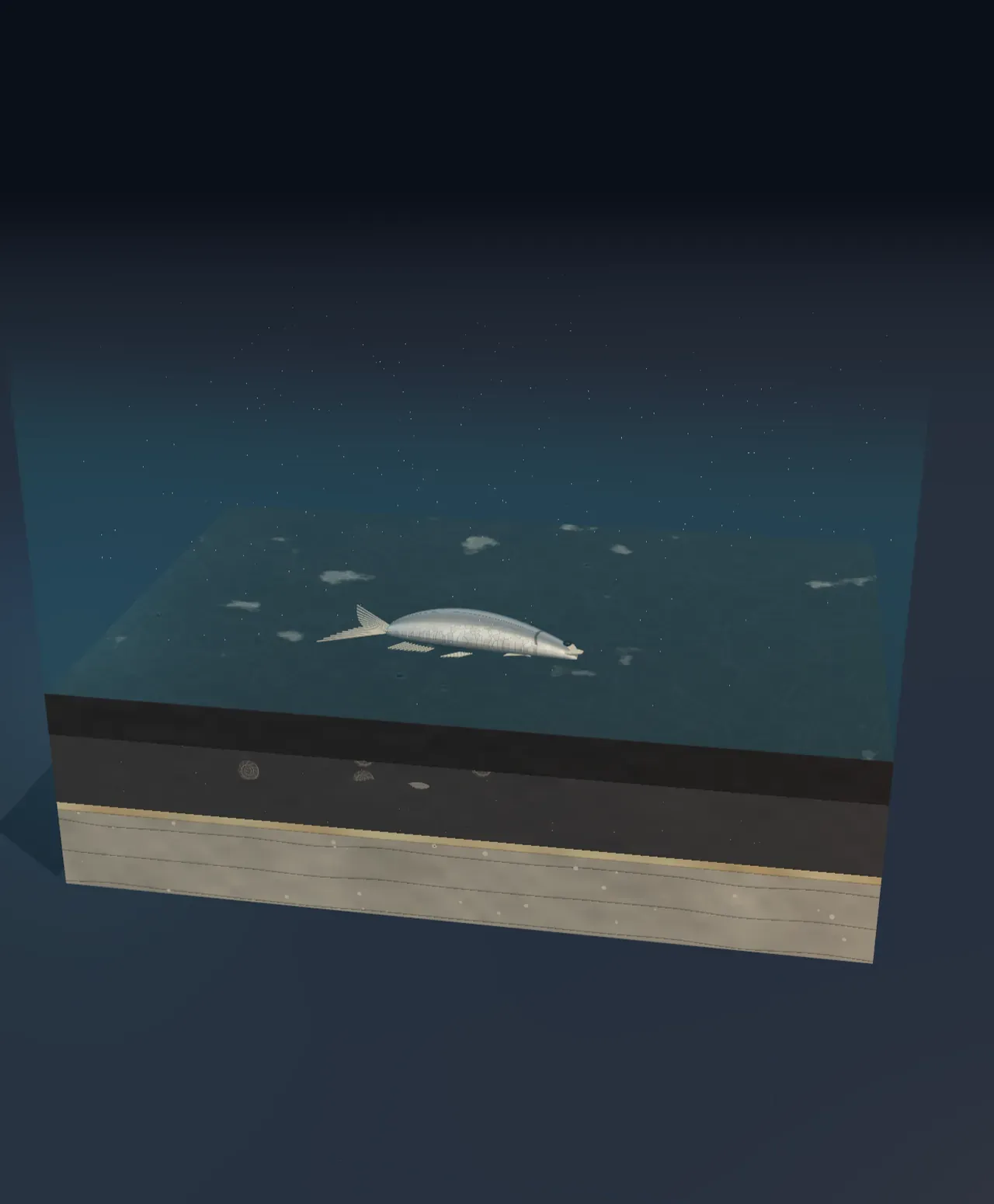
But most living things leave nothing at all. The Scene shows the road from a body on the sea floor to a fossil in a cliff. What dies, Oxygen at the sea floor and Covered by mud are fixed, and Time will run to Exposed once you choose an answer.
Step 2 of 5
Soft bodies
A fossil forms when sediment covers the body, and water seeping through it slowly replaces its substance with minerals. That takes thousands of years, so what is kept is mostly what lasts longest: bones, teeth and shells.
Step 3 of 5
Perfect preservation
Sometimes, very rarely, much more is kept: skin, feathers, eyes. Time stands at Buried, the moment of covering. Whatever survived until then is what can become a fossil.
Step 4 of 5
Reading the layers
Rock layers form from mud and sand settling on the sea floor, layer upon layer, over millions of years. Time stands at Uplifted: the movement of the plates has raised the ancient sea floor, and soon rain and waves will lay the layers bare in a cliff.
Between the layers there is sometimes a thin bed of volcanic ash, from an eruption. Ash holds tiny crystals with uranium, which decays at a known rate, so it can be dated. The fish itself cannot be dated that way.
Step 5 of 5
Deep time
Rock builds up slowly: often only a few millimetres a century, so even a low cliff stands for a very long time. The Grand Canyon has about km of layers, with rocks nearly two billion years old at the bottom.
Loading the interactive version…
Loading the interactive version…
Each step sets up the Scene for you, and a control marked “fixed” stays put for that step.
Practice · Predict, then look
A fish dies and sinks to a well-aired sea floor, and mud covers it only after weeks. What of it will be left as a fossil?
Practice · Predict, then look
A fish dies and sinks to a well-aired sea floor, and mud covers it only after weeks. What of it will be left as a fossil?
Practice · Predict, then look
A jellyfish, with no bones or shell, dies on a sea floor with little oxygen, and is covered by mud after weeks. What will be left of it?
Practice · Predict, then look
A jellyfish, with no bones or shell, dies on a sea floor with little oxygen, and is covered by mud after weeks. What will be left of it?
Practice · Reach the target
Palaeontologists hunt for rare fossils in which the soft parts are kept too: skin, eyes, even stomach contents. Change Oxygen at the sea floor and Covered by mud until the fish is kept with its soft parts, then press Check.
Practice · Reach the target
Palaeontologists hunt for rare fossils in which the soft parts are kept too: skin, eyes, even stomach contents. Change Oxygen at the sea floor and Covered by mud until the fish is kept with its soft parts, then press Check.
Practice · Choose
In the cliff, an ash bed below the fish’s layer is dated to million years, and an ash bed above it to million years. What can be said about the fish’s age?
Practice · Choose
In the cliff, an ash bed below the fish’s layer is dated to million years, and an ash bed above it to million years. What can be said about the fish’s age?
Practice · Calculate
How much time passed between the two ash beds, and million years? Answer in millions of years.
Practice · Calculate
How much time passed between the two ash beds, and million years? Answer in millions of years.
Lesson complete. Every practice question here is done.