Almost nothing becomes a fossil
A fossil is any trace of life kept in rock: a bone, a shell, the print of a leaf, a footprint, a burrow. Fossils are common enough that a beach below the right cliff can be littered with them, yet they are the rare exception. When a fish dies in the sea, the usual ending is that crabs and worms eat it, bacteria rot what they leave, and currents scatter and grind down the bones. Within a few years there is nothing left. Only a tiny share of the animals and plants that ever lived left any fossil at all, and many kinds of living thing are known from a handful of specimens or none.
Whether a body escapes that fate depends mostly on three things, and the Scene lets you change all three: what the body is made of, how much oxygen the water at the sea floor holds, and how soon mud covers it.
Hard parts last; soft parts rot
Bones, teeth, scales and shells are made of minerals: calcium phosphate in bone, calcium carbonate in a shell. Bacteria cannot eat minerals, so hard parts can lie on the sea floor for years. Skin, muscle and guts are food, and in warm sea water they rot in days. A plant’s leaves sit in between: tough fibres and waxy skin let them last weeks or months in water. A jellyfish, which is about 95% water, collapses and is gone in a day or two.
That is why the fossil record is full of shells and bones. An ammonite, a relative of squid and octopus that lived in a coiled, chambered shell, makes a fossil under almost any conditions; ammonites are among the most common fossils of the age of the dinosaurs. A jellyfish almost never does.
Try it: with Covered by mud on After weeks, try each choice under What dies, stepping Time from Death to Buried each time. The ammonite’s shell is still whole; the fish keeps its skeleton but loses its skin; the fern is browned and holed; the jellyfish is gone. The bars in the chart show what is left of each.
Oxygen, scavengers and burrowers
On a well-aired sea floor, life is busy. Crabs, snails and fish find a carcass within hours and strip it. Worms and other burrowers churn the mud, so even a buried skeleton gets pulled apart and its bones mixed through the sediment. Bacteria that breathe oxygen rot soft tissue fastest of all.
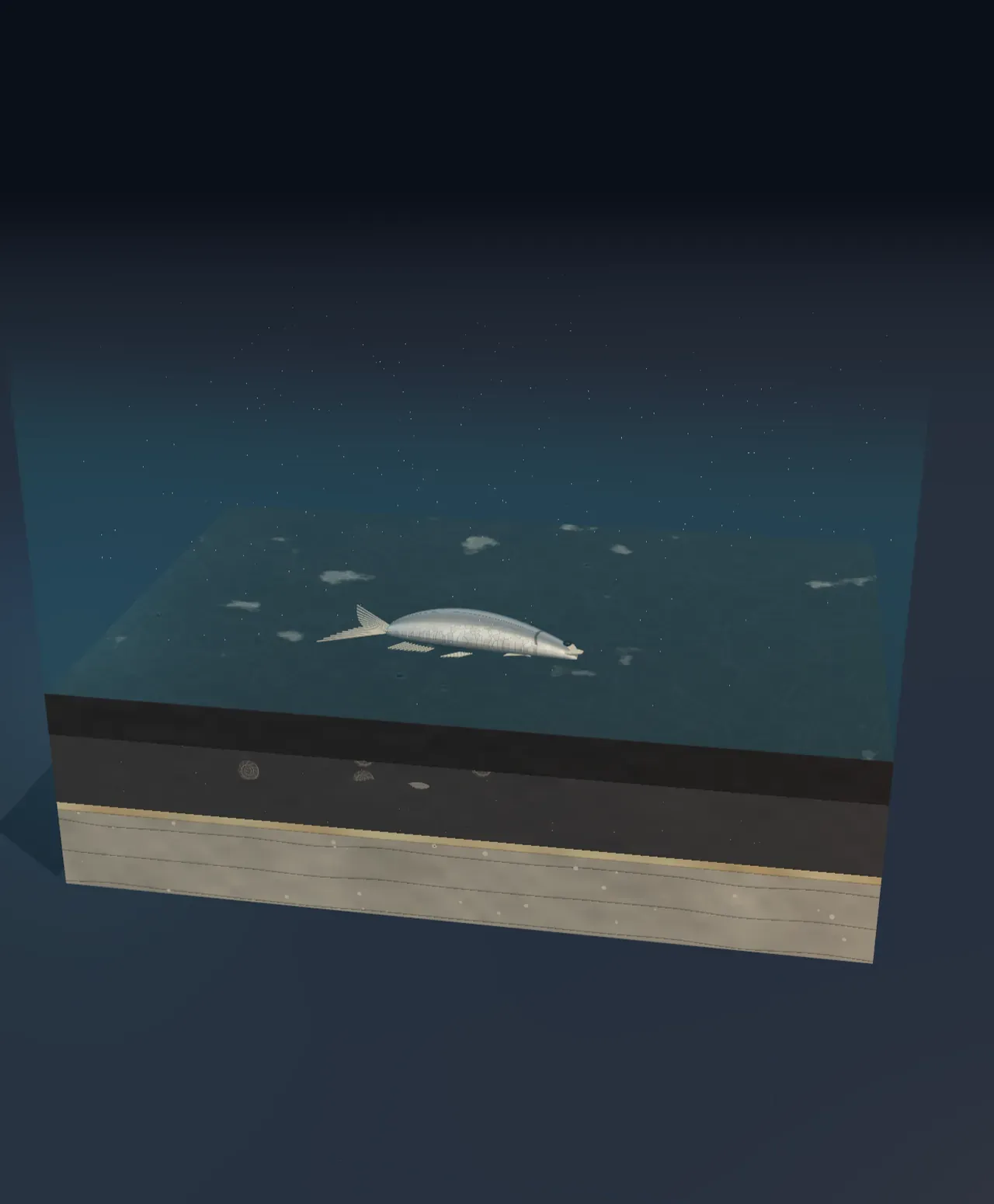
Where the water at the bottom has no oxygen, none of that happens. Nothing lives there to eat or burrow; only bacteria that breathe sulfate instead of oxygen, which work more slowly and leave the mud black and smelling of rotten eggs. In the Scene, a sea floor with no oxygen is black mud with pale mats of sulfur bacteria; a well-aired one is grey mud riddled with burrows.
Try it: choose Bony fish and slide Oxygen at the sea floor up to 100%. Crabs walk in, and when you step to Buried the skeleton lies in scattered pieces. Slide it down to 0% and it is buried whole.
Buried fast
The surest way to escape scavengers is to be buried. A storm that stirs up the shallow sea floor, or a flood that pours mud into the sea, can drop a bed of silt many centimetres thick in a few hours. A body covered that quickly is out of reach of crabs, and most burrowers cannot dig so deep. Over most of the sea floor, though, mud settles a fraction of a millimetre a year, and a body can lie in the open for decades before it is covered.
The best fossils of all, with skin, feathers or the outlines of soft bodies, come from places that combined quick burial with water that had no oxygen. Holzmaden, in Germany, is one: its black shale, laid down about 183 million years ago on a sea floor without oxygen, keeps whole ichthyosaurs with the outline of their skin, along with fish, ammonites and crinoids.
Try it: choose Jellyfish, slide Oxygen at the sea floor to 0% and set Covered by mud to Within hours (a storm), then step to Turning to stone. The jelly is gone but its shape stays pressed into the mud. Change either condition and nothing is left. Choose Bony fish with the same settings, and the skeleton keeps a dark film where its skin was.
Turning to stone
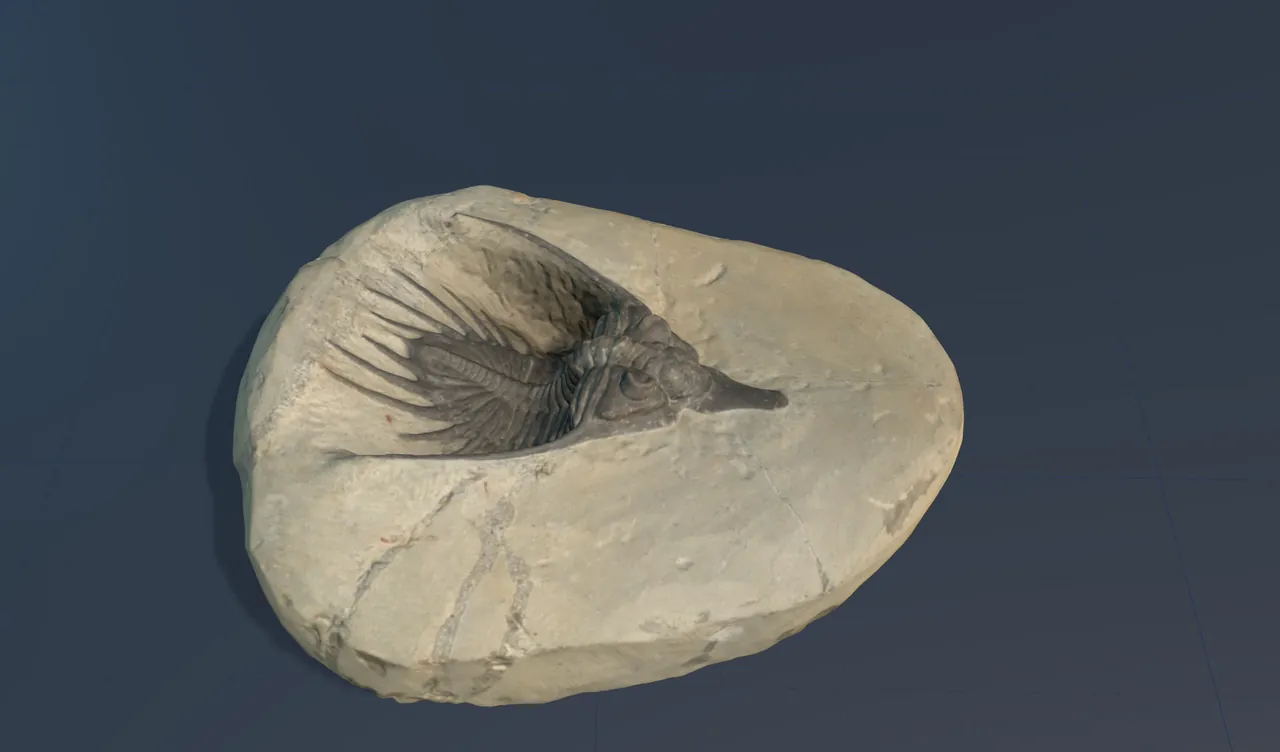
Once buried, the remains are soaked in the water that fills the gaps in the mud, and minerals from that water slowly fill and replace them. Bones are already mineral, so they keep their shape: their pores fill and they turn brown or black, stained by iron and by what is left of their own organic matter. The empty chambers of an ammonite fill with calcite, or, in mud with no oxygen, where bacteria make hydrogen sulfide, with pyrite, the brassy mineral called fool’s gold. Leaves are pressed and slowly heated until only a film of carbon is left, still showing every vein. Sometimes nothing of the body survives, but the mud keeps its shape as an imprint or a mould.
As more layers pile on, their weight squeezes the water out of the mud, which shrinks to a fraction of its thickness and hardens into shale. The fossils in it are flattened too, which is why many ammonites in shale are crushed flat while those filled early with pyrite keep their shape. How mud and sand turn into rock is told in Rocks and the rock cycle.
Try it: choose Ammonite, step to Turning to stone and slide Oxygen at the sea floor from 0 to 100. Below 10% the shell fills with gold pyrite; above, with grey calcite. At Buried deep the calcite one is squashed and the pyrite one is not.
Back to the surface
A fossil a kilometre or two down is no use to anyone. To be found, the rock has to come back up. Where plates push against each other, old sea floors are raised into land, sometimes into mountains, over tens of millions of years. Rain, rivers, frost and waves then wear the rock away, and wherever they cut a cliff or a valley into the layers, the fossils in them come back to light. How that wearing away works is the subject of Erosion and weathering.
Exposure is also a race. A fossil weathered out of a cliff breaks up and washes away within years, so it has to be found while it is fresh. Collectors walk the beaches below crumbling cliffs after every winter storm for just that reason.
Try it: step Time from Buried deep to Exposed. The column rises, its top turns to land and wears down, and the fossil ends up on a ledge at the foot of a cliff with scree around it.
Reading time in the layers
Layers of sediment are laid down one on top of another, so in a pile that has not been overturned, each layer is younger than the one below it and older than the one above. This law of superposition, written down by Nicolas Steno in 1669, gives the order of events but not their dates. In the 1790s the surveyor William Smith noticed that each layer in England carries its own set of fossils, in the same order wherever he found them, so a layer can be recognised by its fossils from one place to the next. Ammonites changed so quickly that a single species often marks less than a million years of rock, and geologists use them as index fossils to match layers across continents.
Numbers come from ash. When a volcano erupts, its ash settles as a thin bed, and the tiny zircon crystals in it can be dated by the uranium in them. A fossil lying between two ash beds is younger than the one below and older than the one above. In the Scene’s cliff, the beds below and above the fossil are dated at 183.4 and 182.6 million years, so the fish is about 183 million years old. How the zircons are read is told in Radiometric dating and the age of the Earth.
What the record tells us
Put together from rocks all over the world, fossils show life changing through time: the oldest rocks hold only microbes, later ones the first animals with shells, then fish, then plants and animals on land, dinosaurs and, in the most recent layers, mammals like us. Whole groups appear, flourish and vanish; the ammonites, for example, died out with the dinosaurs 66 million years ago. That changing record is some of the strongest evidence that living things have evolved, as explained in Natural selection. Timeline of life follows life’s whole history, and Classifying life shows how living things are sorted into groups.
The record is also biased. It favours animals with shells and bones, animals that lived in water where mud settles, and animals that were common. Soft-bodied animals, land animals of dry uplands and rare species are hardly represented. A gap in the record is often a gap in preservation, not in life.
What this model leaves out
The block shows about a metre of rock around the fossil. The covering beds are drawn thick enough to bury the body; in reality, decades on an open sea floor would lay down only a few centimetres of mud. The deep burial is drawn as a few more beds and a fifth of compaction, while the chart gives the 1,500 m that buried it; real mud can lose more than half its thickness. The front of the block is cut away so the fossil stays in view; until the cliff forms at the end, that cut is a way of seeing, not a real hole.
The rates come from simple rules: soft parts rot in days, skeletons fall apart in weeks, bones and shells left exposed are destroyed over years to decades, about three times slower where there is no oxygen, and scavengers and burrowers disappear below a few per cent of oxygen. Real rates depend on the temperature, the size of the body and the animals living there. Each choice under Covered by mud is one fixed time: about six hours, three weeks or twenty years. The dates of the ash beds, and the depth and timing of burial and uplift, are illustrative, chosen to match the sort of shales in which such fossils are found.