Rock is always on its way somewhere
Pick up a pebble and it seems the picture of permanence. Yet every rock was something else before, and will be something else again. Geologists sort rocks into three families by how they formed. Igneous rocks crystallise from molten rock. Sedimentary rocks are made of pieces of older rock, laid down and hardened. Metamorphic rocks are older rocks changed by heat and pressure without melting. The rock cycle is the set of paths by which each kind becomes the others.
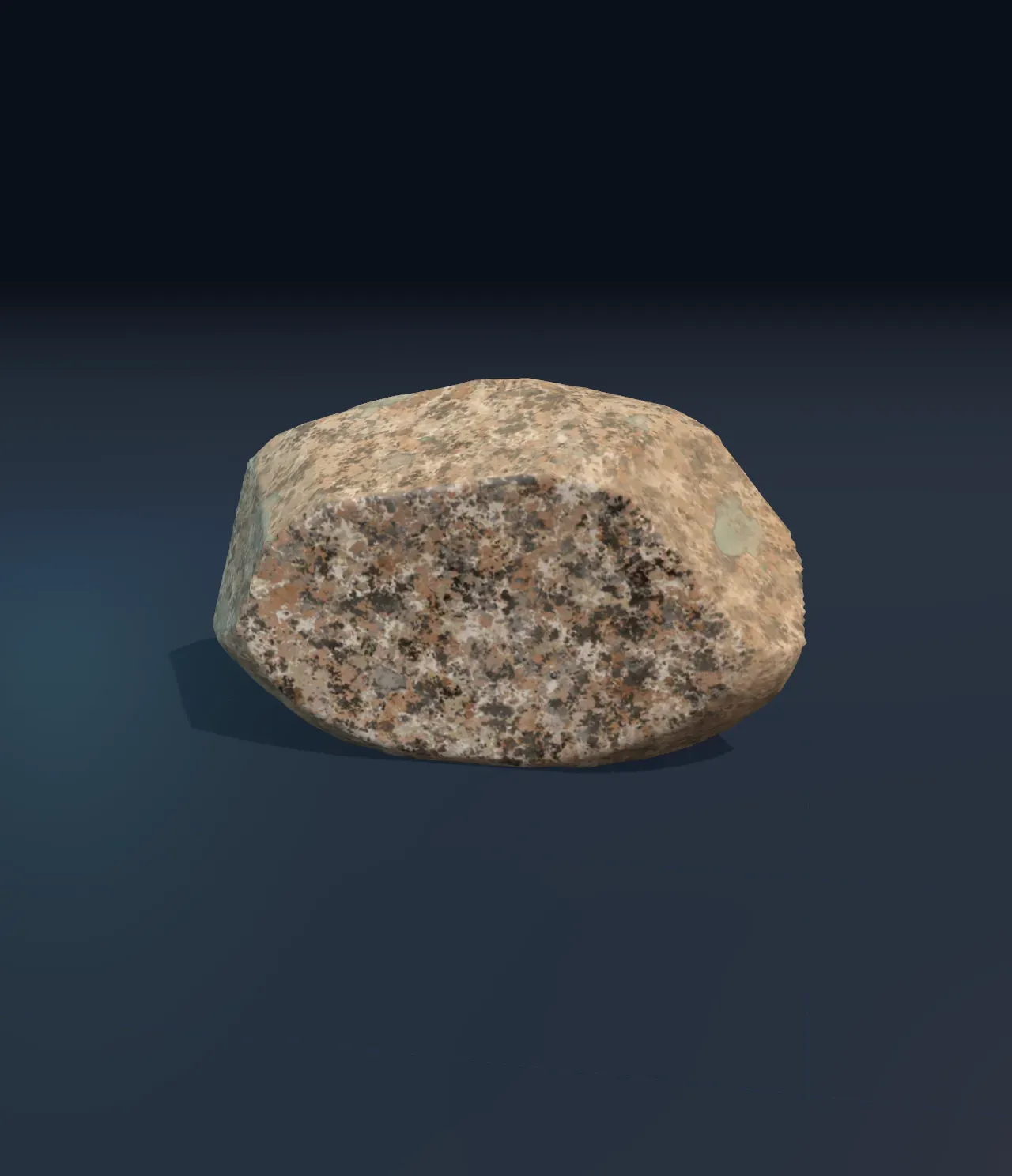
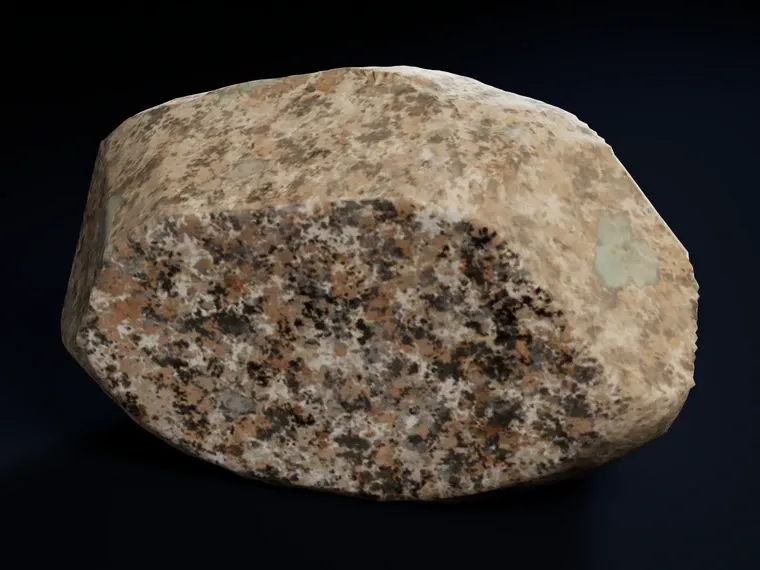
The Scene follows one piece of rock all the way round. It starts as granite, crumbles into sand, hardens into sandstone, is baked into a metamorphic rock and finally melts, ready to start again. Its path through the ground, down and up, hot and cool, is drawn in the chart beside it.
Igneous: crystals from a melt
Deep in the crust, where rock gets hot enough, it partly melts into magma. Magma is lighter than the solid rock around it, so it rises, until it stalls underground and cools, or erupts as lava (how it erupts is the subject of Volcanoes). As it cools, crystals of minerals grow from the melt: pink and white feldspar, glassy grey quartz, flakes of black mica. They grow until they crowd into one another, which is why granite is a tight mosaic of interlocking crystals with no gaps between them.
How big the crystals grow depends on how long they have. A body of magma several kilometres down, wrapped in rock that is already warm, takes a hundred thousand years or more to set solid, and its crystals grow to several millimetres: granite. The same melt erupted as lava cools in days to months, too fast for crystals to grow large, and becomes a fine-grained rock, rhyolite, often with a few bigger crystals that grew before it erupted and faint streaks where it flowed. Why slow cooling grows big crystals is explained in Crystals.
Try it: on Igneous, slide Magma cooled at to 0 km deep, lava at the surface, then down to 7 km deep. It is the same melt, but a different rock: rhyolite’s crystals are too small to see, granite’s are about 5 mm across. The foot of the chart gives how long each took to cool.
Sediment: broken down at the surface
Granite forms kilometres underground, yet it is found on mountain tops. It gets there when the crust is pushed up and the rock above it is worn away, over millions to tens of millions of years. Where the crust is pushed up, and why, is the subject of Plate tectonics.
At the surface, rock meets water, air and living things, and it starts to rot: this is weathering. Rainwater, made weakly acidic by carbon dioxide, slowly turns feldspar into clay and rusts the iron in mica. Quartz hardly reacts at all. Once the crystals around it have softened, the quartz falls loose, and the granite crumbles into a coarse sand. Rivers carry the sand and clay away and drop them where the water slows, in lakes, deltas and the sea, layer on layer. How rain and rivers do that work is the subject of Erosion and weathering.
Try it: step from Igneous to Sediment. The feldspar clouds over and the mica rusts, grains drop out, and sand piles up in layers round the rock until there is nothing left of it.
Sedimentary: pressed and glued
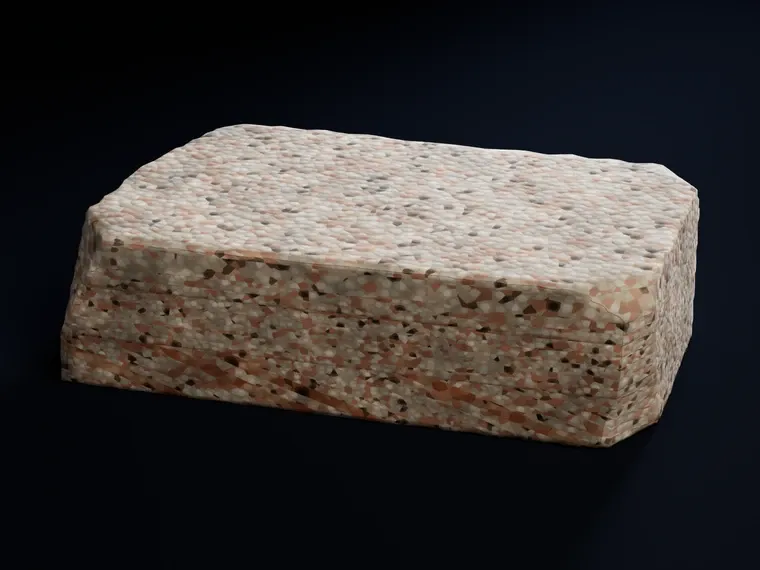
Each new layer buries the ones below. Freshly laid sand is about two-fifths empty space, filled with water. As it is buried a kilometre or more, the weight above packs the grains closer, and minerals dissolved in the water (quartz, calcite, iron oxides) crystallise in the gaps and glue the grains together. The sand has become sandstone, still at well under 200 °C. The layers it was laid in survive as its bedding, sometimes with the tilted laminae of old ripples and dunes.
Not every sedimentary rock is made of sand. Mud hardens into mudstone and shale; shells and the skeletons of tiny sea creatures build limestone; salt left by drying seas becomes rock salt. Sedimentary rocks are also where fossils are kept, which is a story for the fossil record.
Try it: step to Sedimentary. The bed settles about a fifth lower as its gaps close, the dark spaces between the grains fill with pale cement, and the sawn face shows its layers.
Metamorphic: changed without melting
If the sandstone is carried deeper, as it is when continents collide and thicken the crust into mountains, it heats up. In much of the continental crust the temperature rises by roughly 25 °C for every kilometre of depth, and the pressure by about 27 megapascals, some 270 times the air pressure at sea level. Above about 200 °C, the minerals in the rock are no longer the stable ones. Atoms move through the solid and rebuild it as new minerals and bigger crystals, without ever melting: the rock becomes metamorphic.
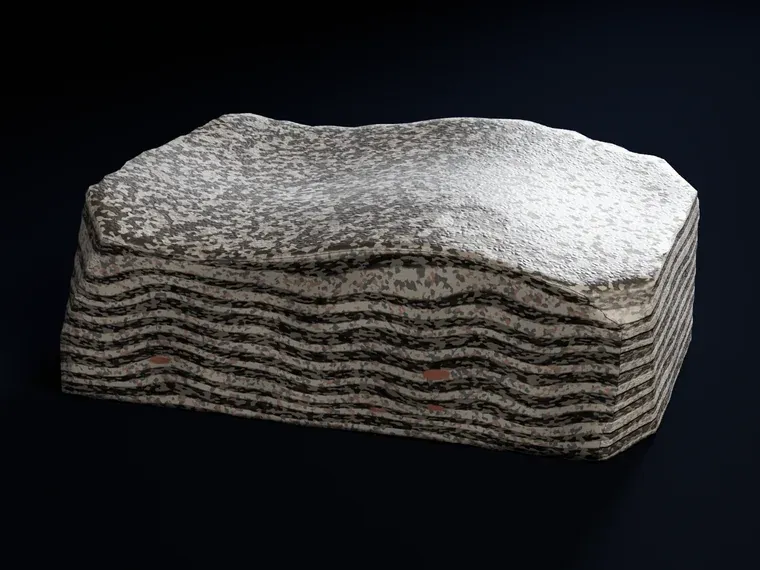
The deeper it goes, the further it changes; geologists call this the metamorphic grade. At a few hundred degrees the sand grains grow into one another, making a hard, sugary rock (a metasandstone; a sandstone of pure quartz becomes quartzite). Hotter, new flakes of mica grow, and because the rock is being squeezed, they line up across the squeeze, so the rock glitters and splits along their planes: schist. Hotter still, above about 550 °C, the minerals sort themselves into pale bands of quartz and feldspar and dark bands of mica: gneiss, often folded where the rock flowed.
Try it: step to Metamorphic and try the presets under Sandstone buried to. Under a basin (5 km, about 140 °C) leaves it sandstone; Mountain belt (16 km, about 415 °C) makes schist; Deep mountain root (24 km, about 615 °C) makes banded gneiss. Somewhere near 10 km gives metasandstone.
Melting closes the loop
Deeper and hotter, the rock starts to melt. A rock like this one, made of quartz and feldspar with a little water, begins to melt at about 650 to 700 °C, long before it is all liquid at around 1,000 °C. The first melt forms in the pale bands of quartz and feldspar, which leaves a streaky rock that is part melted and part solid: migmatite. Once about a third of the rock has melted, the melt can gather and rise as magma, and the cycle is back where it began.
Try it: press Deep enough to melt (34 km, about 865 °C) and step to Melting. The pale bands glow first, then the whole rock, which slumps as more of it melts; the chart puts it at 58% melted. At 28 km it only gets as far as migmatite.
Not every rock goes the whole way round. A sandstone never buried deep enough to change can be pushed back up and worn away, sediment back to sediment. Granite can be squeezed into gneiss without ever becoming sand, and any rock at all can be weathered at the surface. These shortcuts are as much a part of the cycle as the full loop.
Try it: with Under a basin, step to Melting. The sandstone never gets hot enough to change, so it is raised, rusts and sheds its grains, and the chart takes it straight back to the surface as sediment.
What keeps it turning
Two engines drive the cycle. Heat from inside the Earth, much of it from the slow radioactive decay of uranium, thorium and potassium, keeps the mantle moving and the plates with it, which buries rock, melts it and pushes mountains up. Sunlight drives the weather: evaporation, rain, rivers and frost, which wear the mountains down again.
A lap takes tens to hundreds of millions of years, and the Earth has had time for many. Because its surface keeps being recycled, very old rock is rare. The oldest whole rocks known are about 4 billion years old, and single grains of zircon, a mineral tough enough to survive several laps, reach 4.4 billion. How their ages are read is the subject of Radiometric dating and the age of the Earth.
What this model leaves out
The Scene changes one piece of rock where it sits. In reality the burial and the raising happen to whole regions, kilometres thick, and the rock travels: its sand is carried far from the granite it came from and mixed with sand from elsewhere, and its melt rises away to cool somewhere new. The chart shows that travel; the Scene does not.
Temperature rises with depth along one straight line of 25 °C per kilometre. Real gradients curve, flattening with depth, and range from under 15 °C per kilometre where cold ocean floor sinks to over 50 near volcanoes. Pressure matters as well as heat: where rock is pushed down fast and stays cool, it forms high-pressure rocks such as blueschist that the Scene leaves out. The temperatures for each step, 200, 350, 550 and 680 °C, are typical values; real changes depend on the rock’s minerals, its water and time. Sandstone of pure quartz would make quartzite, never schist, and schist forms most readily from mudstone; the Scene’s sandstone, built from granite, has enough clay and feldspar to grow mica.
Cooling times and crystal sizes come from a smooth fit to the right orders of magnitude, not a calculation of heat flow; real crystal sizes also depend on the size of the body of magma and on its water. Melting rises in a straight line from 680 to 1,000 °C. A real rock buried 30 or 40 km deep is usually cooler than the straight line says, and melts only where the crust is thickest or extra heat or water arrives.