Molten rock on the move
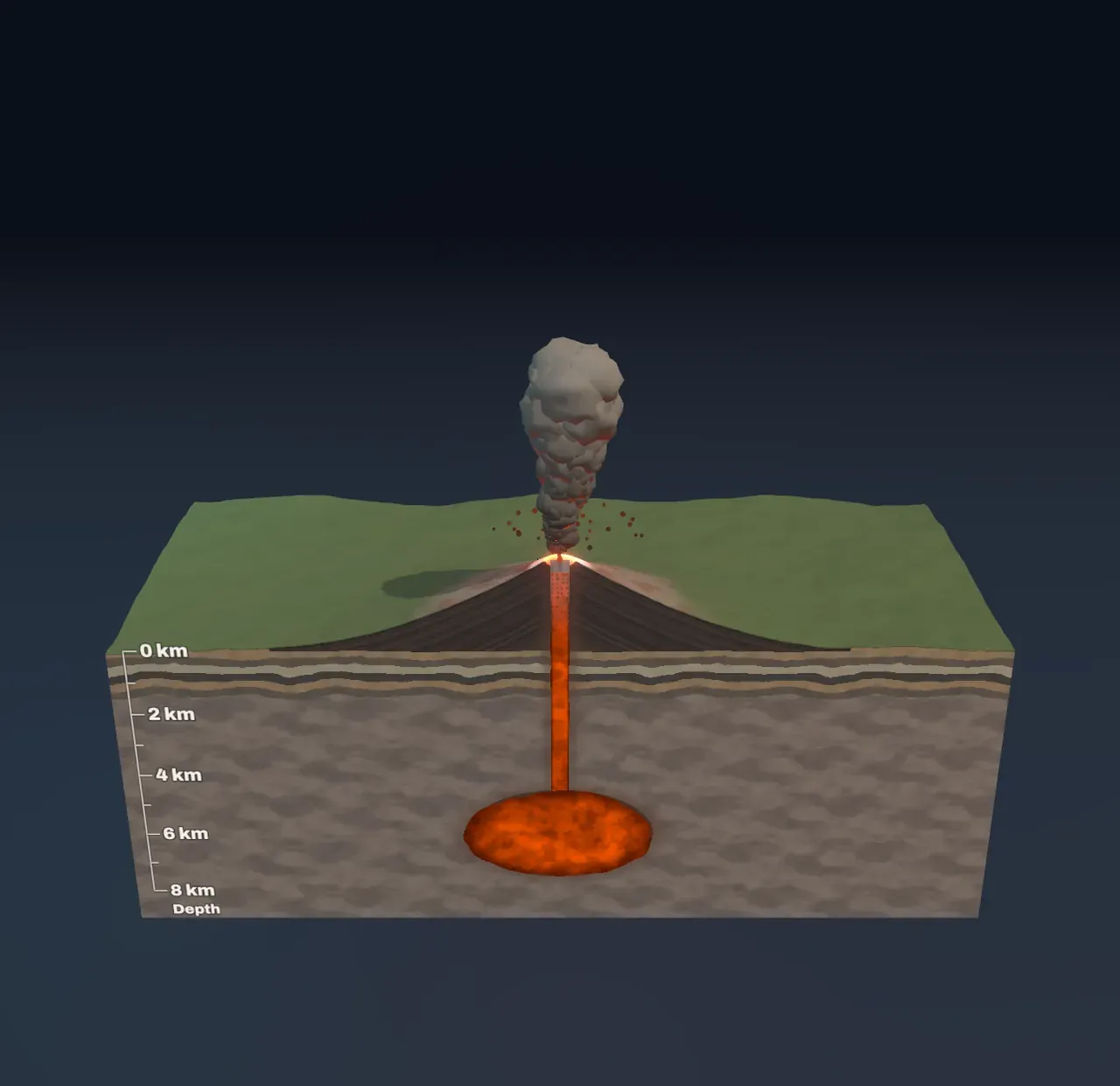
Under a volcano lies magma, rock hot enough to be partly or wholly molten. It forms where the mantle melts: where tectonic plates pull apart, over hot spots such as Hawaii, and above plates that sink back into the mantle (see Plate tectonics). Magma is lighter than the solid rock around it, so it rises and gathers in a magma chamber a few kilometres below the surface. When the chamber fills and its pressure grows, magma forces its way up a pipe, the conduit, to a vent at the surface. Once it pours out it is called lava.
The Scene cuts a volcano in half through its summit. The chamber lies 6 km down, and the layers on the cut face are the volcano’s own history: each band is an old lava flow or a bed of ash from an earlier eruption.
Silica makes magma sticky
Almost all magma is mostly silica, silicon and oxygen. In a melt, silicon and oxygen atoms link into chains and sheets, and the more silica there is, the more links. Pulling the melt past itself means breaking them, so silica-rich magma is far stickier, or more viscous, than silica-poor magma.
Basalt magma is about 50 per cent silica and erupts at around 1,150 to 1,200 °C. Its viscosity is about 100 pascal-seconds, which is roughly as thick as peanut butter. Rhyolite is over 70 per cent silica and erupts cooler, at 750 to 850 °C, and the lower temperature stiffens it further. Once it has lost its gas it is about a billion times stickier than basalt, stiffer than cold pitch. Andesite and dacite lie in between. The chart beside the Scene shows the stickiness at the vent along its top edge.
Each kind of magma glows at its own temperature. In the Scene, basalt glows yellow-orange in the chamber and rhyolite a dull cherry red, the colours any object shows at those temperatures.
The fizz in the magma
Magma also carries a few per cent of dissolved gas, mostly water, with some carbon dioxide and sulfur gases. Deep down the pressure keeps it in solution, like the gas in a sealed bottle of fizzy drink. As the magma rises, the pressure on it falls, the gas comes out as bubbles, and the bubbles swell. One litre of magma holding 3 per cent water makes more than 400 litres of steam at the surface.
Try it: slide Erupt to about the middle, zoom in on the conduit and watch the bubbles appear in the rising magma, turning it paler as they grow. Slide Gas in the magma down to 0.5%: the bubbles start only just below the vent. Slide it up to 5%: they start several kilometres down. Push the gas to its top and the bubbles appear in the chamber itself.
Runny lava lets go; sticky magma explodes
What the gas does next depends on how sticky the magma is. In runny basalt, bubbles rise through the melt, join up and burst at the surface, so the gas escapes on the way. The lava pours out quietly in lava flows that can run for tens of kilometres, or, with more gas, sprays up in lava fountains hundreds of metres high, as at Kīlauea in Hawaii.
In sticky magma the bubbles cannot move. They grow where they are until the gas fills about three quarters of the volume, and then the froth tears itself apart: fragmentation. The shreds of froth freeze into ash and pumice and blast out of the vent at hundreds of metres per second, building an ash column that can climb 10 to 40 km into the sky. When a column grows too heavy to rise, it collapses into pyroclastic flows, avalanches of hot ash and gas that race down the slopes faster than a car, the deadliest thing a volcano does. Mount St Helens in 1980 and Pinatubo in 1991 both erupted sticky dacite magma.
Sticky magma does not always explode. If it rises slowly, its gas leaks away through cracks, and the lava squeezes out like toothpaste and piles up over the vent as a lava dome.
Try it: set Gas in the magma to 5%, then compare Basalt with Rhyolite under Silica in the magma, with Erupt at Full eruption. Then keep Rhyolite and slide Gas in the magma down to 0.5%: the same magma now builds a dome instead of an ash column.
Shields and cones
Over many eruptions, each kind of magma builds its own kind of mountain. Runny basalt spreads far before it freezes, so it builds broad shield volcanoes with gentle slopes of a few degrees. Mauna Loa in Hawaii, the largest volcano on Earth, rises about 9 km from the sea floor. Sticky lava and ash pile up close to the vent into steep stratovolcanoes, layered cones of lava and ash such as Mount Rainier. Move Silica in the magma from Basalt to Andesite and the mountain in the Scene changes from one to the other, with its cut face from thin lava sheets to alternating lava and ash beds.
Where a volcano stands decides which magma it gets. Basalt comes straight from melting mantle, under mid-ocean ridges and hot spots like Hawaii and Iceland. Above a sinking plate, water released from the plate helps the mantle melt, and as that magma rises through the thick crust of a continent it melts some of the crust and loses crystals poor in silica, so it grows richer in silica. That is why the Pacific’s Ring of Fire is a ring of explosive stratovolcanoes. When magma freezes it becomes igneous rock (basalt, andesite, rhyolite, frothy pumice, glassy obsidian), the starting point of the rock cycle.
What this model leaves out
The model gives each magma one temperature and one stickiness from its silica alone, using a smooth fit to typical values that is good to within about a factor of ten. Real magmas also differ in their crystals, which stiffen them, and in their gases. The style of an eruption is decided here by silica and gas only. In reality the speed at which the magma rises, the shape of the conduit and outside water all matter: magma that meets sea water or groundwater turns it to steam in an instant and can explode even where it would otherwise flow, which helped make the 2022 eruption of the undersea volcano Hunga Tonga–Hunga Haʻapai so violent.
The Scene follows one eruption from a chamber at rest to its height. Real eruptions start and stop, change style from day to day, and can empty the chamber so fast that the summit collapses into a wide crater, a caldera. Earthquakes often come first, as magma cracks the rock on its way up (see Earthquakes and seismic waves).