Magma rises, the pressure drops and the gas comes out as bubbles. Work out at what depth they appear, and see how silica and gas decide whether the lava flows, piles into a dome, throws up fountains or explodes into ash.
Step 1 of 6 · The magma chamber
Step 1 of 6
The magma chamber
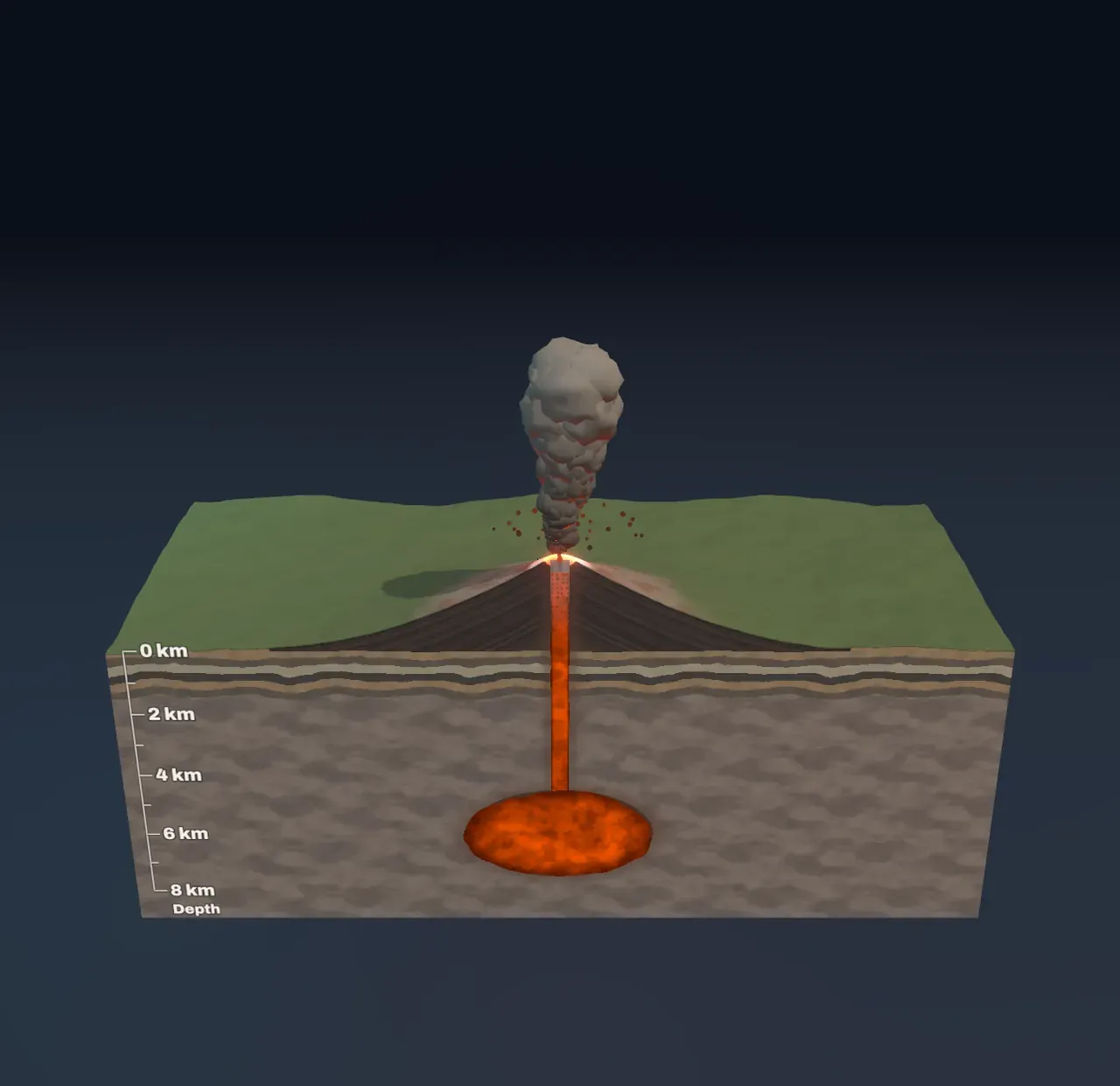
In the Scene there is a volcano cut in two, from the surface to a depth of several kilometres. Erupt is at the start: the magma rests in its chamber, and its gas is still dissolved, like carbon dioxide in a sealed bottle of fizzy drink.
Step 2 of 6
Bubbles
The main gas in magma is water vapour. At high pressure it is dissolved in the magma, and as the magma rises and the pressure falls, it can hold less. The pressure in a liquid grows with depth: . Gas in the magma is locked.
Step 3 of 6
Runny or sticky
Magma is mostly silica, silicon dioxide, from about half to three quarters of its mass. The more silica, the more viscous it is: it resists flowing, as honey does compared with water. The chart beside the Scene maps the kind of eruption by silica and gas.
Step 4 of 6
An explosion
Sticky magma with little gas builds a dome. But what happens when it holds plenty of gas too? Silica in the magma is locked.
Step 5 of 6
Gas in basalt
Does the gas alone decide whether a volcano explodes? The magma is now basalt, and Gas in the magma is low.
Step 6 of 6
Shields and cones
Every eruption leaves a layer: a lava flow or a bed of ash. After thousands of eruptions the layers build a mountain, and its shape tells which magma built it. Try moving Silica in the magma and watch the mountain change shape.
Loading the interactive version…
Loading the interactive version…
Each step sets up the Scene for you, and a control marked “fixed” stays put for that step.
Practice · Choose
A chamber of magma sits 6 km down. Where did it come from, and why does it rise?
Practice · Choose
A chamber of magma sits 6 km down. Where did it come from, and why does it rise?
Practice · Calculate
Gas in the magma is locked at dissolved water. A magma can hold per cent of water dissolved, with the pressure in megapascals. The magma’s density is 2400 kg/m³, so its pressure rises by about 23.5 MPa every kilometre of depth. At what depth, as the magma rises, do bubbles start to form in it? (The air’s pressure, 0.1 MPa, can be neglected.)
Practice · Predict, then look
The magma is now basalt, with silica and little gas, and the lava runs far down the slopes. Predict: what will happen if Silica in the magma rises to , rhyolite?
Practice · Predict, then look
The magma is now basalt, with silica and little gas, and the lava runs far down the slopes. Predict: what will happen if Silica in the magma rises to , rhyolite?
Practice · Reach the target
Silica in the magma is locked at , andesite, and the lava piles up into a dome. Change Gas in the magma until the eruption is explosive, and press Check.
Practice · Reach the target
Silica in the magma is locked at , andesite, and the lava piles up into a dome. Change Gas in the magma until the eruption is explosive, and press Check.
Practice · Predict, then look
Basalt with gas pours out lava quietly. Predict: what will happen if Gas in the magma rises to , more than in the andesite that exploded before?
Practice · Predict, then look
Basalt with gas pours out lava quietly. Predict: what will happen if Gas in the magma rises to , more than in the andesite that exploded before?
Practice · Choose
Mauna Loa in Hawaii is broad and flat like a shield, and Fuji in Japan is steep and conical. What explains it?
Practice · Choose
Mauna Loa in Hawaii is broad and flat like a shield, and Fuji in Japan is steep and conical. What explains it?
Lesson complete. Every practice question here is done.