A fault lets go
An earthquake starts on a fault, a crack between two blocks of rock that are being pushed or pulled past each other, often where two tectonic plates meet (see Plate tectonics). Friction holds the blocks locked while the strain builds, for decades or centuries. When the rock finally gives, the fault slips by centimetres or metres in a few seconds, and the stored energy leaves as seismic waves, vibrations that run through the rock in every direction.
The point underground where the slip starts is the focus, and the point on the surface right above it is the epicentre. The Scene’s quake is 10 km down, off the coast of northeast Japan. Its waves cross the whole planet: a big quake anywhere is recorded by seismometers all over the world within about twenty minutes.
Two kinds of wave through the rock
Two kinds of wave travel through the body of the Earth. P waves (primary) push and pull: the rock is squeezed and stretched along the direction the wave moves, like a pulse along a stretched spring or a sound wave in air (see Sound). S waves (secondary) shear: the rock is shaken from side to side, across the direction the wave moves, like a flick travelling along a rope.
P waves are faster, about 6 km/s in the crust and almost 14 km/s near the bottom of the mantle. S waves travel at a little over half that speed, so they always arrive second. The gap between them grows with distance, which is how one seismometer can tell how far away a quake was: three of them together pin down where it was.
Try it: set Seismometer to 30°, then slide Time since the quake, which runs the clock from the quake to 28 minutes after it, from Quake strikes towards Waves cross the Earth. The seismogram beside the Scene shows P arriving first, then the bigger S. Move the seismometer further away and watch the gap between them grow.
Paths that bend
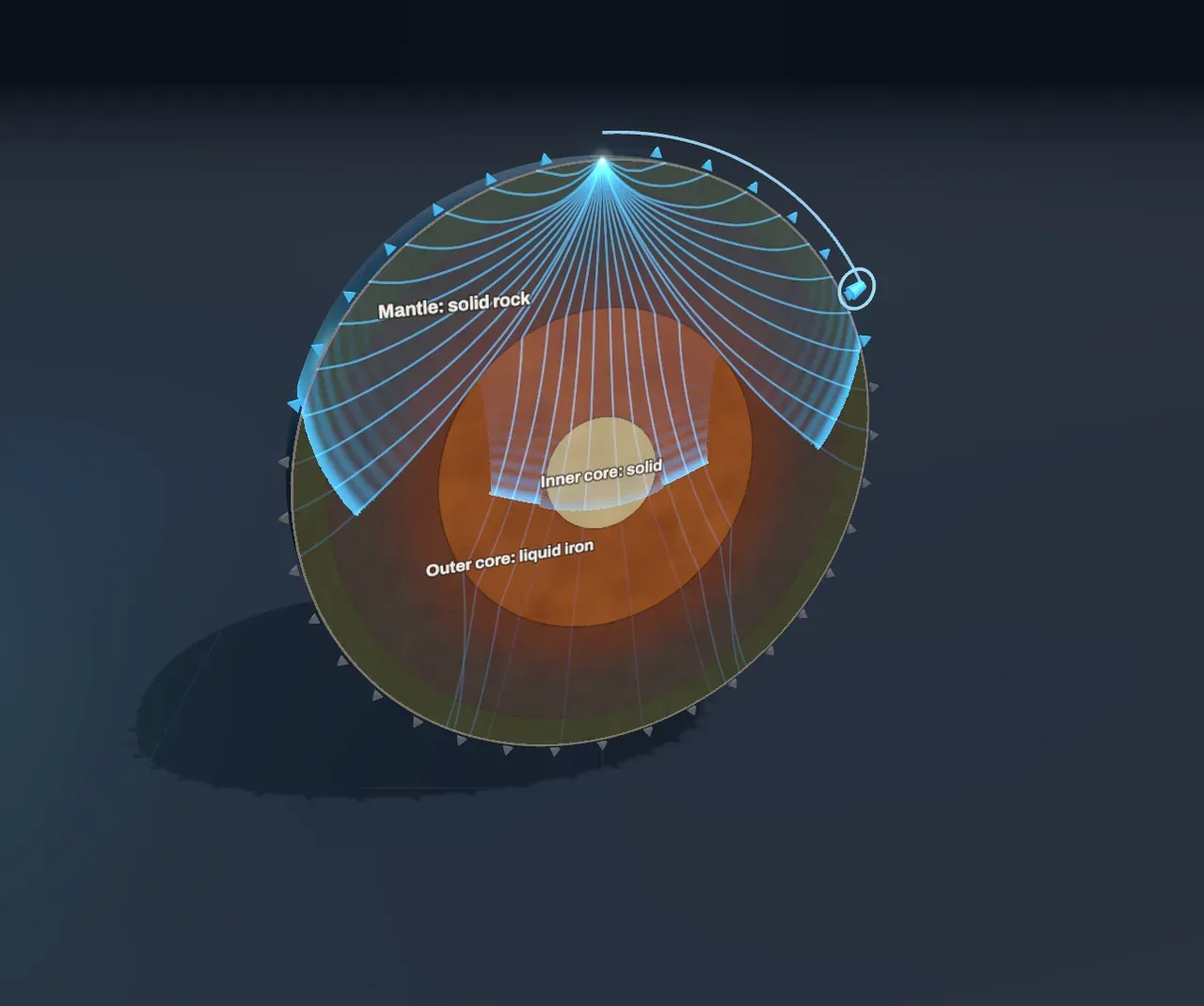
Rock deep in the Earth is squeezed so hard that waves run faster through it. A wave front heading down at a slant reaches faster rock on its lower side first, so it swings round, the way light bends passing from air into glass (see Refraction). Seismic rays therefore curve back up towards the surface instead of running in straight lines. A seismometer 30° round the Earth from the quake is reached by a ray that dipped about 650 km down; one at 90° by a ray that went down about 2,700 km, close to the bottom of the mantle.
The speed also jumps at sharp boundaries between layers, and each jump bends the rays again. The biggest boundary of all is 2,890 km down, where the solid rock of the mantle meets the outer core.
Shadows on the far side
S waves cannot cross the outer core. A shear wave needs a material that springs back when it is bent sideways, and a liquid does not: it simply flows. Every S wave that reaches the core stops there. Beyond about 103° from a quake, the rays that would have reached the surface would have had to cross the core, so no S waves arrive at all: the S-wave shadow zone covers the whole far side of the planet.
P waves do cross the core, but the liquid iron slows them from almost 14 km/s to about 8. Entering it, they bend steeply inward, like light into a lens, and come out on the far side bunched together, well beyond 140°. Between the last waves that skim past the core and the first that come through it lies a ring where almost no P waves arrive: the P-wave shadow zone, roughly from 104° to 140°.
Try it: choose P waves, slide Time since the quake all the way to Waves cross the Earth, and look for the dark band of seismometers on the lower half of the Earth. Then choose S waves and see the shadow spread over the whole far side.
Reading the shadows
These shadows are how the inside of the Earth was found. In 1906 Richard Oldham noticed that P waves arrived late, or not at all, at distant stations, and argued for a core. In 1914 Beno Gutenberg put its edge at about 2,900 km down, close to today’s value. That S waves never cross it, together with the Earth’s response to the Moon’s tides, convinced Harold Jeffreys in 1926 that the core is liquid.
In 1936 Inge Lehmann, a Danish seismologist, noticed faint P waves arriving inside the P shadow zone, where none should be. She proposed a smaller core inside the core, in which waves travel faster again, bending them out into the shadow. The inner core, 1,220 km in radius, is solid iron and nickel: the pressure at the centre is so great that the iron freezes despite being as hot as the surface of the Sun.
Try it: with P waves chosen, set Seismometer to 110°, in the shadow, and slide Time since the quake to the end: nothing arrives. Then raise the seismometer to 125°: a small, late wiggle appears, labelled faint P. Those are Lehmann’s waves.
The liquid outer core matters far beyond seismology: its churning iron makes the Earth’s magnetic field (see Earth’s magnetic field).
What this model leaves out
The Scene draws only the first wave of each kind to reach each point. A real seismogram is busier. Waves reflect off the surface and the core and arrive again later. An S wave that hits the core can turn into a P wave, cross the liquid, and turn back into an S wave on the far side, so S-type waves do reach parts of the shadow zone by that roundabout route. Waves also creep a little way round the edge of the core, blurring the edges of both shadows, which is why the textbook numbers, 104° to 140°, differ by a few degrees from where the traced rays end.
Most of the shaking that brings down buildings comes from surface waves, which run along the ground more slowly than S waves and are left out here. The quake is a single point, while a great earthquake can rupture a fault hundreds of kilometres long over a minute or more. The Earth in the model is perfectly layered, with speeds from a standard reference model; the real interior has hotter and colder regions that speed waves up or slow them down by a few per cent, which seismologists map to see the mantle moving.