An earthquake sends out two kinds of wave, P and S, at different speeds. The gap between their arrivals gives the distance to the source, and three stations locate it on the map.
Step 1 of 6 · Two kinds of wave
Step 1 of 6
Two kinds of wave
An earthquake is rock breaking suddenly along a fault, and the energy released goes out in every direction as waves. In the Unit on waves we saw longitudinal waves, in which the material moves along the direction of travel, and transverse waves, in which it moves at right angles to it. Here too there are two kinds: P waves, compression waves, and S waves, shear waves.
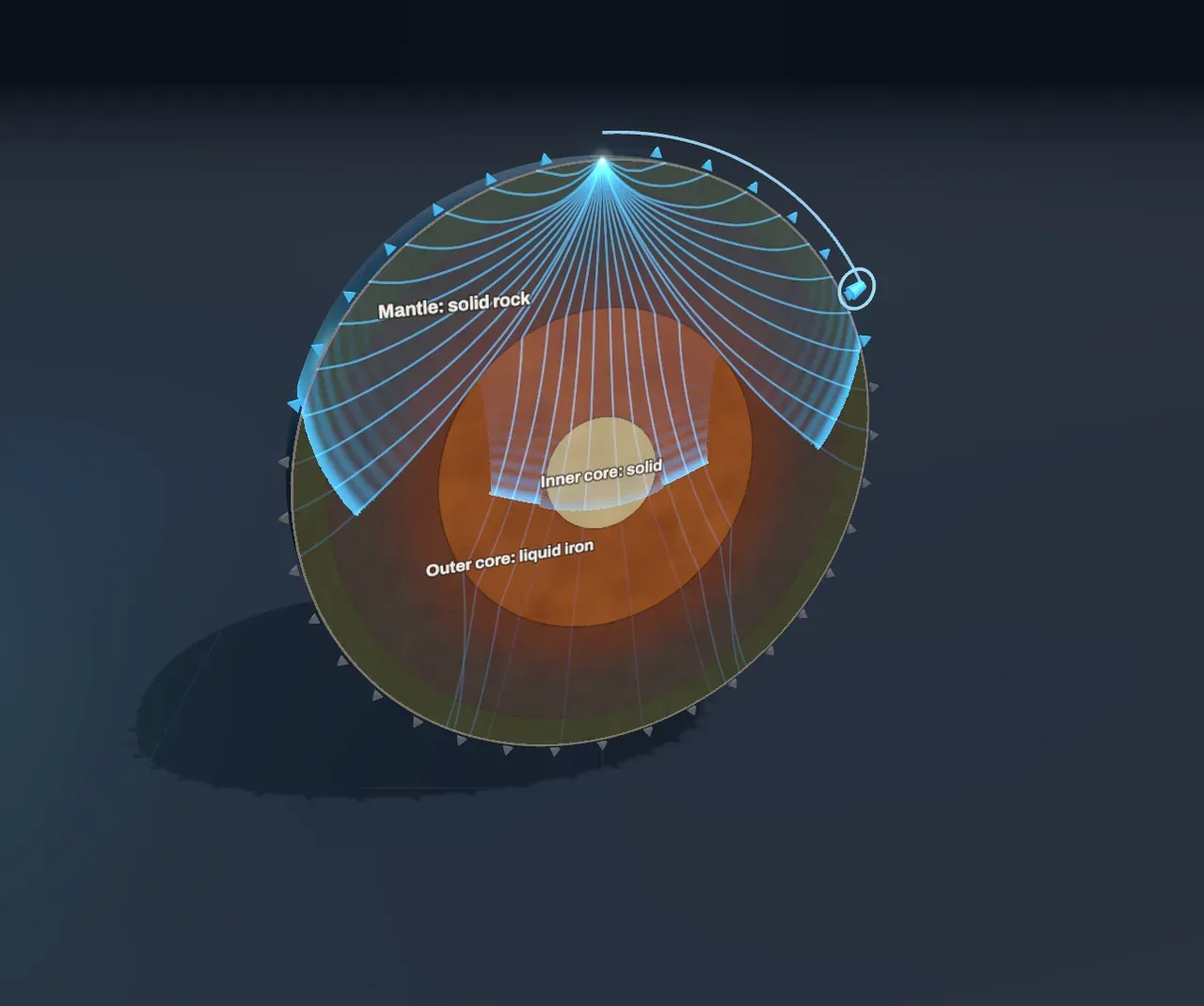
In the Scene the Earth is cut in half through the quake, and the waves cross its inside. Time since the quake is a timeline, from the moment the quake strikes until the waves have crossed the Earth. Seismometers stand round the rim, every , and light up when the wave reaches them.
Step 2 of 6
Arrival times
The picked seismometer is drawn with an arc from the quake, and its seismogram, the record of its shaking over time, is beside the Scene. Time since the quake is at the end, after minutes, and Wave type changes only what is drawn inside the Earth: the seismogram shows both waves. The Seismometer is locked.
Step 3 of 6
The gap grows
Both waves leave the source at the same moment. Predict what will happen to the gap between them at a station farther away.
Step 4 of 6
How far
At a distance , the P wave arrives after and the S wave after , so the gap
is in proportion to the distance. For a nearby quake, when the waves travel in the crust, the speeds are almost constant, and the formula gives the distance directly.
Step 5 of 6
Reading distance from the gap
For a distant quake the waves dive deep, where the rock is faster, so instead of a formula a graph of arrival times is used. The Scene works it out from the structure of the Earth.
Step 6 of 6
Three stations
From the gap each station knows how far away the source is, but not in which direction.
Loading the interactive version…
Loading the interactive version…
Each step sets up the Scene for you, and a control marked “fixed” stays put for that step.
Practice · Choose
An earthquake sends out P waves and S waves in every direction. Which wave will reach a distant seismograph first?
Practice · Choose
An earthquake sends out P waves and S waves in every direction. Which wave will reach a distant seismograph first?
Practice · Calculate
The Seismometer is locked from the quake, about 3300 km along the surface. The seismogram beside the Scene shows when each wave arrived. How long passed between the arrival of the P wave and the arrival of the S wave?
Practice · Calculate
The Seismometer is locked from the quake, about 3300 km along the surface. The seismogram beside the Scene shows when each wave arrived. How long passed between the arrival of the P wave and the arrival of the S wave?
Practice · Predict, then look
At from the quake the gap between the P and S waves is about five minutes. The Seismometer is moved to , twice as far. What will happen to the gap?
Practice · Predict, then look
At from the quake the gap between the P and S waves is about five minutes. The Seismometer is moved to , twice as far. What will happen to the gap?
Practice · Calculate
A seismograph in Eilat records a small quake: the S wave arrives 10 s after the P wave. In the crust, P waves travel at 6.0 km/s and S waves at 3.5 km/s. How far away is the source?
Practice · Calculate
A seismograph in Eilat records a small quake: the S wave arrives 10 s after the P wave. In the crust, P waves travel at 6.0 km/s and S waves at 3.5 km/s. How far away is the source?
Practice · Reach the target
A distant station recorded a gap of minutes between the P wave and the S wave. Move the Seismometer until the gap there is minutes, and press Check. That will tell you how many degrees the station is from the quake.
Practice · Reach the target
A distant station recorded a gap of minutes between the P wave and the S wave. Move the Seismometer until the gap there is minutes, and press Check. That will tell you how many degrees the station is from the quake.
Practice · Choose
From the gap between the P and S waves, each station knows how far away the source is. How many stations does it take, at least, to find where it is on the map?
Practice · Choose
From the gap between the P and S waves, each station knows how far away the source is. How many stations does it take, at least, to find where it is on the map?
Lesson complete. Every practice question here is done.