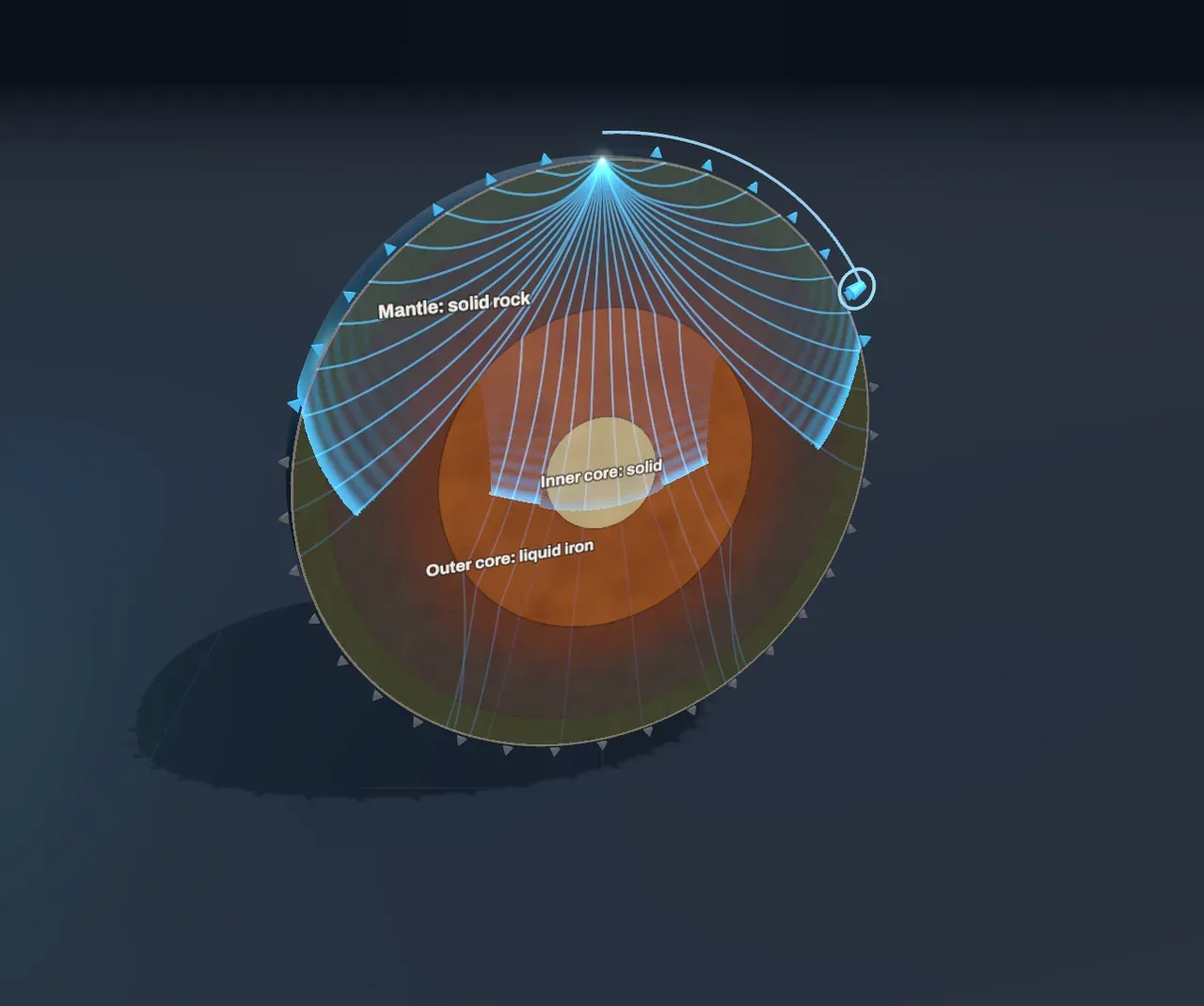
Nobody has drilled deeper than twelve kilometres, but seismic waves cross the whole Earth. The S-wave shadow reveals a liquid outer core, the P-wave shadow the refraction in it, and faint waves in the shadow a solid inner core.
Step 1 of 5 · The S-wave shadow
Step 1 of 5
The S-wave shadow
The deepest hole ever drilled, on the Kola Peninsula in Russia, reached about kilometres: less than two thousandths of the way to the centre. Everything known about the depths comes from seismic waves. Every large quake lights up the inside of the Earth, and seismometers all over the world record what got through and what did not.
Wave type is locked on S waves, and the Seismometer at from the quake. Time since the quake will run to the end.
Step 2 of 5
A liquid core
The paths in the Scene show what happens to S waves that go deep: they reach a boundary at a depth of about 2900 km, and stop there.
Step 3 of 5
The edge of the shadow
Wave type is locked. The waves do not travel in straight lines: their speed grows with depth, so they refract all the time, like light, and their paths curve back towards the surface.
Step 4 of 5
The P-wave shadow
Now Wave type is P waves. They go down into the core too, but they do not stop there.
Step 5 of 5
The inner core
Look at the seismometers inside the P-wave shadow: some of them light up all the same, faintly. The layers the waves revealed, from the outside in: a thin crust, a mantle of solid rock down to about 2900 km, an outer core of liquid iron and nickel, and a solid inner core.
Loading the interactive version…
Loading the interactive version…
Each step sets up the Scene for you, and a control marked “fixed” stays put for that step.
Practice · Predict, then look
The Seismometer is from the quake, and Wave type is S waves. Will S waves reach it?
Practice · Predict, then look
The Seismometer is from the quake, and Wave type is S waves. Will S waves reach it?
Practice · Choose
S waves do not cross the core, and P waves do. What does that tell us about the outer core?
Practice · Choose
S waves do not cross the core, and P waves do. What does that tell us about the outer core?
Practice · Calculate
Wave type is locked on S waves. Move the Seismometer and find the distance from the quake beyond which S waves no longer arrive. At what angle does the shadow begin?
Practice · Calculate
Wave type is locked on S waves. Move the Seismometer and find the distance from the quake beyond which S waves no longer arrive. At what angle does the shadow begin?
Practice · Choose
P waves travel through liquids, and still they have a shadow: between about and about from the quake no strong P waves arrive. Why?
Practice · Choose
P waves travel through liquids, and still they have a shadow: between about and about from the quake no strong P waves arrive. Why?
Practice · Choose
In 1936 Inge Lehmann, a Danish seismologist, noticed that inside the P-wave shadow faint P waves arrive all the same. What did she conclude?
Practice · Choose
In 1936 Inge Lehmann, a Danish seismologist, noticed that inside the P-wave shadow faint P waves arrive all the same. What did she conclude?
Lesson complete. Every practice question here is done.