Sorting by looks
Give someone pictures of a bat, a sparrow, a bee, a shark and a whale and ask them to sort them, and the bat, the sparrow and the bee usually end up together, because they fly, and the whale goes with the shark, because they swim. A mushroom goes with the plants: it grows out of the ground and never walks away. Bacteria and other microbes go in one pile, because they are all too small to see.
That is a perfectly good way to sort things if what you care about is how they live. A bird-watcher and a fisherman sort animals that way every day. But it says nothing about where the animals came from, and it is easily fooled. Wings evolved separately in insects, in birds and in bats, and a streamlined body with fins evolved separately in sharks and in whales, because flying through air and swimming through water set the same problems whatever animal solves them. Biologists call this convergent evolution: unrelated living things that come to look alike because they live alike.
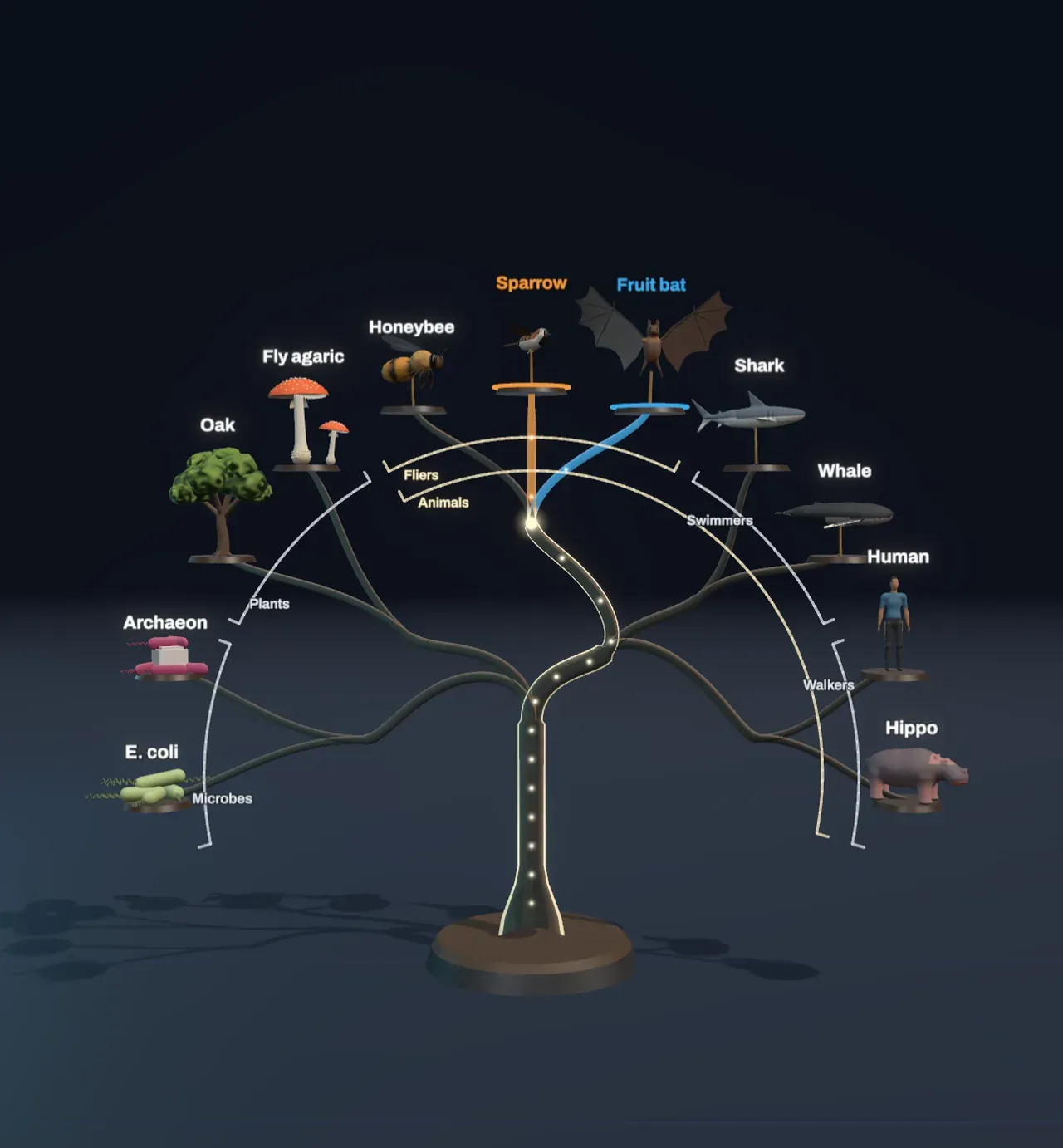
Try it: with Sort by ancestry at By looks, keep Focus on at Fruit bat and Compare with at Sparrow. Their branches run together almost to the tips, under the bracket marked Fliers. Now choose Whale and Shark: filed together as Swimmers.
A family tree for every living thing
A classification that means something beyond appearances groups living things by how they are related. Two cousins are more closely related than two second cousins because their shared grandparents lived more recently than the great-grandparents the second cousins share. The same idea works across all of life. Every two living things share an ancestor somewhere in the past, a population of organisms from which both descend, and the more recently that last shared ancestor lived, the closer kin they are.
Drawn out, those relationships make a tree. Each tip is a living species. Follow two tips back towards the root and their lines join at a point that stands for their last shared ancestor. Charles Darwin sketched the first such tree in a notebook in 1837, and the only figure in On the Origin of Species (1859) is a branching diagram of descent. Every living thing, from a bacterium to you, sits at a tip; none is “higher” than another, and all of them have been evolving for exactly as long. How the branches split, generation by generation, is the subject of Natural selection.
Try it: choose By ancestry under Sort by ancestry. The bat leaves the sparrow and moves next to the hippo and the whale, and the white marker where its line parts from the sparrow’s drops deep into the tree, to about 320 million years ago. Choose Human under Compare with: they part at about 90 million years.
Reading the tree
On the ancestry tree, distance out from the root is time, and the tips are today. Where two lines part tells you when their last shared ancestor lived, and you can read it off the faint rings of the clock: the white ring through the marker is the ancestor’s age. A bat and a sparrow part at the ring for 320 million years ago, at an animal that laid eggs on land and was the ancestor of every bird, reptile and mammal. A bat and a human part much later, at an early placental mammal living among the dinosaurs.
A tree also says who is not related as closely as they look. A shark and a whale share an ancestor 465 million years ago, an early fish with jaws. A whale and a human share one less than a fifth as long ago. On a family tree, a whale is a mammal that went back to the sea: it breathes air, feeds its calf on milk and still carries tiny hip bones left over from the legs of its ancestors.
The order of the tips along the tree does not matter: any branch can be spun round its point without changing what the tree says. Only the meeting points carry the information.
Try it: under Focus on pick Whale, then step Compare with through Hippo, Human, Shark and E. coli. The marker slides from the outer rings towards the trunk, and the chart shows fewer and fewer shared ranks.
What DNA changed
For most of history, kinship had to be judged by body plans: how bones are arranged, how an embryo develops, what a cell looks like under a microscope. That got a great deal right. Carl Linnaeus already placed whales and bats among the mammals in 1758, because they have hair and feed their young on milk. But some things anatomy could not settle, and when biologists learned to compare the DNA of living things, the tree changed in three places this Scene shows.
Archaea. In 1977 Carl Woese and George Fox compared a molecule that every cell carries in its ribosomes and found that some “bacteria”, many of them living in hot springs, salt pans and the guts of animals, were as different from ordinary bacteria as either was from us. They called them archaea. Under a microscope they look like bacteria: small, with no nucleus. Their genes tell another story, and many biologists now think the first cells with a nucleus arose from within the archaea.
Fungi. Mushrooms were filed with plants for two thousand years. DNA shows that fungi and animals share an ancestor about 1.1 billion years ago, after the line to plants had split off. A mushroom, which makes its walls of chitin like an insect’s shell and feeds on other living things, is closer kin to you than to an oak. How fungi live is told in Fungi.
Whales and hippos. Whales were known to be mammals, but which mammals? DNA pointed to the even-toed hoofed mammals, and within them to the hippopotamus. Fossils found in Pakistan in 2001 settled it: early whales with legs had the same double-pulley ankle bone that only cows, pigs, deer and hippos have.
DNA also gives dates. Differences pile up in a lineage’s DNA at a roughly steady pace, so counting the differences between two species, and calibrating the count with fossils of known age, estimates when they last shared an ancestor. This molecular clock gave the ages on the tree. How DNA carries its message is explained in Genetics and DNA, and how fossils are dated in The fossil record.
Try it: compare Fly agaric with Oak, then with Honeybee. By looks the mushroom sits with the oak; by ancestry it parts from the bee later than from the oak. Then compare Archaeon with E. coli and with Human.
Ranks: boxes drawn on the tree
The scientific names in the chart come from a system Linnaeus set out in the 1750s. Every species has a two-part name, its genus and its own epithet, such as Homo sapiens. Species are grouped into ranks inside ranks: genus, family, order, class, phylum, kingdom and, since 1990, domain. There are three domains: Bacteria, Archaea and Eukaryota, the organisms whose cells have a nucleus.
Today each rank is meant to name a group that contains one ancestor and all its descendants, a branch of the tree cut off at one point. The brackets under the tips show some of them: mammals inside vertebrates inside animals inside eukaryotes. But the ranks are a filing system laid over the tree, not a measure of it. A whale and a hippo now share an order, Artiodactyla, while a bat and a human share only a class. A fly agaric shares just one rank, its domain, with both the oak and the bee, even though the tree shows it is nearer the bee. And names change as the tree is revised: the phylum that holds E. coli was renamed in 2021, and the kingdoms of bacteria and archaea were only named in 2024.
Try it: watch the chart as you change Compare with. Shared ranks sit on a pink band; the dashed rule marks the first rank where the two differ.
What this model leaves out
Eleven tips stand for a tree with perhaps ten million living species, most of them insects, and with millions more of bacteria and archaea, whose real diversity dwarfs that of animals. The tree shows only how these eleven are related, so the bacterial and archaeal branches look like single long limbs. Single-celled eukaryotes such as amoebae and algae, which make up most of the eukaryote branches, are left out altogether.
Real lineages do not always split cleanly. Bacteria and archaea swap genes across branches, and the cell with a nucleus took in a bacterium that became its mitochondria, so near the root the tree is more of a web. The exact branching near the root, including whether eukaryotes sit inside the archaea, is still debated.
The dates are rounded estimates, and molecular clocks give older dates than the first fossils for some splits: the split between insects and vertebrates is drawn at 600 million years, with estimates from about 550 to 700. The looks tree is a caricature of how people sort living things, not any historical scheme. The organisms are stylised models, enlarged or shrunk to one size.