The ranks from domain to species, the difference between sorting by looks and sorting by ancestry, shared ancestors on the tree of life, and why a whale is close to a hippo.
Step 1 of 5 · Ranks
Step 1 of 5
Ranks
Scientists have so far described about two million species of living things, and there are probably several times as many. To find order in them, Carl Linnaeus, in , gave every species a two-part name, its genus and species, for instance Homo sapiens, and arranged the species in groups within groups. The ranks come from him: domain, kingdom, phylum, class, order, family, genus and species.
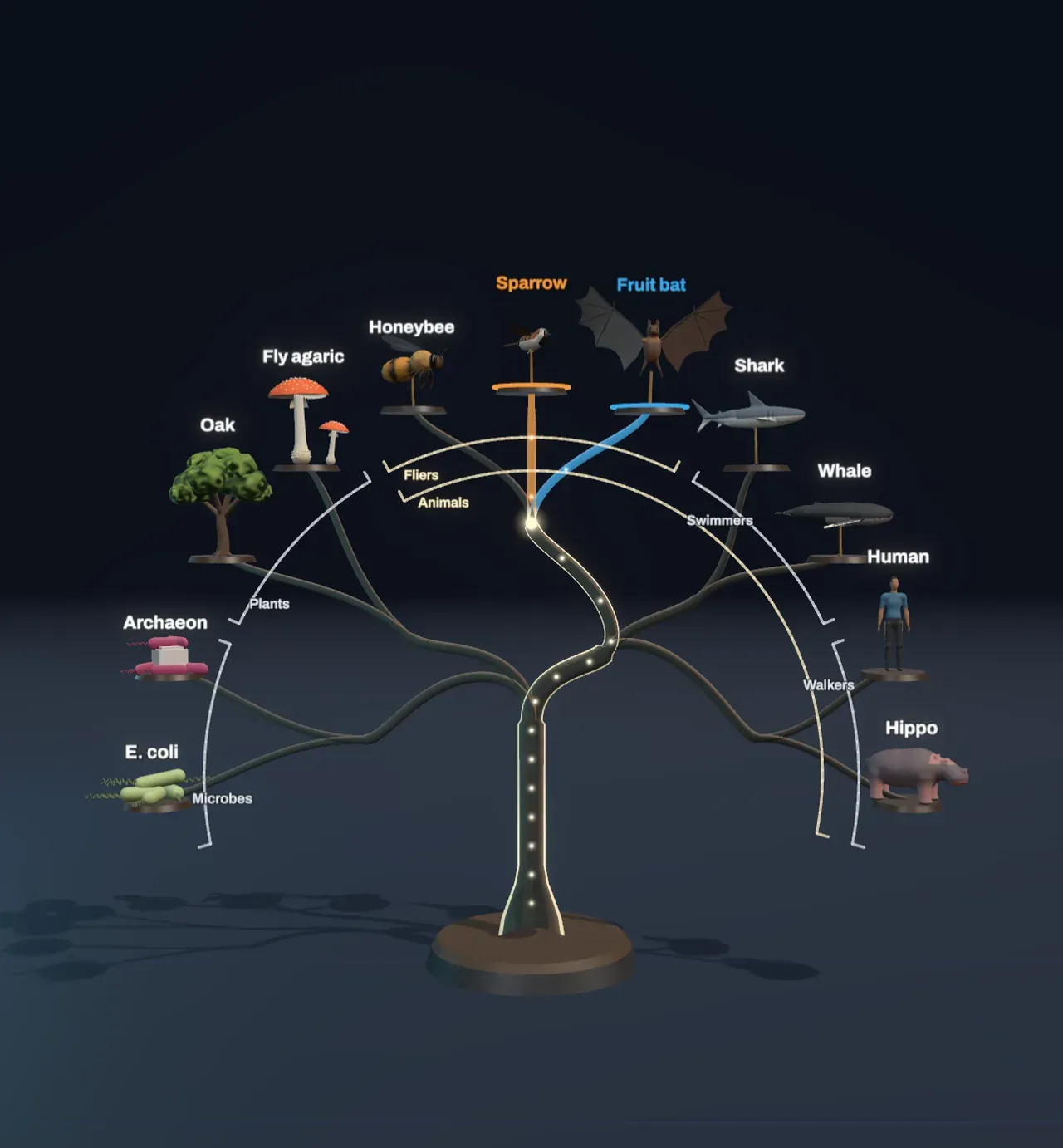
The Scene holds eleven living things. Focus on and Compare with pick two of them, and the table beside the Scene shows the ranks of both, side by side.
Step 2 of 5
Looks and ancestry
Linnaeus sorted by looks, because he had nothing else. After Darwin the sorting took on a new meaning: a group is a family in the literal sense, all the descendants of one ancestor. More closely related living things are those whose last shared ancestor lived more recently.
Sort by ancestry moves the tree from By looks to By ancestry, as DNA shows it. For now it is fixed at By looks, until you choose an answer.
Step 3 of 5
The tree of life
In the tree by ancestry, every branching is a shared ancestor, and the nearer it is to the centre, the older it is. The rings are a clock: an age at each ring, from a billion years and more on the inside to today at the tips. When you pick two living things, two lit lines rise from the root, and the marker where they part gives the age of the shared ancestor.
All the tips of the tree are alive today. None is the ancestor of another: humans did not descend from bats, nor from chimpanzees. They have shared ancestors, which no longer live.
Step 4 of 5
Wings twice
Sometimes the same answer evolves more than once, because the same problem keeps coming up: wings to fly, fins to swim, eyes to see. Those traits look alike, but they are no evidence of kinship.
Step 5 of 5
Fungi
The way to find kinship is to compare genes. The longer ago two species parted, the more differences have built up in their DNA. That is how kinships nobody suspected were found: the whale and the hippo, and fungi and animals too.
Loading the interactive version…
Loading the interactive version…
Each step sets up the Scene for you, and a control marked “fixed” stays put for that step.
Practice · Calculate
The table beside the Scene lists the ranks of a human and an Egyptian fruit bat, from domain to species. In how many ranks, from the top, do they match?
Practice · Calculate
The table beside the Scene lists the ranks of a human and an Egyptian fruit bat, from domain to species. In how many ranks, from the top, do they match?
Practice · Predict, then look
Sorted by looks, the whale sits with the shark: both swim with fins. To which is the whale more closely related by descent: the shark, or the hippo?
Practice · Predict, then look
Sorted by looks, the whale sits with the shark: both swim with fins. To which is the whale more closely related by descent: the shark, or the hippo?
Practice · Reach the target
Focus on is fixed at Human, and the tree is sorted by ancestry. Choose in Compare with the living thing whose last ancestor shared with the human lived about million years ago, then press Check.
Practice · Reach the target
Focus on is fixed at Human, and the tree is sorted by ancestry. Choose in Compare with the living thing whose last ancestor shared with the human lived about million years ago, then press Check.
Practice · Predict, then look
The bat and the sparrow both fly, and sorted by looks they are in the same group. To which is the bat more closely related: the sparrow, or the hippo?
Practice · Predict, then look
The bat and the sparrow both fly, and sorted by looks they are in the same group. To which is the bat more closely related: the sparrow, or the hippo?
Practice · Choose
The fly agaric is a fungus. To which is it more closely related: the oak, or the human?
Practice · Choose
The fly agaric is a fungus. To which is it more closely related: the oak, or the human?
Lesson complete. Every practice question here is done.