All 4.5 billion years of the Earth squeezed into one day and one year: microbes alone for most of the day, animals arriving in the evening, dinosaurs in December, and our species in the last seconds.
Step 1 of 6 · A day of history
Step 1 of 6
A day of history
The Earth formed about million years ago. A number like that is hard to feel, so the Scene squeezes it into one day: the Earth forms at midnight, and the present is the next midnight. Each hour is then about million years, and each minute about million.
To place an event on the clock, ask what share of the Earth’s history has already gone by: an event million years ago sits at of the day. Through time is at Earth forms.
Step 2 of 6
Animals come late
Through time is locked at First animals, about million years ago: soft, leaf-like creatures on the sea floor. Look how much of the dial the hand has already left behind. After them, million years ago, comes the Cambrian explosion, with shells, legs and eyes.
Step 3 of 6
Microbes alone
The first life, about million years ago, was single cells with no nucleus, like today’s bacteria. Cells with a nucleus appear about million years ago, and many-celled life, red seaweeds, only about a billion years ago, at Many cells. Move Through time between First life and Many cells, and see how much of the day goes by.
Step 4 of 6
A year of history
Now Squeeze it into is at One year: the Earth forms at midnight on 1 January, and the present is the end of 31 December. Each day of the calendar is about million years. Through time is at Plants on land, million years ago.
Step 5 of 6
Dinosaurs, mammals and us
Dial shows is at Last 70 million, so the end of the year is magnified, and Through time is at Asteroid: million years ago an asteroid wiped out the dinosaurs, except the birds, their living descendants. The first dinosaurs appeared about million years ago, and the first mammals soon after.
Step 6 of 6
The last seconds
Through time is locked at Our species, Homo sapiens, about years ago. On the day of history, each second is about years.
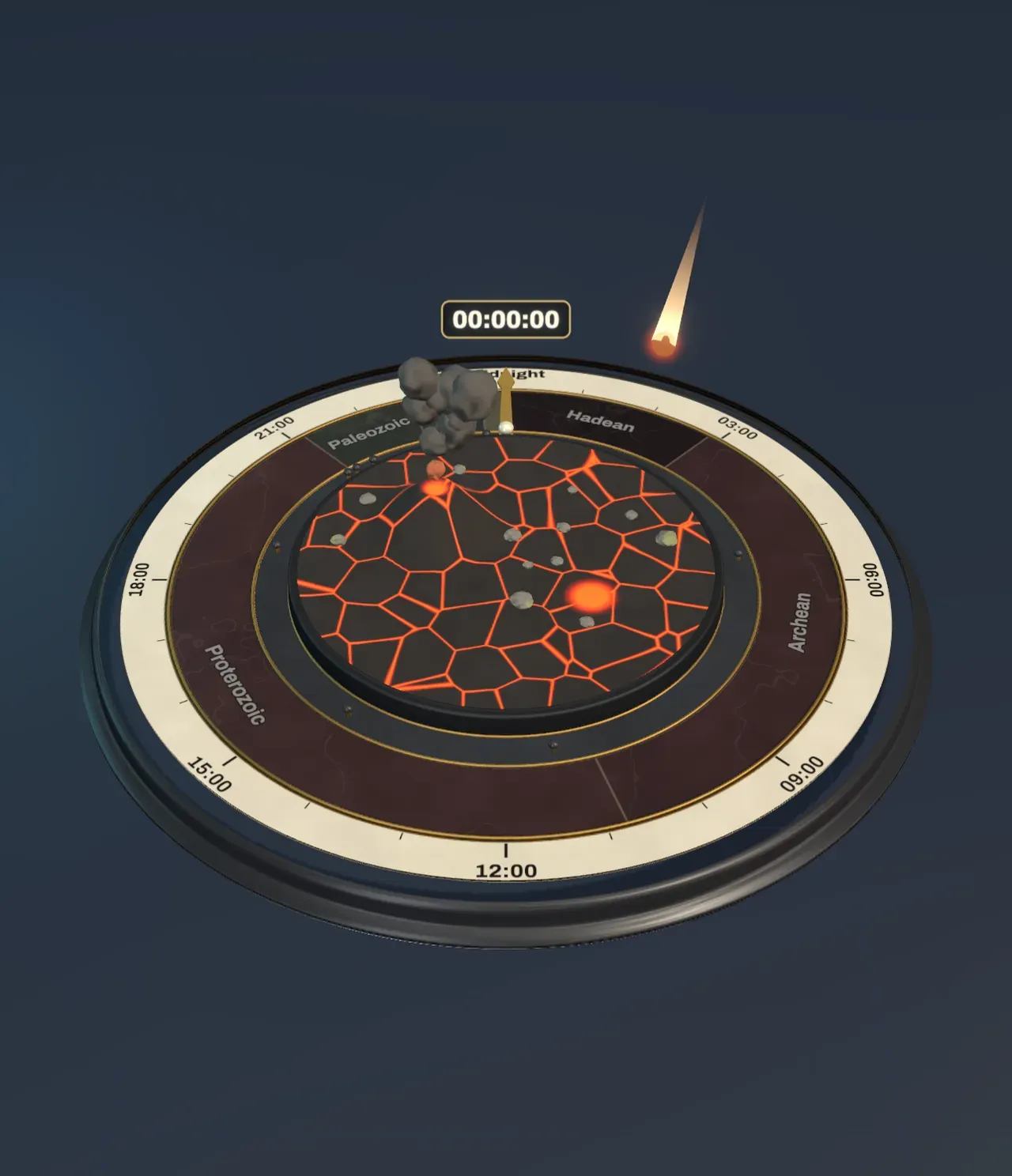
Loading the interactive version…
Loading the interactive version…
Each step sets up the Scene for you, and a control marked “fixed” stays put for that step.
Practice · Predict, then look
The first sure signs of life are about million years old. The Earth formed million years ago, at midnight. Predict how many hours after midnight life appears on the one-day clock.
Practice · Predict, then look
The first sure signs of life are about million years old. The Earth formed million years ago, at midnight. Predict how many hours after midnight life appears on the one-day clock.
Practice · Calculate
The first animals appeared about million years ago. On the one-day clock, how long before midnight do they arrive?
Practice · Calculate
The first animals appeared about million years ago. On the one-day clock, how long before midnight do they arrive?
Practice · Choose
Life appeared about million years ago, and the first many-celled life about million years ago. For what share of all the time there has been life on Earth were all living things single cells?
Practice · Choose
Life appeared about million years ago, and the first many-celled life about million years ago. For what share of all the time there has been life on Earth were all living things single cells?
Practice · Predict, then look
The Earth’s whole history is squeezed into one year. The first dinosaurs appeared about million years ago. Predict when in the year they arrive.
Practice · Predict, then look
The Earth’s whole history is squeezed into one year. The first dinosaurs appeared about million years ago. Predict when in the year they arrive.
Practice · Choose
Which of these lived at the same time as the dinosaurs other than birds, between and million years ago? Choose all of them.
Practice · Choose
Which of these lived at the same time as the dinosaurs other than birds, between and million years ago? Choose all of them.
Practice · Calculate
Our species appeared about years ago. On the one-day clock, how many seconds before midnight?
Practice · Calculate
Our species appeared about years ago. On the one-day clock, how many seconds before midnight?
Lesson complete. Every practice question here is done.