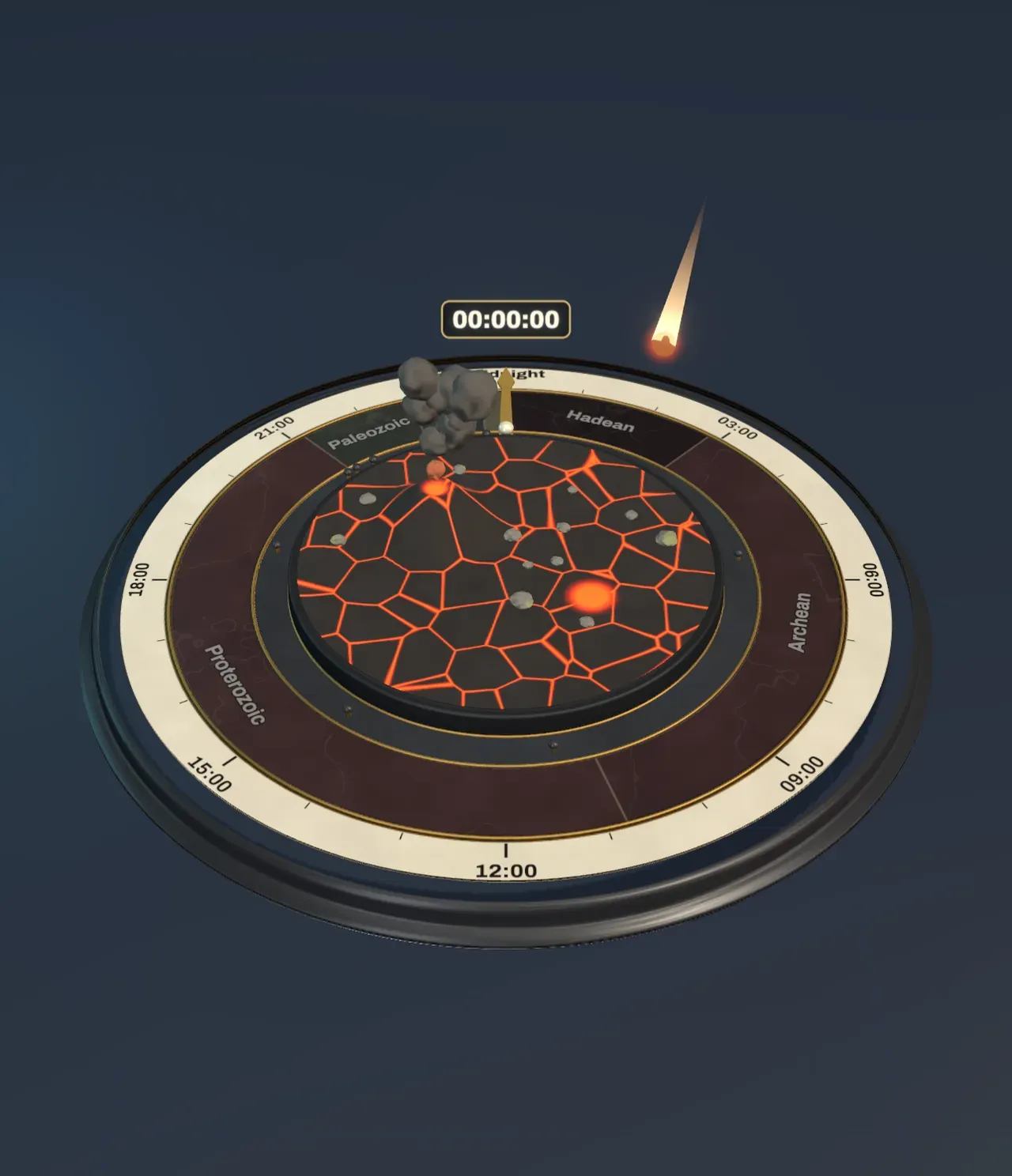
A day of 4.5 billion years
The Earth formed about 4,540 million years ago. A number that size is hard to feel, so the Scene squeezes it into something familiar: one day. The Earth forms at midnight, and the present is the next midnight. Each hour of the clock is then about 189 million years, each minute about 3 million years, and each second about 52,500 years.
On that clock, the history of life is lopsided. Life appears before breakfast, but for most of the day it is invisible: single cells, and mats and mounds built by them. The first animals turn up a little before nine in the evening. Plants reach land at half past nine, dinosaurs arrive at a quarter to eleven, and an asteroid ends their reign at 23:39. Our own species arrives about six seconds before midnight.
Try it: step Through time through all twelve moments, from Earth forms to Our species, and watch the pins light up round the dial. The first half dozen are spread around it; the last six crowd into the final eighth.
Microbes alone
For its first few hundred million years the Earth was too hot and too often struck by rocks from space for anything to live on it. By about 3,500 million years ago, at 05:30 on the clock, there was life. The oldest widely accepted signs of it are stromatolites: mounds of thin layers built up by mats of microbes, which trap grains of sediment and grow up through them towards the light. Stromatolites still grow today in a few warm, salty bays. Some chemical traces in older rocks may mean that life began even earlier, but they are disputed.
These first living things were single cells without a nucleus, like the bacteria and archaea alive today; Bacteria shows what such a cell is like inside. For the next 2,500 million years, until about a quarter to seven in the evening on the clock, every living thing on Earth was microscopic, a single cell or a colony of them. Microscopic life shows the variety such cells reach today.
Oxygen changes the air
The young Earth’s air had almost no oxygen. Some bacteria, the cyanobacteria, learned to split water using sunlight and gave off oxygen as waste. For a long time that oxygen was used up as fast as it was made, mostly by iron dissolved in the sea, which rusted and settled into red-and-grey striped rocks called banded iron formations. About 2,400 million years ago, at 11:19 on the clock, oxygen began to build up in the air: the Great Oxidation Event.
It was a disaster for the many microbes that oxygen poisons, and an opportunity for those that could use it to burn their food. Oxygen high in the air also formed the ozone layer, which later made it possible to live on land under the Sun’s ultraviolet; see The ozone layer. Even so, the air held only a small fraction of today’s oxygen for well over a billion years.
Try it: step Through time to Oxygen. Bubbles rise from green mats of cyanobacteria, and the rock at the back is banded with rust.
Cells with a nucleus, then many cells
By about 1,800 million years ago, at half past two in the afternoon, there were larger cells with their DNA wrapped in a nucleus and other compartments inside them. These are the eukaryotes, the kind of cell that every animal, plant and fungus is made of. Their mitochondria, where food is burned with oxygen, were once free-living bacteria that came to live inside a larger cell; plants’ chloroplasts were once cyanobacteria taken in the same way.
Life made of many cells, with different cells doing different jobs, came later. Red algae preserved in rock about a billion years old, at about 18:40 on the clock, are among the oldest. Living together as many cells was invented several times over, in algae, in fungi and in animals.
Animals arrive late
The first animals large enough to see appear about 575 million years ago, at two minutes to nine in the evening. These Ediacaran animals were soft: quilted fronds rooted in the sea floor, flat ribbed ovals such as Dickinsonia that lay on mats of microbes, and others hard to compare with anything alive today.
Then, from about 538 million years ago, at 21:09, comes the Cambrian explosion. Within a few tens of millions of years, the sea fills with animals that have shells, jointed legs, eyes and jaws, and nearly every major group of animals alive today makes its first appearance: trilobites, early relatives of crabs and insects, the first animals with backbones and hunters such as Anomalocaris, a predator up to half a metre long with grasping limbs. Shells and skeletons fossilise far better than soft bodies, which is why the fossil record suddenly fills up here; The fossil record shows how a fossil forms.
Try it: step Through time from Many cells to First animals and then Cambrian. On the dial, the hand has nearly seven-eighths of the circle behind it when the first fronds appear.
Onto land
For almost all of the day, the land was bare rock with, at most, a film of microbes. Small plants like liverworts and mosses spread onto damp ground by about 470 million years ago, at half past nine in the evening, and the first upright plants with stems followed. Millipedes and other small animals came after the plants; by about 385 million years ago there were forests, and by 375 million years ago, fish with sturdy fins were becoming the first four-legged animals.
Five mass extinctions
Five times since the Cambrian, a large share of all species died out within a short time: a mass extinction. The worst, about 252 million years ago, ended the Permian Period. Huge eruptions in what is now Siberia poured out lava and gases for hundreds of thousands of years, warming the climate and taking oxygen out of the sea. Most species in the sea and many on land died. It is called the Great Dying.
The best known is the most recent, 66 million years ago, at 23:39 on the clock. An asteroid about 10 km across struck what is now Mexico’s Yucatán Peninsula, filling the sky with soot and dust. It ended the dinosaurs, except for the birds, which are their living descendants, and the ammonites with them. Each extinction cleared the way for the survivors to spread into the empty places.
Dinosaurs, mammals and us
The first dinosaurs appear about 230 million years ago, at 22:47, and the first mammals soon after, small and mostly active at night. Dinosaurs dominated the land for about 165 million years, more than 50 minutes of the clock. Only when they were gone did mammals grow large and spread into every way of life.
The line that led to humans split from the one that led to chimpanzees about 6 to 7 million years ago, a little over two minutes before midnight. Our genus, Homo, appears about 2.8 million years ago, and our own species, Homo sapiens, about 300,000 years ago: 23:59:54. Farming began about 12,000 years ago, a quarter of a second before midnight, and all of written history fits in the last tenth of a second.
Try it: choose One year under Squeeze it into and step to Dinosaurs and then Our species. The dinosaurs arrive on 13 December; we arrive at 23:25 on New Year’s Eve.
Magnifying the end
Because so much happens at the end, the Scene can magnify it. Dial shows turns the dial into the last 600, 70 or 7 million years of the day. Showing the last 600 million years magnifies the end of the day about eight times, and the animals’ story spreads round the dial. Showing the last 7 million years magnifies it 650 times, and even then our species takes up only the last twenty-third of the circle.
Try it: set Dial shows to Last 600 million and step from First animals to Asteroid; then set it to Last 7 million and step to Our species. Moments older than the stretch the dial shows leave the hand waiting at its start.
How the dates are known
Rocks are dated by the radioactive elements in them, which decay at steady, measured rates; Radiometric dating and the age of the Earth shows how a tiny crystal keeps that time. Fossils are dated by the dated rock layers above and below them. The order of events is also written in living things: how far apart the DNA of two groups has drifted roughly tells how long ago they split. All of it tells one story of life changing over time, explained by Natural selection. How living things are sorted into groups, from bacteria to mammals, is the subject of Classifying life.
What this model leaves out
The twelve moments are a selection, and their dates are rounded values that scientists still argue about. The first life may be older than 3,500 million years; the first cells with a nucleus may be anywhere from about 2,100 to 1,600 million years old; many cells evolved several times; and the first animals may be older than their first fossils. The Great Oxidation Event took tens of millions of years, and every extinction lasted thousands of years or more, not one instant.
The divisions on the dial follow the international geological time scale, rounded. The dioramas are drawn at whatever size reads on the pedestal: the cells thousands of times larger than life, the trees and the dinosaur smaller than life, and none of them to the same scale as another. Each shows a typical scene of its time, not one place, and some plants and animals in it are a little later than the moment they stand for.