Four ingredients
No two moths, beetles or people are exactly alike. That variation is the first ingredient. The second is inheritance: offspring tend to resemble their parents, because they carry copies of their parents’ genes. The third is selection: some variations make an individual more likely to survive and breed than others. The fourth is time. Put the four together and the next generation has a few more of whatever helped, and the one after that a few more again. Nobody chooses. The environment does the sorting simply by who it lets live.
Charles Darwin and Alfred Russel Wallace reached this idea independently, and it was announced in 1858; Darwin’s On the Origin of Species followed a year later.
The peppered moth
The peppered moth rests by day on tree trunks, where its speckled pale wings blend with lichen-covered bark. In 1848 a black one was recorded near Manchester. As coal smoke killed the lichens and coated trees in soot, the black form spread, and by 1895 roughly 98 per cent of the moths around Manchester were black. In 1896 the naturalist J. W. Tutt suggested why: birds were picking off whichever moths stood out.
Bernard Kettlewell tested the idea in the 1950s by releasing marked moths in polluted and clean woods, and the larger, more careful experiment Michael Majerus ran near Cambridge from 2001 to 2007 confirmed that birds eat conspicuous moths more often. After clean air laws in the 1950s, the lichens returned and the black form became rare again. In 2016 geneticists traced the black colour to a single change in one gene that first appeared around 1819.
Watching it happen
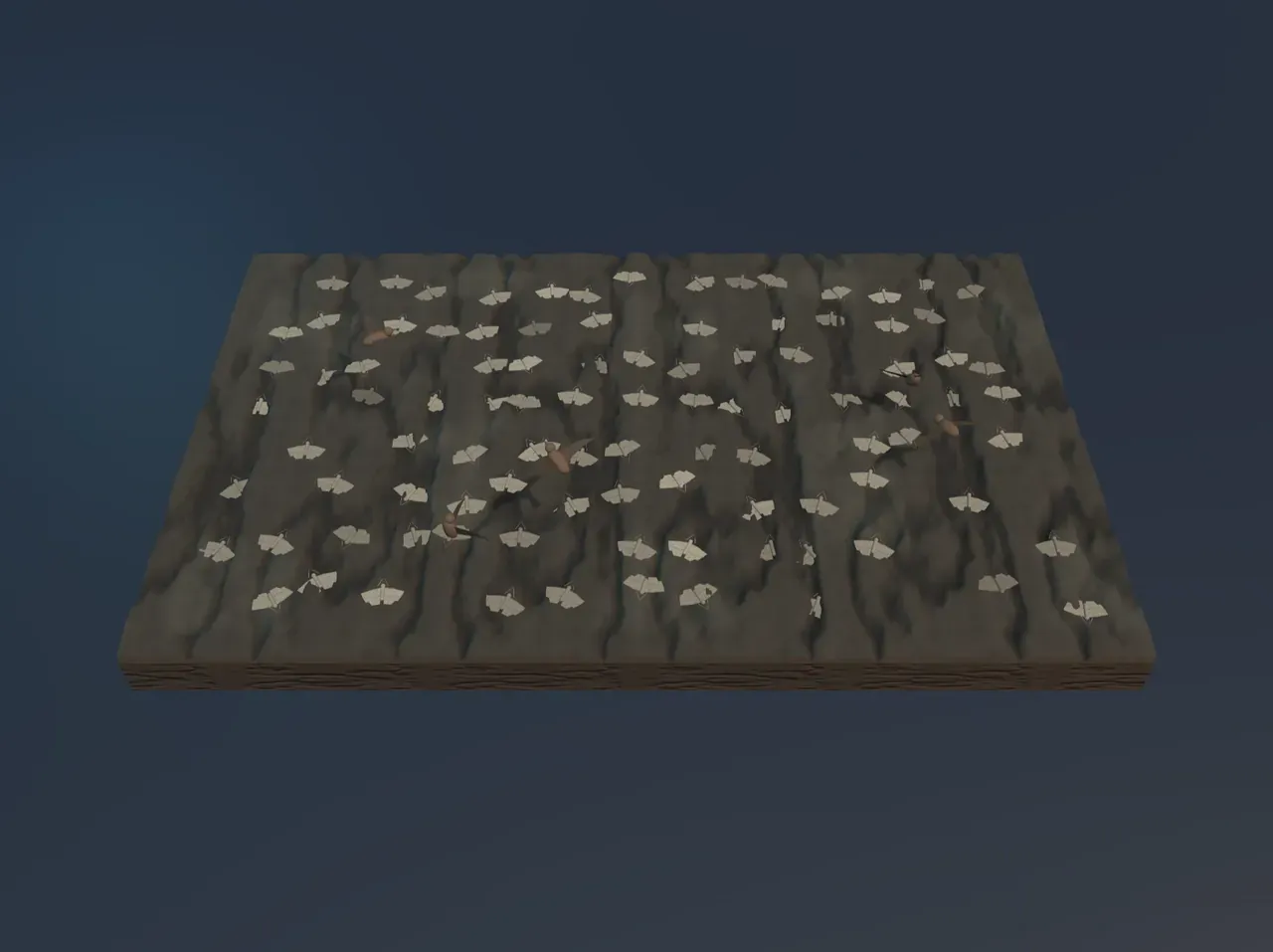
The scene runs the same process on a patch of bark. Each generation, birds take moths, more often the more they stand out. The survivors breed the next generation, with small random changes in shade.
Try it: press Sooty bark, then slide Generation from 0 up to 50. Choose Sorted by shade under Sort by shade to compare with the blue outlines of generation 0. Then slide Bird predation down to 0%.
With no predation the colours only drift. With heavy predation they change faster, as long as some moths are already close enough to the bark’s shade to survive. Selection cannot make a variation that is not there; it only sorts what each generation provides.
Faster than you think
Bacteria can divide every half hour in good conditions, so a few days hold hundreds of generations. Within a few years of penicillin coming into wide use in the 1940s, resistant Staphylococcus had become common in hospitals. The drug was the predator: it killed the susceptible bacteria and left the rare resistant ones to multiply. Taking antibiotics only when they are needed slows that selection down.
What selection is not
Selection is not effort or intention. A moth cannot decide to be darker, and a bacterium does not learn to resist a drug. New variations arise by chance, mostly through copying errors in DNA; selection only changes how common they become. “Fittest” means best suited to the current surroundings, which is why the pale moth won again once the trees were clean.
What this model leaves out
Real moths have two parents, and darkness in the peppered moth is controlled mostly by one gene with a few forms rather than a smooth scale. Real populations change in size, migrate between woods and face many dangers besides birds. The model’s kill rates are chosen to make the change visible in a few dozen generations; they are not measured values.