Moths on tree bark: variation already in the population, birds that select, adaptation over generations, and why without selection almost nothing changes.
Step 1 of 6 · Variation
Step 1 of 6
Variation
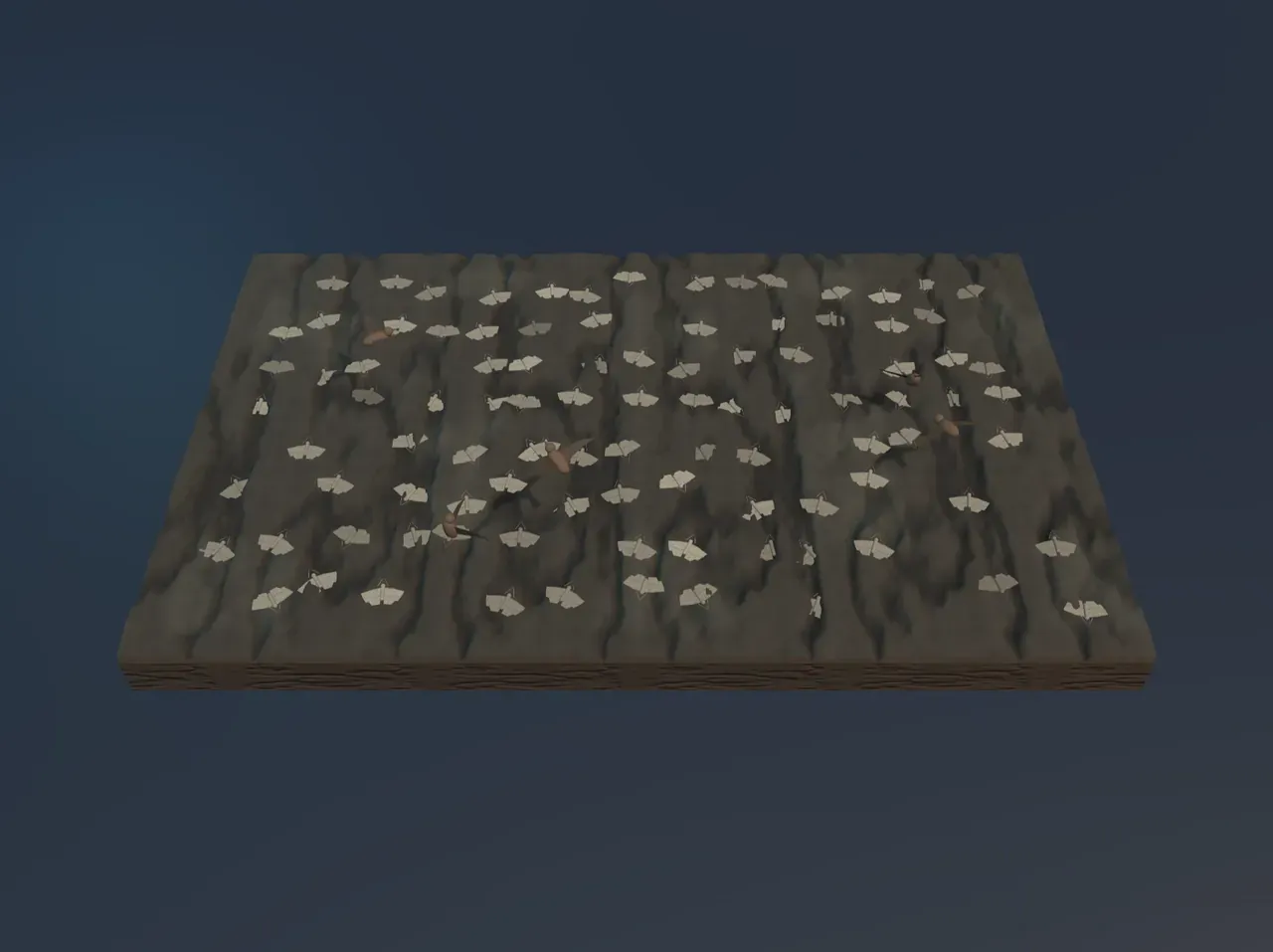
In 19th-century England most peppered moths were pale, the colour of the lichen on tree bark. When coal-burning works blackened the trees with soot, a dark form, once very rare, became the majority in industrial areas within a few decades. The Scene is a model of that story.
Sort by shade is at Sorted by shade: each column is one wing shade, from pale to dark. The moths are not all the same shade. Those differences, the variation, are inherited: a moth passes its shade to its young, plus a small random change.
Step 2 of 6
Fifty generations
According to Charles Darwin, in , three things are enough for a population to change: there is variation in a trait, the trait is inherited, and because of it some individuals survive and breed more than others. That is natural selection.
Here the bark is sooty, and the birds are hunting. Generation is fixed until you choose an answer.
Step 3 of 6
The catch
At the end of each generation the survivors breed a new generation of the same size. The birds in the Scene show, in a loop, the hunt of the current generation. Generation is fixed until you answer, and will then jump to generation .
Step 4 of 6
No birds
A population adapts to its surroundings when the traits that help survival there become common. But what exactly drives the change, the bark or the birds? Test it as in any experiment: change one thing only. Bird predation is fixed at : no birds at all.
Step 5 of 6
Matching the bark
Change Bark darkness, and see where the population settles.
Step 6 of 6
Populations, not individuals
Sort by shade is at Sorted by shade again, and the blue outlines show generation . All the columns have moved, but no moth changed colour: every moth in generation was born with its shade.
Loading the interactive version…
Loading the interactive version…
Each step sets up the Scene for you, and a control marked “fixed” stays put for that step.
Practice · Choose
The bark has been blackened by soot, and a pale moth stands out on it. Where will the dark moths that multiply over the next generations come from?
Practice · Choose
The bark has been blackened by soot, and a pale moth stands out on it. Where will the dark moths that multiply over the next generations come from?
Practice · Predict, then look
The bark is sooty, and the birds are hunting. What will happen to the moths’ mean darkness after generations?
Practice · Predict, then look
The bark is sooty, and the birds are hunting. What will happen to the moths’ mean darkness after generations?
Practice · Predict, then look
In the first generation the birds eat of the moths. How many will they eat in generation , when the population is already dark?
Practice · Predict, then look
In the first generation the birds eat of the moths. How many will they eat in generation , when the population is already dark?
Practice · Predict, then look
Now there are no birds at all. The bark is still sooty. What will happen to the mean darkness after generations?
Practice · Predict, then look
Now there are no birds at all. The bark is still sooty. What will happen to the mean darkness after generations?
Practice · Reach the target
Generation is fixed at , and Bird predation at . Change Bark darkness until, after the generations, the moths’ mean darkness is about half, , then press Check.
Practice · Reach the target
Generation is fixed at , and Bird predation at . Change Bark darkness until, after the generations, the moths’ mean darkness is about half, , then press Check.
Practice · Choose
One pale moth lives its whole life on sooty bark. What happens to it?
Practice · Choose
One pale moth lives its whole life on sooty bark. What happens to it?
Lesson complete. Every practice question here is done.