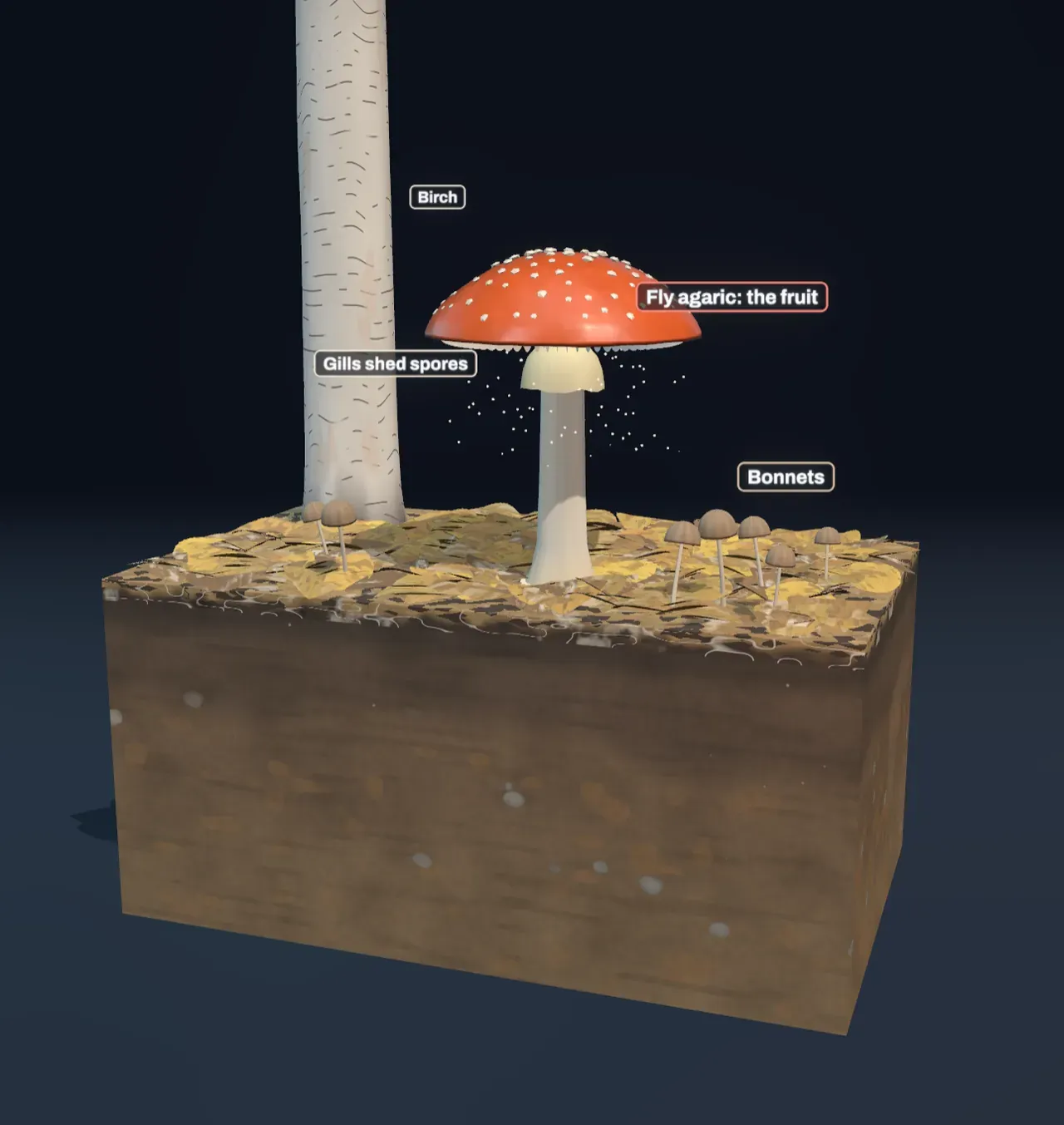
What comes up above the ground is only the fruit: the web of threads below digests leaves outside its body, works faster in warmth and slower when the soil is too dry or too wet, and trades sugar for water with the tree’s roots.
Step 1 of 6 · Fruit of a hidden body
Step 2 of 6
Eating from outside
The white threads are hyphae, each a few thousandths of a millimetre across, and together they make a mycelium. A fungus has no chlorophyll, and its cell walls are made of chitin, the stuff of insects’ shells. In the tree of life fungi are closer to animals than to plants. But they cannot swallow anything.
Step 3 of 6
Warmer and faster
The bonnets are decomposers: their threads grow into fallen leaves and digest them. The lower chart follows a leaf that falls today and loses mass over the years, and its half-life is the time it takes to lose half. Like most chemistry, the fungi’s work speeds up about times for every 10 °C, up to about 30 °C. Now the soil is moist, at 10 °C, and a leaf’s half-life is about a year and a half.
Step 4 of 6
The best soil
Fungi need water: their enzymes and the food they absorb move in thin films of water round the soil grains. In dry soil those films break, and the threads stop working. Soil moisture is the share of the spaces between the grains filled with water, and it is at 25%, dry, for now. The upper chart shows how fast the fungi work at each moisture.
Step 5 of 6
Too wet
If water is good for fungi, is more water better still? The threads, like us, breathe oxygen, and the soil’s air sits in the same spaces the water fills.
The litter on the floor is a matter of balance: leaves fall at a steady rate, and each year the fungi break down a share of what lies there. Litter builds up until the two rates match, , so when rotting slows, litter piles up. That is how peat bogs form.
Step 6 of 6
Trading with the tree
The fly agaric is not a decomposer. It lives in a mycorrhiza, a “fungus-root”: its threads sheathe the tips of the birch’s fine roots and run out from there into the soil, far beyond anywhere a root reaches. Watch the dots moving along the threads: amber one way and sky blue the other.
Loading the interactive version…
Loading the interactive version…
Each step sets up the Scene for you, and a control marked “fixed” stays put for that step.
Practice · Choose
A fungus has no mouth and no chlorophyll. How do the bonnets’ threads feed on the fallen leaves?
Practice · Choose
A fungus has no mouth and no chlorophyll. How do the bonnets’ threads feed on the fallen leaves?
Practice · Predict, then look
In moist soil at 10 °C a fallen leaf’s half-life is about years. The fungi work times faster for every 10 °C. Predict the half-life, in years, when Soil temperature rises to 20 °C.
Practice · Predict, then look
In moist soil at 10 °C a fallen leaf’s half-life is about years. The fungi work times faster for every 10 °C. Predict the half-life, in years, when Soil temperature rises to 20 °C.
Practice · Reach the target
Soil temperature is locked at Autumn. Change Soil moisture until the leaves rot as fast as they can, and press Check.
Practice · Reach the target
Soil temperature is locked at Autumn. Change Soil moisture until the leaves rot as fast as they can, and press Check.
Practice · Predict, then look
The soil is moist, 60%. Predict what happens to the fallen leaves when Soil moisture rises to 95%, waterlogged.
Practice · Predict, then look
The soil is moist, 60%. Predict what happens to the fallen leaves when Soil moisture rises to 95%, waterlogged.
Practice · Choose
Below the ground, the fly agaric’s threads sheathe the birch’s root tips. What passes between them?
Practice · Choose
Below the ground, the fly agaric’s threads sheathe the birch’s root tips. What passes between them?
Lesson complete. Every practice question here is done.