Carbon passes from the air to the grass, the rabbit, the dead leaves and the soil, and back to the air. What plants build themselves from, how much they breathe back, how the decomposers close the cycle, and what happens when they are too slow or too fast.
Step 1 of 6 · Where the carbon comes from
Step 1 of 6
Where the carbon comes from
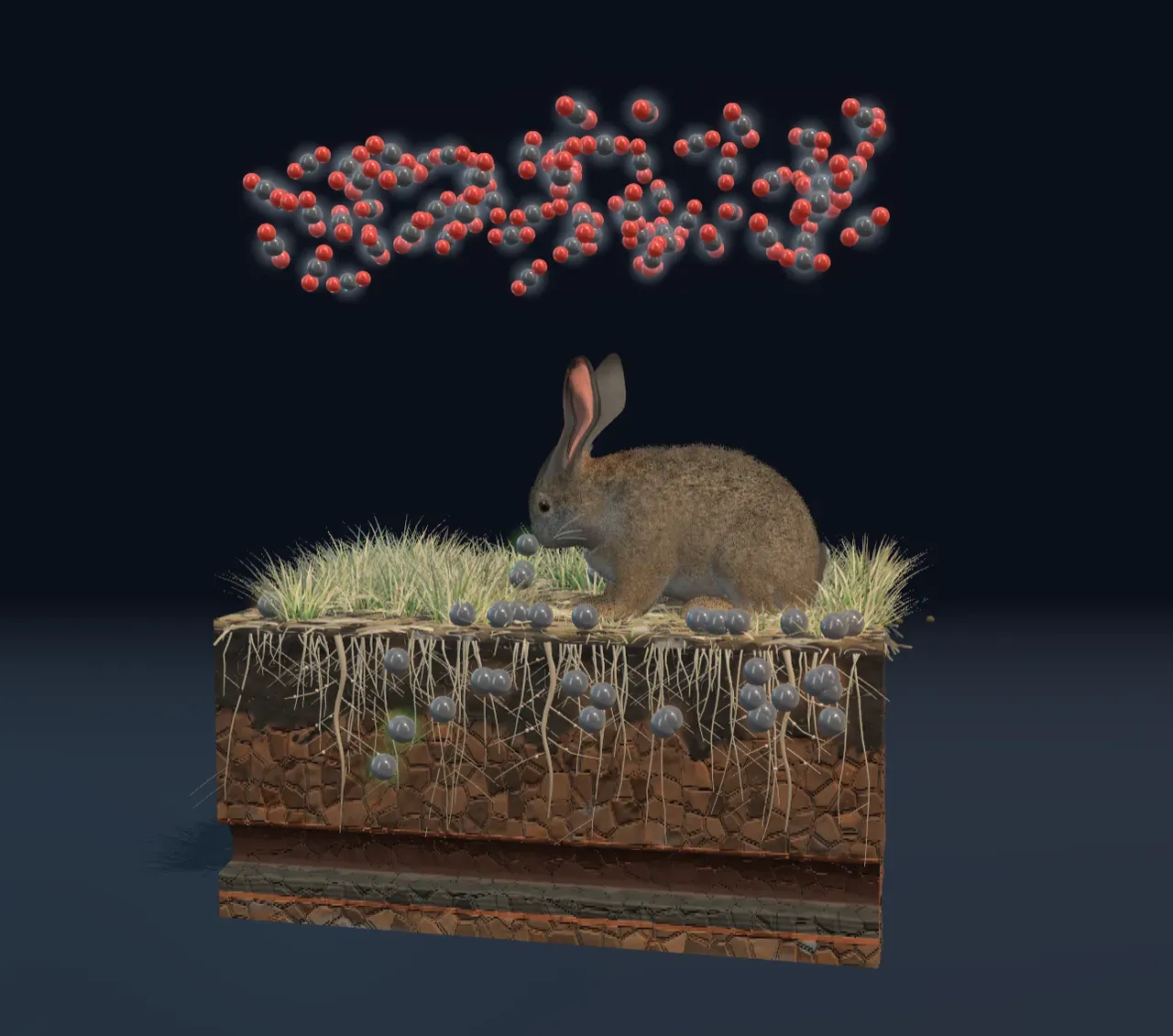
Energy passes through an ecosystem once and leaves as heat, but matter stays and is used again and again. The Scene is one square metre of meadow, grass and white clover with a rabbit, from 1 March to the next 1 March, with its soil cut away in front of you. Through the year is the date, and Follow is fixed on Carbon: each grey atom stands for 25 g of carbon.
Through the year is locked at 1 March for now. Over the next half year the plants will grow from about to about grams of carbon a square metre. Answer, and the Scene will run the time on to the end of August.
Step 2 of 6
Breathing it back
Through the year is at the start of summer. Watch the atoms: some come down from the air into the grass, and some rise straight back out of it. Plants do not only take in carbon dioxide; like every living thing, they also burn sugar in cellular respiration and breathe out carbon dioxide.
Step 3 of 6
No decomposers
A dead leaf is food. Fungi, bacteria and earthworms, the decomposers, eat it and breathe most of its carbon back into the air. What is left becomes humus, the dark matter that colours the top of the soil, and they eat that too, more slowly. Here Decomposers is fixed at 0%, and Through the year is locked at 1 March. Predict, and the Scene will run a whole year.
Step 4 of 6
Closing the cycle
In a steady year the meadow’s books balance: it takes about a kilogram of carbon out of the air over each square metre and gives the same amount back, through the grass, the rabbit and the decomposers. Through the year is at A year on, and the chart writes how far above or below its start the meadow ends the year.
Step 5 of 6
A peat bog
Where rot is slower than growth, dead matter builds up year after year. That is how peat forms in cold bogs, thick forest floors in cold regions, and on a vast scale, over millions of years, coal too. Here Decomposers is fixed at 50%, half pace.
Step 6 of 6
Faster rot
Decomposers work faster in the warmth: in the model the rate of rot doubles for every 10 °C. Decomposers is fixed at 100%, the normal pace, for now, and will change once you predict.
Loading the interactive version…
Loading the interactive version…
Each step sets up the Scene for you, and a control marked “fixed” stays put for that step.
Practice · Predict, then look
From 1 March to the end of August the meadow’s plants grow from about to about grams of carbon a square metre. Where does the extra carbon come from?
Practice · Predict, then look
From 1 March to the end of August the meadow’s plants grow from about to about grams of carbon a square metre. Where does the extra carbon come from?
Practice · Calculate
In a year the meadow’s plants take up about grams of carbon over each square metre by photosynthesis. The note in the Scene says that in summer they breathe half the carbon they take in straight back out. How many grams of carbon are built into new leaves and roots in a year?
Practice · Calculate
In a year the meadow’s plants take up about grams of carbon over each square metre by photosynthesis. The note in the Scene says that in summer they breathe half the carbon they take in straight back out. How many grams of carbon are built into new leaves and roots in a year?
Practice · Predict, then look
Decomposers is at 0%: nothing rots. The grass goes on growing and dying back. Where does the carbon pile up by the end of the year?
Practice · Predict, then look
Decomposers is at 0%: nothing rots. The grass goes on growing and dying back. Where does the carbon pile up by the end of the year?
Practice · Reach the target
Through the year is at A year on. With Decomposers at half pace, the meadow ends the year with more carbon than it started with. Change Decomposers until the cycle closes: every store ends the year with what it held at the start. Press Check.
Practice · Reach the target
Through the year is at A year on. With Decomposers at half pace, the meadow ends the year with more carbon than it started with. Change Decomposers until the cycle closes: every store ends the year with what it held at the start. Press Check.
Practice · Calculate
Decomposers are at half pace, as in cold, wet soil. The chart shows how much more carbon the meadow ends the year with than it started with. If that went on for a hundred years, how many kilograms of carbon would build up on each square metre?
Practice · Calculate
Decomposers are at half pace, as in cold, wet soil. The chart shows how much more carbon the meadow ends the year with than it started with. If that went on for a hundred years, how many kilograms of carbon would build up on each square metre?
Practice · Predict, then look
Warmer soil speeds up the decomposers. Decomposers will rise to 200%, double pace. What happens to the meadow over a year?
Practice · Predict, then look
Warmer soil speeds up the decomposers. Decomposers will rise to 200%, double pace. What happens to the meadow over a year?
Lesson complete. Every practice question here is done.