How an enzyme speeds up a reaction without changing, why it works on one substrate only, and what heat, cold and pH do to it.
Step 1 of 7 · Shape and site
Step 1 of 7
Shape and site
Nearly every chemical reaction in a cell, from splitting sugar to copying DNA, is sped up by an enzyme: a protein that acts as a catalyst. Without enzymes, most of those reactions would take years at body temperature.
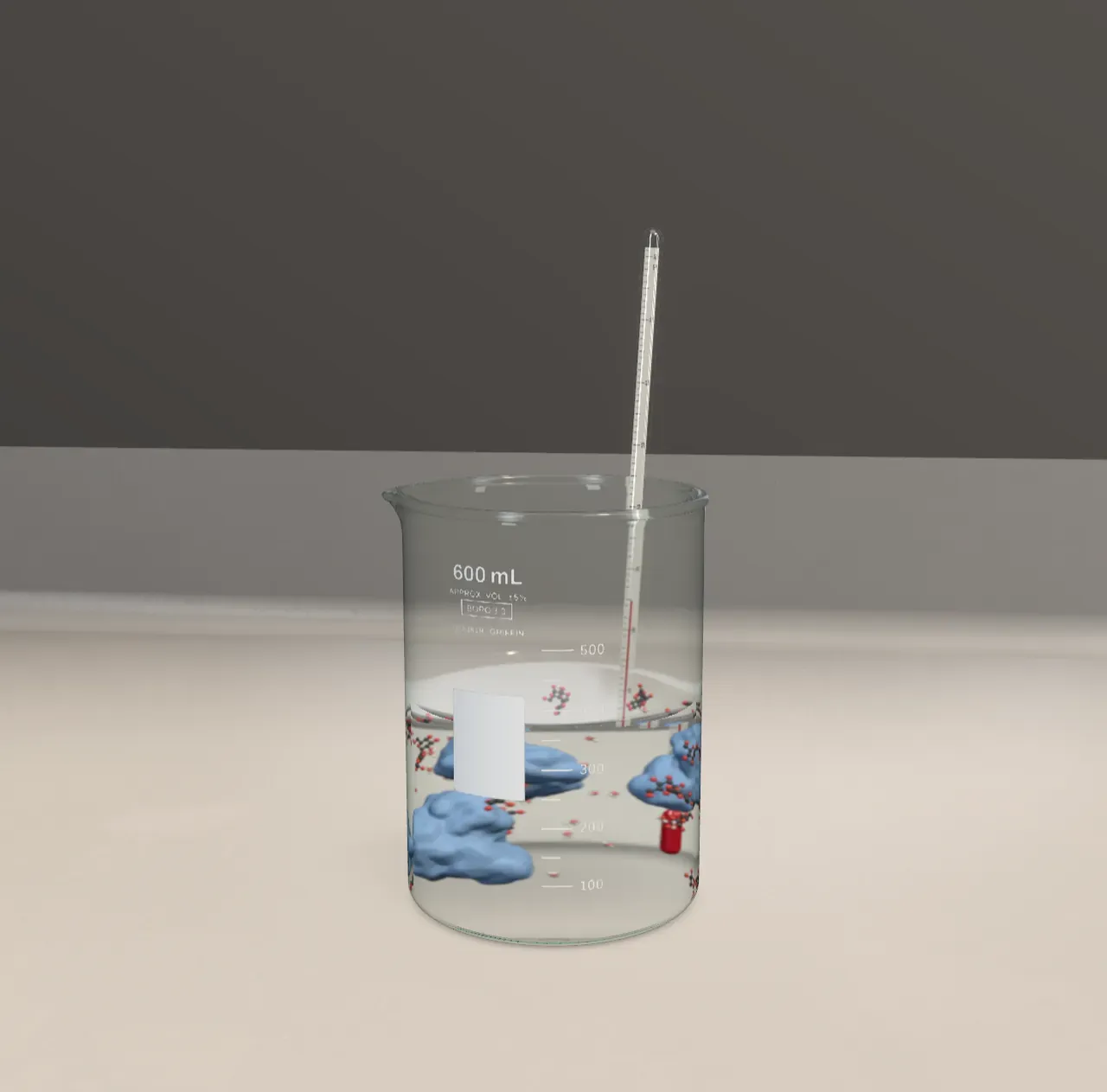
In the beaker in the Scene three enzymes swim in water among molecules of a double sugar. Each enzyme has a pocket, the active site, whose shape matches the sugar molecule, the substrate, exactly. A substrate that enters the active site binds, splits into two simple sugars, and they leave.
Step 2 of 7
A lower barrier
For a reaction to happen, molecules must collide with enough energy to break bonds: that is the activation energy. The second chart is the reaction’s energy profile, with an enzyme and without.
Step 3 of 7
Again and again
Follow one enzyme for a few seconds. How many molecules does it split?
Step 4 of 7
Too hot
Two effects of temperature pull opposite ways. On one side, the hotter it is, the faster the molecules move, and the more collisions carry enough energy. On the other, the enzyme is a protein, and in heat its fold unravels, as you saw in the last Lesson.
Step 5 of 7
Too cold
In the Fridge collisions carry very little energy. But what happens to the fold?
Step 6 of 7
Too acidic
pH, how acidic the water is, changes how the enzyme works too. The substrate holds on in the active site not only by its shape but also by the electric charges of the side chains there.
Step 7 of 7
Lock and key
Now Temperature and pH are both free. Move each one and watch the activity curve. Every enzyme has an optimum temperature and an optimum pH, and every enzyme has its own substrate.
Loading the interactive version…
Loading the interactive version…
Each step sets up the Scene for you, and a control marked “fixed” stays put for that step.
Practice · Choose
An enzyme that has denatured stops working. Why?
Practice · Choose
An enzyme that has denatured stops working. Why?
Practice · Choose
How does an enzyme speed up a reaction?
Practice · Choose
How does an enzyme speed up a reaction?
Practice · Choose
What happens to an enzyme after it has split one sugar molecule?
Practice · Choose
What happens to an enzyme after it has split one sugar molecule?
Practice · Predict, then look
The enzymes are working at body temperature. We will move them to a Hot bath, 50 °C. What will happen to the rate at which they split sugar?
Practice · Predict, then look
The enzymes are working at body temperature. We will move them to a Hot bath, 50 °C. What will happen to the rate at which they split sugar?
Practice · Predict, then look
Now we move them to the Fridge, 4 °C. What will happen?
Practice · Predict, then look
Now we move them to the Fridge, 4 °C. What will happen?
Practice · Predict, then look
These enzymes work best at pH 7, neutral. We will lower pH to 3, as acidic as lemon juice. What will happen?
Practice · Predict, then look
These enzymes work best at pH 7, neutral. We will lower pH to 3, as acidic as lemon juice. What will happen?
Practice · Choose
The enzyme in the Scene splits a double sugar into two simple sugars. If we add starch and protein to the beaker, what will it do with them?
Practice · Choose
The enzyme in the Scene splits a double sugar into two simple sugars. If we add starch and protein to the beaker, what will it do with them?
Lesson complete. Every practice question here is done.