The parts of a flower, pollination, the race of the pollen tubes down the style, fertilisation, and how the number of seeds decides whether there is a fruit and how big it grows. And why many flowers reject their own pollen.
Step 1 of 6 · A seed factory
Step 1 of 6
A seed factory
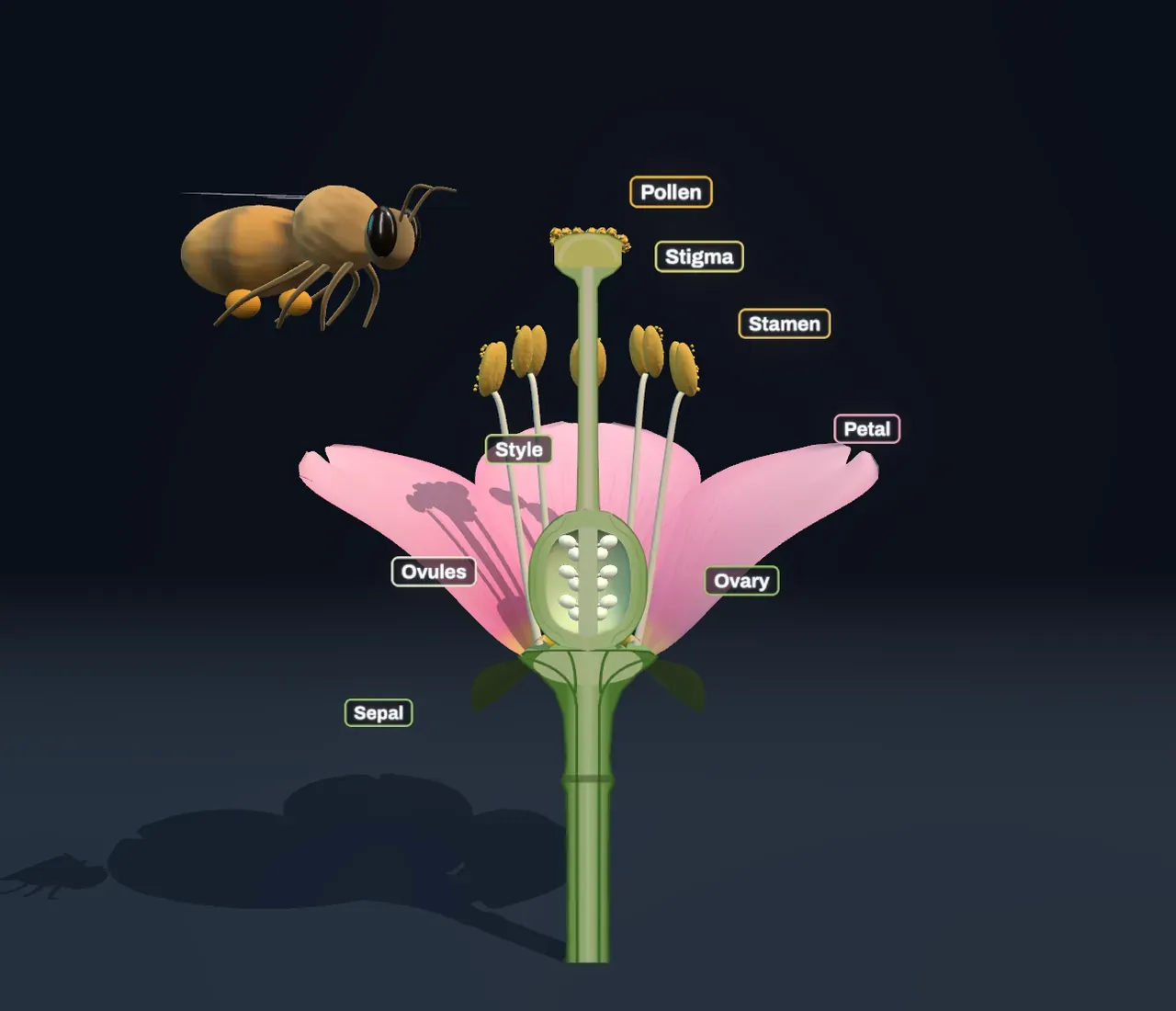
A flower looks like decoration, but every part of it is there to make seeds. From the outside in: the green sepals wrapped the bud, and the petals attract insects with colour and scent. Inside stand the stamens, the male parts, each topped by an anther that releases pollen. In the middle stands the pistil, the female part: on top the sticky stigma that catches pollen, below it the style, and at its base the ovary, with the ovules inside. The flower in the Scene has ovules.
Pollination is anything that carries pollen from an anther to a stigma. Here the bee did it, and it still hovers by the flower. Turn the flower and look at the cut, then answer.
Step 2 of 6
A tube for every ovule
A pollen grain cannot move. When it lands on a stigma of its own species, it takes up water and grows a pollen tube, a single long cell that grows down the style, with two sperm cells at its tip. When the tube reaches an ovule, one sperm cell fertilises the egg cell, and the other joins a large cell in the middle of the ovule that will become the endosperm, the seed’s food store: double fertilisation. Here Pollen grains is fixed at , the most it goes.
Step 3 of 6
The race
The tubes grow at slightly different speeds, and the first to reach the ovary take the ovules. Drag Time slowly from Pollination and watch on the chart as the tubes grow and the ovules are fertilised one after another.
Step 4 of 6
Too few seeds
Time is now at Ripe fruit, and Pollen from is fixed on another plant. Growing seeds make hormones that swell the fruit around them, and a fruit with few seeds is not worth the food it costs the plant. Lower Pollen grains and watch when the plant gives up on the fruit.
Step 5 of 6
Half the ovules
Time is now locked at Pollination, and only grains have landed on the stigma. One grain in seven grows no tube, so only half the ovules will be fertilised. Predict what kind of fruit comes of it.
Step 6 of 6
Pollen from the same plant
This time all the pollen is from The same plant: the bee went between flowers of one plant. For most species that is no use. A plant that fertilises itself mixes only its own genes, and its offspring are very like it. Predict what happens to this pollen.
Loading the interactive version…
Loading the interactive version…
Each step sets up the Scene for you, and a control marked “fixed” stays put for that step.
Practice · Choose
Seven weeks after pollination, which part of the flower has become the fruit?
Practice · Choose
Seven weeks after pollination, which part of the flower has become the fruit?
Practice · Calculate
Thirty pollen grains from another plant have landed on the stigma. One in seven grows no tube, so tubes grow. How many seeds will the fruit have?
Practice · Calculate
Thirty pollen grains from another plant have landed on the stigma. One in seven grows no tube, so tubes grow. How many seeds will the fruit have?
Practice · Calculate
A pollen tube grows 0.8 mm an hour, and the style is 10.4 mm long. How long does a tube take to grow the length of the style?
Practice · Calculate
A pollen tube grows 0.8 mm an hour, and the style is 10.4 mm long. How long does a tube take to grow the length of the style?
Practice · Reach the target
Pollen from is fixed on another plant. The plant drops a fruit with too few seeds. Lower Pollen grains to find the smallest number of seeds for which the plant still keeps the fruit, then press Check.
Practice · Reach the target
Pollen from is fixed on another plant. The plant drops a fruit with too few seeds. Lower Pollen grains to find the smallest number of seeds for which the plant still keeps the fruit, then press Check.
Practice · Predict, then look
Seven grains from another plant have landed, six tubes grow, and of the ovules will be fertilised. What kind of fruit comes of it?
Practice · Predict, then look
Seven grains from another plant have landed, six tubes grow, and of the ovules will be fertilised. What kind of fruit comes of it?
Practice · Predict, then look
Sixteen pollen grains have landed on the stigma, but all from The same plant. What happens?
Practice · Predict, then look
Sixteen pollen grains have landed on the stigma, but all from The same plant. What happens?
Lesson complete. Every practice question here is done.