A flower is a seed factory
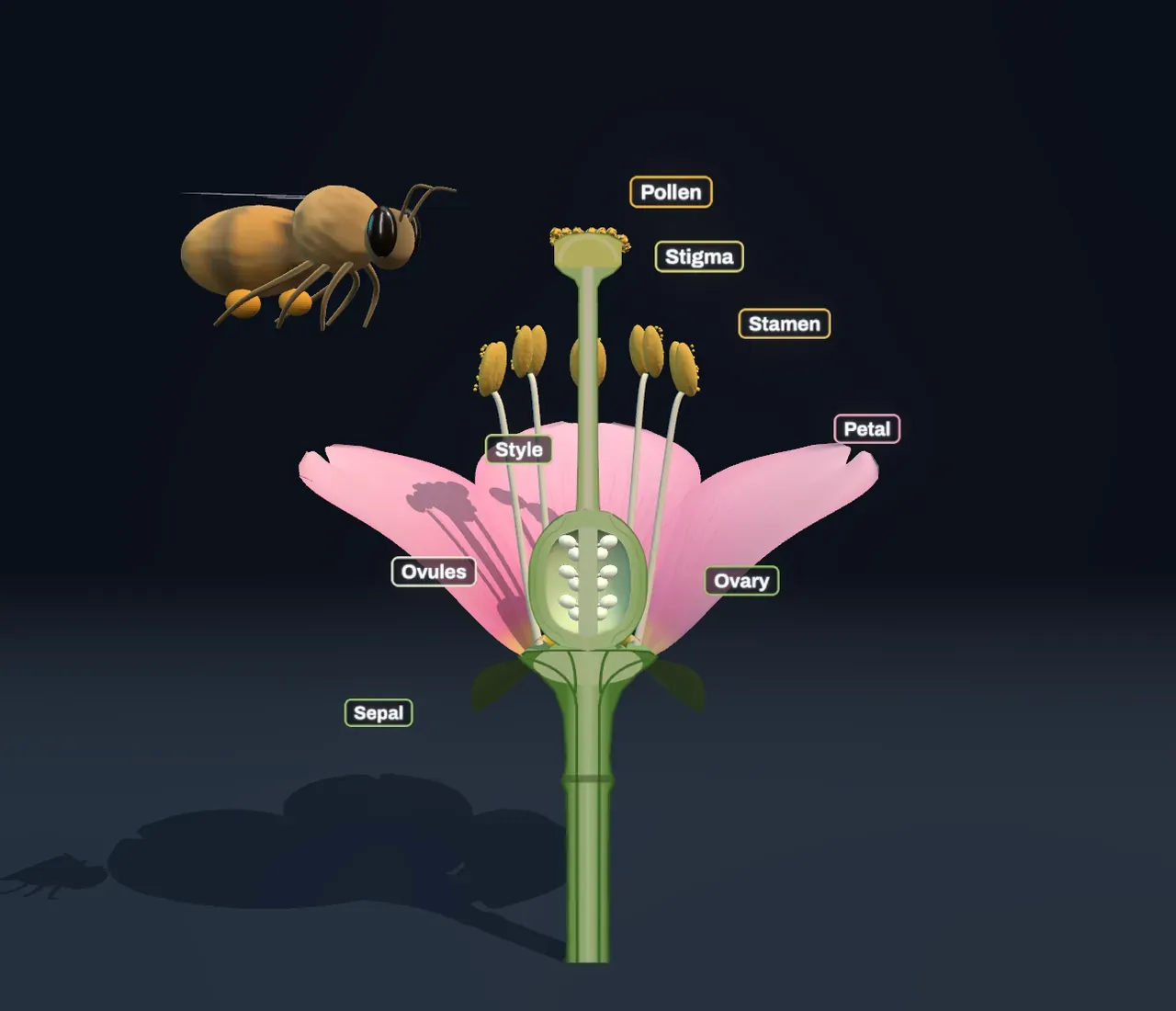
A flower can look like decoration, but every part of it is there to make seeds. Start from the outside of the Scene. The green sepals wrapped the bud before it opened. The petals advertise: their colour, scent and the lines that point to the centre tell an insect where to land and where the food is. Inside them stand the stamens, the male parts: each is a thin stalk, the filament, carrying an anther that splits open to release pollen.
In the middle stands the female part, the pistil, also called the carpel. On top is the stigma, sticky and covered in tiny bumps that catch pollen. A long tube, the style, joins it to the swollen base, the ovary. Inside the ovary are the ovules, small pale beads on a central column. Each ovule holds one egg cell and can become one seed. The flower in the Scene has twelve; a tomato flower has a few hundred.
The ring of yellow tissue at the foot of the ovary is the nectary, which makes the sugary nectar that pays visiting animals for their work.
Try it: with Time at Pollination, turn the flower and look at the cut. The ovules hang inside a hollow chamber, and the style is solid all the way up.
Getting pollen to the stigma
A pollen grain cannot move by itself. Pollination is anything that carries it from an anther to a stigma. In most flowering plants, an animal does the carrying. A bee visits flowers for nectar and for pollen, which is its protein food. Its body is covered in branched hairs, and pollen sticks to them as it climbs past the anthers. Honeybees and bumblebees comb much of it into baskets on their hind legs, the orange lumps in the Scene, but plenty stays loose in the fur, and some rubs off on the next stigma the bee touches.
A bee on one trip tends to stay with one kind of flower, which is exactly what a plant needs: its pollen goes to a flower of its own species instead of being wasted. Other plants use other carriers. Grasses, cereals and many trees let the wind do it, with small plain flowers, no nectar, and huge amounts of light, dry pollen, most of which never lands anywhere useful. Hay fever is that pollen landing in people instead.
About three in four of the main kinds of food crop, from apples to almonds to coffee, give more or better harvests when animals pollinate them, although the wind-pollinated cereals, rice, wheat and maize, make up most of the world’s food by weight.
Try it: slide Pollen grains to 0. No pollen reaches the stigma, so slide Time to Ripe fruit: the petals fall, the ovary yellows and the flower bows on its stalk, ready to drop. No pollen, no seeds, no fruit.
A tube for every ovule
A pollen grain is tiny, a few hundredths of a millimetre across, and the egg it must reach is buried at the bottom of the style, many millimetres away. So the grain grows. Once it lands on a stigma of the right species, it takes up water and pushes out a pollen tube, a single long cell that grows down through the soft tissue in the middle of the style, feeding on sugars the style provides. Inside the grain are two sperm cells, made by meiosis and a cell division, and they travel down at the growing tip.
The tubes do not wander. Chemical signals guide them through the style and into the ovary, and cells beside each egg release small proteins that attract a tube to one ovule and through the tiny opening in its coat. Once one tube has entered an ovule, that ovule stops attracting others. So every ovule needs a pollen grain of its own, and grains beyond the number of ovules are wasted. In the flower in the Scene, the journey takes about a day.
Try it: slide Pollen grains up to 24 and slide Time slowly from Pollination. The tubes race down the style at slightly different speeds; the first twelve to arrive each take an ovule, and the chart shows the rest losing the race.
Two sperm, two jobs
When the tube reaches an ovule, its tip bursts and releases both sperm cells. One joins the egg cell. That is fertilisation: the fertilised egg, the zygote, has one set of DNA from the plant that made the pollen and one from the plant that made the egg, and by dividing again and again it becomes the embryo, the tiny plant inside the seed.
The other sperm joins a large cell in the middle of the ovule, which holds two nuclei of its own. That cell becomes the endosperm, the seed’s food store. This double fertilisation happens only in flowering plants. It means the plant spends its food on a store only for an egg that has actually been fertilised. The white of a coconut and most of a grain of wheat, rice or maize are endosperm, which makes it a large share of everything people eat.
Try it: watch the chart’s The twelve ovules row as you slide Time through the first day. Each ovule turns green as its tube arrives, and in the Scene it flashes and swells.
From ovary to fruit
Once its ovules are fertilised, the flower has done its job and changes fast. The petals wilt and fall, the stamens shrivel, and the style dries up. The fertilised ovules grow into seeds: the embryo grows, the endosperm fills with food, and the ovule’s outer layers harden into a seed coat. Around them, the ovary wall thickens into the fruit. In a botanist’s sense, a fruit is a ripened ovary, so tomatoes, peppers, cucumbers, pea pods and acorns are all fruits.
The seeds drive the fruit’s growth. Growing seeds release plant hormones, auxins and gibberellins, that make the ovary wall around them swell. A fruit with many seeds grows big and round; one with few seeds stays small, and grows lopsided when the seeds are all on one side. If too few ovules are fertilised, the plant cuts its losses and drops the young fruit. That is why a badly pollinated apple tree gives small, misshapen apples or few at all, and why a strawberry with unpollinated patches grows dented there.
Try it: set Pollen grains to 4. Only three of the four grains grow tubes, so three ovules become seeds, two on the right and one on the left. Slide Time to Ripe fruit: the fruit is smaller and bulges on the right. Now set Pollen grains to 2 and watch the plant drop the fruit.
Some crops have been bred to make fruit without seeds, so bananas, navel oranges and many cucumbers grow without any fertilised ovules. Growers can also spray the same hormones on tomato flowers to make fruit set without pollen in cold greenhouses where bees are scarce.
Its own pollen will not do
Many flowers could easily pollinate themselves, since their anthers are a few millimetres from their stigma. Some do: peas, beans, wheat and garden tomatoes routinely fertilise their own ovules, which is what let Mendel breed pea plants true and then cross them by hand. But a large share of flowering plants, including apples, pears, cherries, plums and many wild relatives of tomatoes and potatoes, reject their own pollen.
They do it with a molecular lock and key. The style carries proteins coded by a set of genes, and the pollen carries proteins from the same genes. If the pollen’s version matches one of the style’s, the style recognises it as coming from the same plant, or a very close relative, and stops its tube partway down. Pollen from a plant with different versions grows on. That is why an apple orchard needs trees of at least two different varieties, and bees to carry pollen between them.
Try it: press The same plant under Pollen from, and slide Time from Pollination. The grains still grow tubes, but every tube stops in the top of the style, and no ovule is fertilised.
Rejecting its own pollen costs a plant some seeds, but its offspring mix genes from two parents. Inbreeding exposes harmful versions of genes, and a mixed family is more varied, so more of it may survive a new disease or a changing climate, the raw material of natural selection.
Seeds on the move
A fruit’s last job is to get the seeds away from the parent, where they would compete with it for light and water. Ripening is a signal. The fruit in the Scene turns from green to red as its seeds become ready, its flesh softens and fills with sugar made by photosynthesis in the leaves, and an animal that eats it carries the seeds away and drops them, often unharmed, far from the plant. Other fruits use the wind (a dandelion’s parachutes, a sycamore’s wings), hooks that catch on fur, or pods that split and fling their seeds.
Plants can also reproduce without seeds. Strawberries send out runners, potatoes grow new plants from tubers, and a cutting from many plants grows roots of its own. Those offspring are copies of the parent. Seeds, made by two parents, are how most flowering plants mix their genes.
What this model leaves out
The Scene’s flower is not a single species. It has twelve ovules, where a tomato or a pepper has hundreds and a cherry just one or two. Its fruit is a berry like a small tomato, and the rule that fewer than three seeds make the plant drop it is an illustration; real plants set their own thresholds and are affected by weather and by how many other fruits they are feeding.
Pollen tubes grow at very different speeds in different plants, from under an hour to many months in some trees; the Scene uses about a day. Each pollen grain is drawn about ten times too big, and each tube far too thick to see, and the tubes are shown on the cut face of the style, where a stained slide would show them, although they grow inside it.
The model also simplifies how pollen is rejected. Plants recognise their own pollen in several ways, some at the stigma and some in the style, and the Scene shows only one: every tube stopped about a third of the way down. It does not show the egg and the other cells inside each ovule, which are too small to draw at this scale.