Two purple parents, one white child
Garden peas come in purple-flowered and white-flowered kinds. Cross a purebred purple plant with a white one and every seedling flowers purple, as if the white had vanished. Cross two of those purple seedlings with each other, though, and about one plant in four in the next generation flowers white again. The white was not gone. It was hidden.
Gregor Mendel, a friar in Brno, worked this out from thousands of pea plants grown in his monastery garden between 1856 and 1863. When he crossed his purple hybrids, he counted 705 purple-flowered plants and 224 white: 3.15 to 1. He published his explanation in 1866. It was largely ignored until 1900, when three botanists reached the same results independently and found his paper.
Two copies of every gene
Mendel’s explanation still holds. Each plant carries two copies of the gene for flower colour, one inherited from each parent. The copies come in versions, called alleles. Here, P makes purple pigment and p does not. When the two copies differ, the plant shows only the dominant one, so a Pp plant is just as purple as a PP plant. The white version is recessive: it shows only in a pp plant, which has no working copy at all.
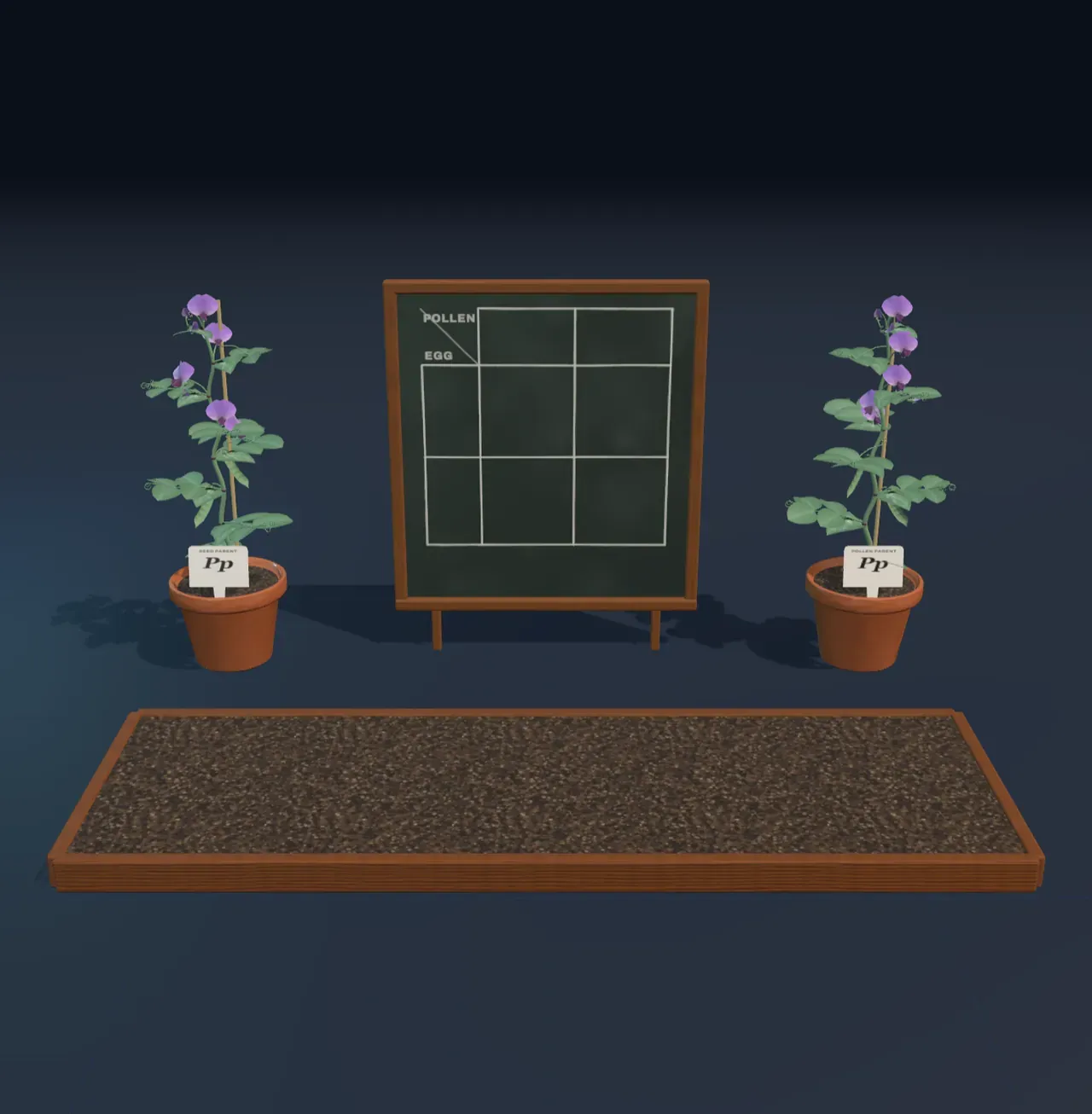
The pair of letters is the plant’s genotype; the colour you see is its phenotype. Two plants with the same phenotype can have different genotypes. That is why the scene labels each pot: you cannot tell PP from Pp by looking.
One copy each, at random
When a plant makes pollen or egg cells, each one gets only one of the plant’s two copies, and which one is a matter of chance, like a coin toss. Mendel called this segregation. A Pp plant makes P and p pollen grains in equal numbers. At fertilisation one pollen grain meets one egg, and the seed that grows has two copies again.
Peas normally pollinate themselves inside a closed flower. To make a cross, Mendel opened the young flower of the seed parent, removed its pollen sacs, and brushed on pollen from the other plant.
Filling in the square
A Punnett square, devised by the British geneticist Reginald Punnett in the early 1900s, lays out every pairing. Write one parent’s possible eggs down the side, the other’s possible pollen along the top, and fill each box with one letter from its row and one from its column. For Pp × Pp the boxes are PP, Pp, pP and pp. Each box is equally likely, so a seedling has a 1 in 4 chance of being PP, 2 in 4 of being Pp and 1 in 4 of being pp. Three boxes out of four contain a P, which gives the famous 3 purple to 1 white.
Try it: leave both parents on Pp and step Cross the parents to Punnett square. Then try PP for the Seed parent and pp for the Pollen parent: every box gets one of each, so every seedling is purple.
Chance needs numbers
The square gives odds, not a guarantee. With only four seedlings from Pp × Pp, getting exactly three purple and one white happens less than half the time, about 42 per cent; all four purple happens nearly a third of the time. The ratio only shows itself in large numbers, because the random draws even out. With 100 seedlings, the share of purple lands within about 4 percentage points of 75 per cent roughly two times in three; with 929, the same odds hold for a band of about 1.4 points. Mendel’s 705 out of 929 is 75.9 per cent.
Try it: step to Seedlings counted, slide Seedlings down to 4 and watch a few sowings, then up to 929, Mendel’s count. On the tally beside the scene, the purple line wanders at first and then settles against the dashed line the square predicts.
Reading the ratio backwards
Ratios also work as evidence. A purple plant of unknown genotype can be crossed with a white pp plant, a test cross. If any white seedlings appear, the purple parent must have been carrying p, and about half the seedlings should be white. The same logic is used in families. Cystic fibrosis is caused by a recessive allele, so two parents who each carry one copy are usually healthy, yet each of their children has a 1 in 4 chance of inheriting two copies.
In 2010 researchers identified the gene behind Mendel’s flower colours. White peas carry a version with a single changed letter in their DNA, which breaks a switch the plant needs to make purple pigment.
What this model leaves out
The scene follows one gene with two versions and complete dominance. Many traits are not like that. In snapdragons a red and a white parent give pink young, because neither version dominates. Human blood groups have three versions of one gene. Height, skin colour and most other traits depend on many genes at once, as well as on food, light and climate, so they vary smoothly rather than falling into two neat colours. Genes that sit close together on a chromosome also tend to be inherited together, which the square for a single gene does not show. The letters P and p are a textbook convention; Mendel wrote A and a.
The garden is staged for counting. Its seedlings flower within seconds, where real peas take a couple of months, and every one of them survives to be counted. The coin tosses come from the computer’s random number generator, and each new sowing is a fresh set of tosses.