The Punnett square as a map of chances: an expected number of offspring, Mendel's counts, why a small sample strays from the ratio, and multiplying the chances of different offspring.
Step 1 of 6 · An expected number
Step 1 of 6
An expected number
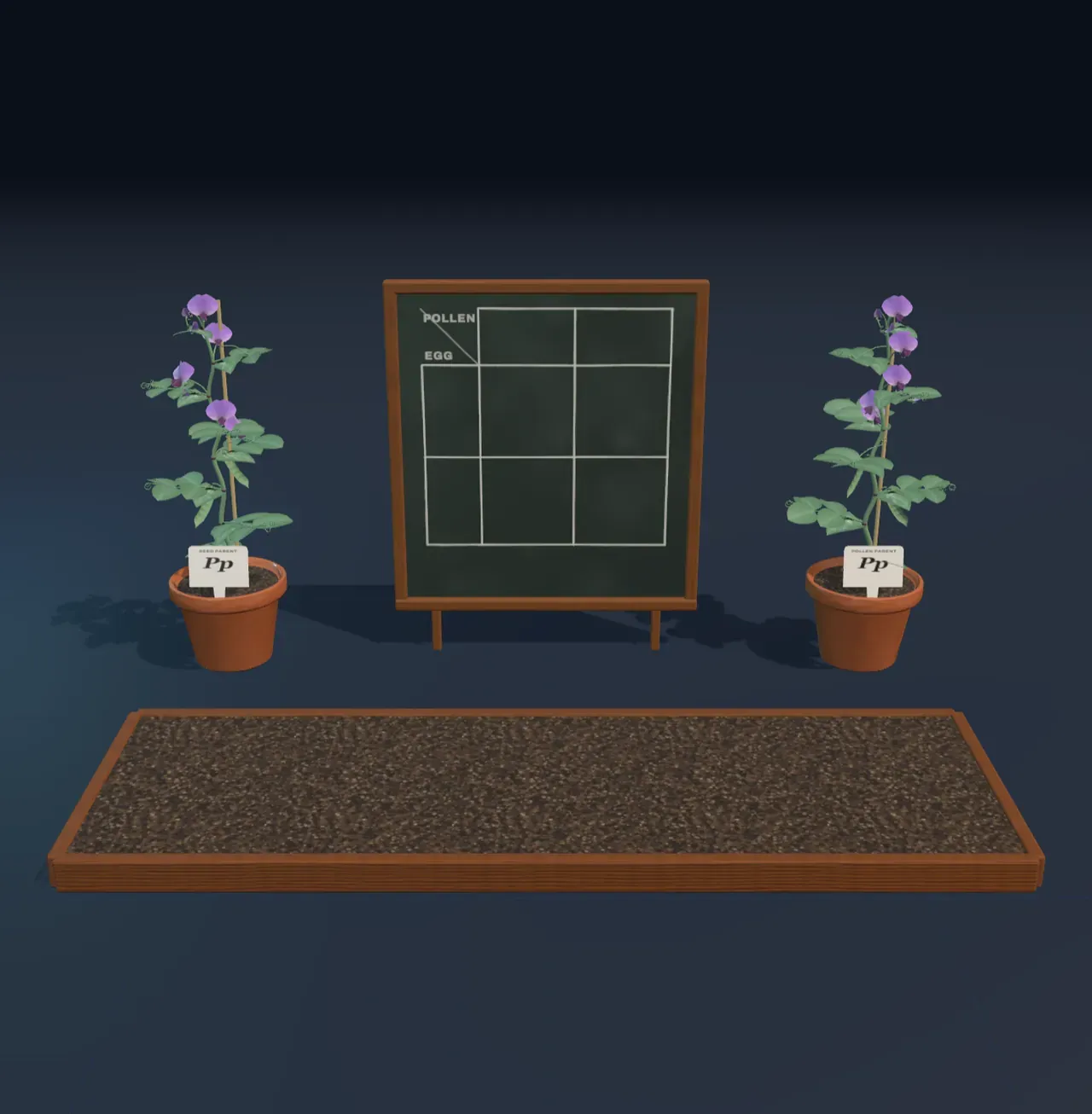
A Punnett square does not say what will happen, but what the chance is. Each box is a quarter of the chance, and each seed is a draw of one box. That is just what you learned in the probability Unit: equally likely outcomes, and an event that is some of them.
When there are many seeds, the chance becomes an expected number: the probability times the number of seeds.
Step 2 of 6
Mendel’s count
Mendel knew nothing of genes. He only counted, and in numbers big enough for the ratio to stand out from the noise. In he published his results, and almost nobody noticed. Only in did three researchers, each on their own, rediscover the same laws, and find that Mendel had beaten them by thirty-four years.
Step 3 of 6
Small samples
Now the bed has only four seeds. Cross the parents is fixed until you choose an answer, and then the bed will be sown and counted.
The chart beside the Scene shows, as the count goes on, the share of purple flowers among those counted so far, against the line. In a small bed it jumps up and down.
Step 4 of 6
No memory
Change Seedlings to and then to , and watch the chart: the more seedlings, the more closely the purple share hugs . But each seedling on its own is still a draw of a quarter against three quarters.
Step 5 of 6
Both at once
Sometimes the question is about two offspring together. The rule from the probability Unit works here too: when independent events must all happen, multiply their chances.
Step 6 of 6
Another cross
Every cross needs its own square. “A quarter” is right only for a cross of two heterozygotes.
Loading the interactive version…
Loading the interactive version…
Each step sets up the Scene for you, and a control marked “fixed” stays put for that step.
Practice · Calculate
You sow seeds from a cross of Pp with Pp. How many purple seedlings does the square lead you to expect?
Practice · Calculate
You sow seeds from a cross of Pp with Pp. How many purple seedlings does the square lead you to expect?
Practice · Calculate
Mendel grew plants from a cross of Pp with Pp. How many of them were expected to flower purple? Round to a whole plant.
Practice · Calculate
Mendel grew plants from a cross of Pp with Pp. How many of them were expected to flower purple? Round to a whole plant.
Practice · Predict, then look
You sow only seeds from a cross of Pp with Pp. How many of the seedlings will flower purple?
Practice · Predict, then look
You sow only seeds from a cross of Pp with Pp. How many of the seedlings will flower purple?
Practice · Choose
From a cross of Pp with Pp three seeds have already come up, and all three are purple. What is the chance that the fourth seedling is white?
Practice · Choose
From a cross of Pp with Pp three seeds have already come up, and all three are purple. What is the chance that the fourth seedling is white?
Practice · Calculate
You pick two seeds at random from a cross of Pp with Pp. What is the chance that both grow into white plants? Answer as a percentage.
Practice · Calculate
You pick two seeds at random from a cross of Pp with Pp. What is the chance that both grow into white plants? Answer as a percentage.
Practice · Calculate
Now you sow seeds from a test cross, Pp with pp. How many white seedlings do you expect?
Practice · Calculate
Now you sow seeds from a test cross, Pp with pp. How many white seedlings do you expect?
Lesson complete. Every practice question here is done.