Genes on the X chromosome: why colour blindness is common in men, how a carrier mother passes it to half her sons, and why the daughters of the same parents are carriers, not colour-blind.
Step 1 of 5 · X and Y
Step 1 of 5
X and Y
Of a person’s pairs of chromosomes, are the same in men and women. The last pair is the sex chromosomes: a woman has two X chromosomes, and a man one X and one much smaller Y. The X carries several hundred genes that have no copy on the Y.
A trait whose gene sits on the X chromosome is called sex-linked. One of the best known is red–green colour blindness: the allele that causes it is recessive, and sits on the X.
Step 2 of 5
A model of the sons
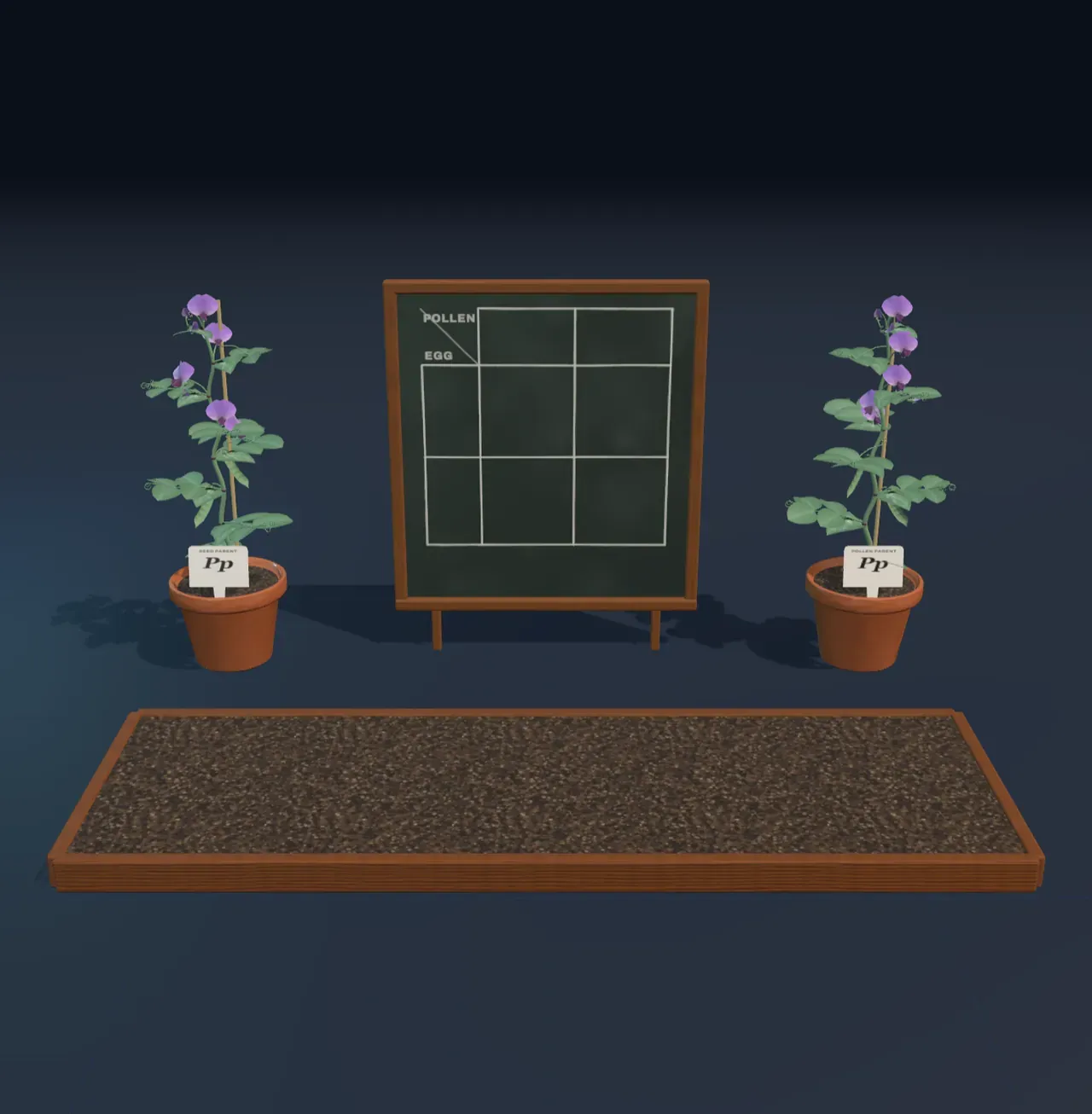
Peas have no sex chromosomes, but the bed can serve as a model, because the arithmetic is the same. Let P be an X with normal vision, and p an X with the colour-blindness allele. Seed parent is the carrier mother, Pp, and it is fixed.
A son has no second copy of the gene: what he gets from his father is a Y. So the other parent must be one that never hides the mother’s allele.
Step 3 of 5
Colour-blind sons
In the bed each seedling now shows only the allele that came from the mother. A white seedling is a colour-blind son, and a purple one a son with normal vision.
Step 4 of 5
The daughters
A daughter has two X chromosomes: one from her mother and one from her father. So she behaves like any ordinary offspring in the square, and the father, who sees colours normally, always gives her a normal X. In the model, the father is now a PP parent.
Step 5 of 5
Any child
Now the two models can be put together. When you do not know whether the child is a boy or a girl, you also need the chance of each. At every birth the chance of a boy is a half: the sperm carries an X or a Y.
The same pattern turns up in haemophilia, an inherited disease in which the blood does not clot properly. Its allele is recessive and on the X, so almost only sons have it. It passed from Queen Victoria, who was a carrier, through her carrier daughters, to grandsons in the royal houses of Russia and Spain.
Loading the interactive version…
Loading the interactive version…
Each step sets up the Scene for you, and a control marked “fixed” stays put for that step.
Practice · Choose
A woman has two X chromosomes, and a man one X and one Y. From whom does a son get his X chromosome?
Practice · Choose
A woman has two X chromosomes, and a man one X and one Y. From whom does a son get his X chromosome?
Practice · Reach the target
The bed will now model the sons of a mother who carries colour blindness. Seed parent, Pp, is the mother: P is an X with normal vision, and p an X with the colour-blindness allele. The father gives a son a Y, which has no copy of the gene at all, so it hides nothing. Choose the Pollen parent that behaves like that Y, then press Check.
Practice · Calculate
In the model of the sons, out of sons of a carrier mother, how many are expected to be colour-blind? (A white seedling is a colour-blind son.)
Practice · Calculate
In the model of the sons, out of sons of a carrier mother, how many are expected to be colour-blind? (A white seedling is a colour-blind son.)
Practice · Calculate
Now the bed models the daughters of the same parents: the father sees colours normally and gives every daughter his normal X, like a PP parent. In how many of the four boxes is the daughter a carrier, Pp?
Practice · Calculate
Now the bed models the daughters of the same parents: the father sees colours normally and gives every daughter his normal X, like a PP parent. In how many of the four boxes is the daughter a carrier, Pp?
Practice · Calculate
A carrier mother and a father with normal vision have a child. Nobody knows yet whether it is a boy or a girl. What is the chance that it is a colour-blind son? Answer as a percentage.
Practice · Calculate
A carrier mother and a father with normal vision have a child. Nobody knows yet whether it is a boy or a girl. What is the chance that it is a colour-blind son? Answer as a percentage.
Lesson complete. Every practice question here is done.