Two copies of every gene, a dominant allele hiding a recessive one, genotype and phenotype, and why a white flower can come from two purple parents.
Step 1 of 4 · Two copies
Step 1 of 4
Two copies
In Gregor Mendel, a monk in the town of Brno, began growing peas in the monastery garden. Over eight years he crossed thousands of plants and counted their offspring, one trait at a time: flower colour, seed shape, plant height. From those counts he worked out how inheritance works, decades before anyone knew what a gene was.
Today we know that every plant, like every person, has two copies of each gene, one from each parent, on the two chromosomes of a homologous pair. A gene can come in different versions, alleles. The pea’s gene for flower colour has an allele for purple, written P, and an allele for white, written p.
A plant’s two alleles are its genotype, and its flower colour, what you see, is its phenotype. A plant with two identical copies, PP or pp, is homozygous, and a Pp plant is heterozygous.
Step 2 of 4
Pure-breeding
Mendel started from pure-breeding varieties: plants that, crossed among themselves generation after generation, give flowers of only one colour. A pure purple variety is PP, and a pure white one pp.
Here one parent is PP and the other pp. Cross the parents is fixed until you answer.
Step 3 of 4
White comes back
A dominant allele shows even when there is only one copy of it. A recessive allele shows only when no dominant copy is beside it, that is only in pp. A Pp plant looks exactly like PP, but it is a carrier of the white allele.
Mendel crossed the plants of his first generation, all purple, with each other. Cross the parents is fixed until you choose an answer, and will then open at Punnett square.
Step 4 of 4
Dominant does not mean common
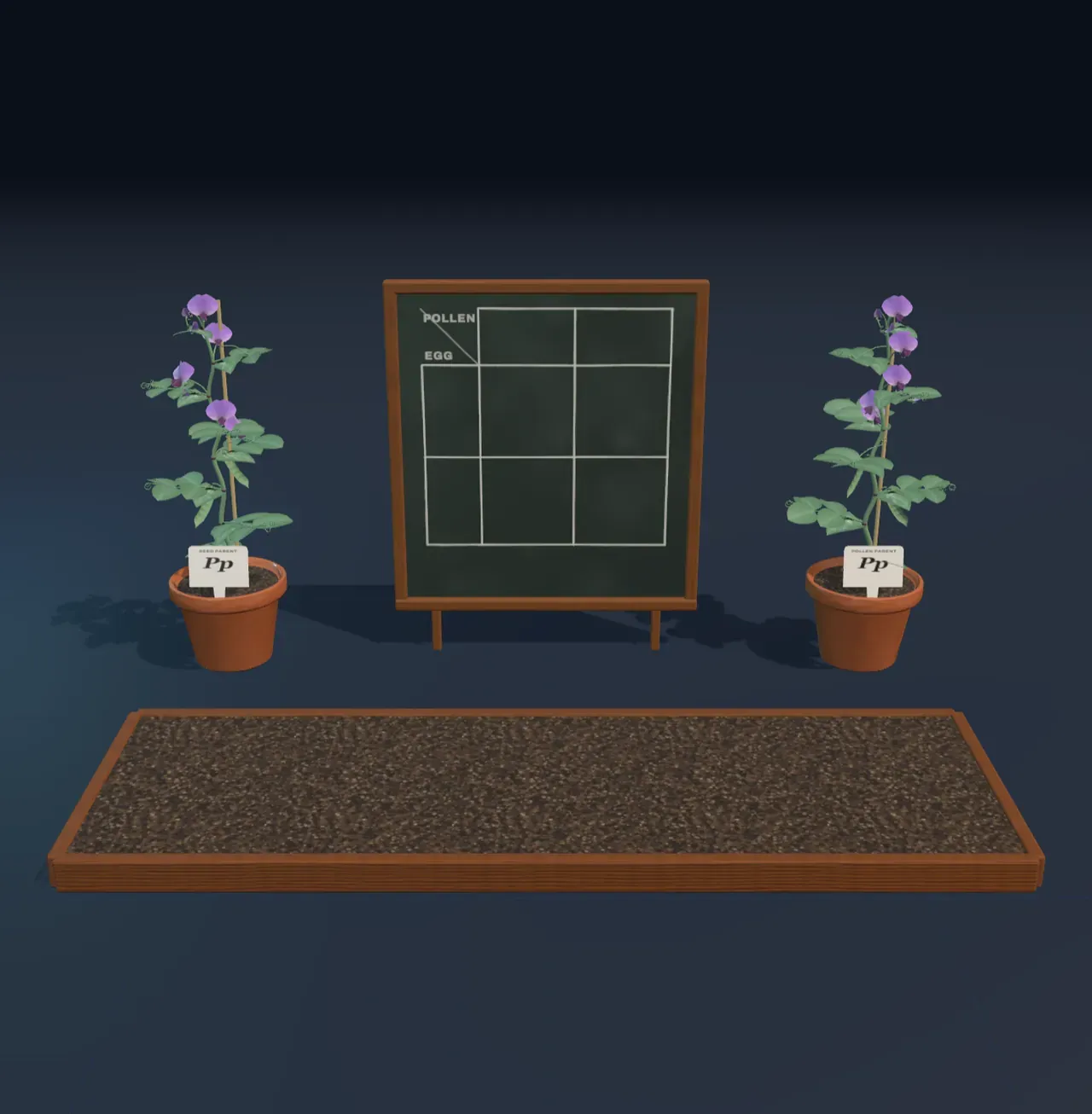
The square on the board shows the four ways the parents’ alleles can meet. In the next Lesson you will build squares like it yourself.
Before that, a common slip of words: “dominant” sounds like “strong” or “common”, but it means neither.
Loading the interactive version…
Loading the interactive version…
Each step sets up the Scene for you, and a control marked “fixed” stays put for that step.
Practice · Choose
Both plants in the Scene have the genotype Pp: one copy of the allele for purple flowers, and one copy of the allele for white. What colour do they flower?
Practice · Choose
Both plants in the Scene have the genotype Pp: one copy of the allele for purple flowers, and one copy of the allele for white. What colour do they flower?
Practice · Calculate
Now the seed parent is PP, pure purple, and the pollen parent pp, white. What percentage of the offspring will flower purple?
Practice · Calculate
Now the seed parent is PP, pure purple, and the pollen parent pp, white. What percentage of the offspring will flower purple?
Practice · Predict, then look
Both parents are purple, and both are Pp. Can they have a white offspring?
Practice · Predict, then look
Both parents are purple, and both are Pp. Can they have a white offspring?
Practice · Choose
The purple allele is dominant over the white one. What can you conclude from that about a field of wild peas?
Practice · Choose
The purple allele is dominant over the white one. What can you conclude from that about a field of wild peas?
Lesson complete. Every practice question here is done.