What makes a solution acidic or basic: hydronium and hydroxide ions, water that splits by itself, and the difference between a strong acid and a concentrated one.
Step 1 of 5 · Two ions
Step 1 of 5
Two ions
Vinegar, lemon juice and stomach acid taste sour; soap, baking soda and bleach feel slippery and taste bitter. The difference comes from ions in water. An acid is a substance that hands a proton, an ion, to a water molecule, making a hydronium ion, :
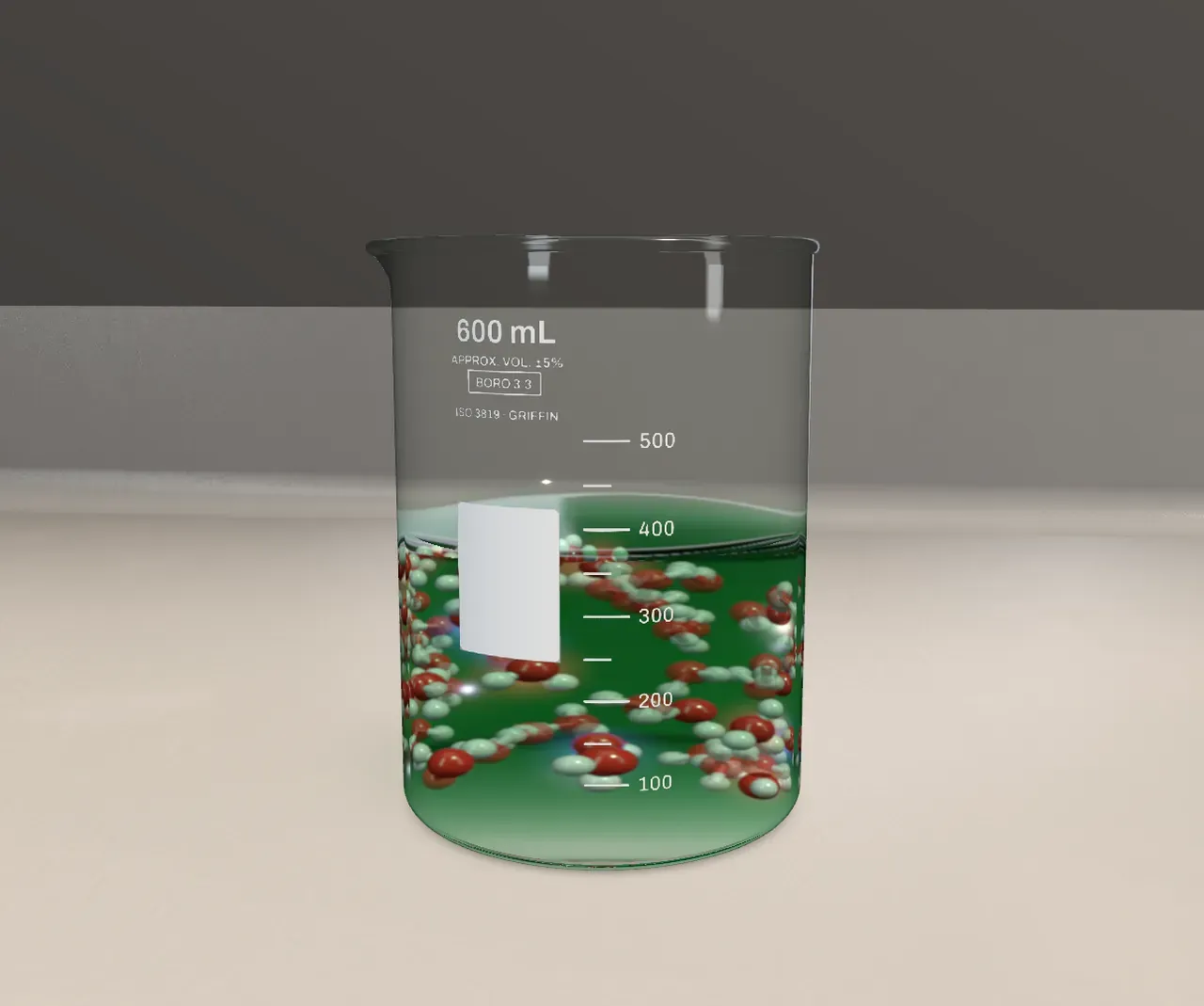
A base is a substance that gives hydroxide ions, , in water. In the Scene is a beaker of water, and the second chart shows how much there is of each of the two ions.
Step 2 of 5
Pure water
Water on its own is not free of ions. At every moment a few water molecules pass a proton to one another, , and at once join back up: an equilibrium, as in the last Unit. In the beaker you see it as small flashes. pH is now fixed at 7.
Step 3 of 5
Strong and weak
Different acids give up protons with different ease. A strong acid, like hydrochloric acid, , gives up all of them. A weak acid, like the ethanoic acid in vinegar, reaches an equilibrium in which most of its molecules stay whole:
Step 4 of 5
Bases
Bases are strong or weak too. Sodium hydroxide, , splits completely into and . Ammonia, , takes a proton from water in only a small share of its molecules, leaving . pH now stands at 11.
Step 5 of 5
The ion product
In water’s equilibrium, at 25 °C, the product of the two ions’ concentrations is fixed:
Add acid and grows while shrinks, so the product holds. In the second chart it looks like a seesaw: when one bar rises, the other falls by the same amount.
Loading the interactive version…
Loading the interactive version…
Each step sets up the Scene for you, and a control marked “fixed” stays put for that step.
Practice · Choose
pH stands at 3. What is true about the ions in the beaker?
Practice · Choose
pH stands at 3. What is true about the ions in the beaker?
Practice · Calculate
In pure water at 25 °C the pH is . What is the concentration of ions?
Practice · Calculate
In pure water at 25 °C the pH is . What is the concentration of ions?
Practice · Choose
Two beakers hold acid at 0.1 mol/L: one hydrochloric acid, , the other ethanoic acid, , the acid in vinegar. The first has pH , the second . Why?
Practice · Choose
Two beakers hold acid at 0.1 mol/L: one hydrochloric acid, , the other ethanoic acid, , the acid in vinegar. The first has pH , the second . Why?
Practice · Choose
pH now stands at 11. What is true about the solution?
Practice · Choose
pH now stands at 11. What is true about the solution?
Practice · Calculate
At pH , . What is ?
Practice · Calculate
At pH , . What is ?
Lesson complete. Every practice question here is done.