Sour and slippery
Lemon juice and vinegar taste sour. Soap, baking soda solution and household bleach feel slippery on the skin. Those two families, acids and bases, behave as opposites: mix them in the right amounts and each cancels the other. (Never taste or touch laboratory chemicals to find out which is which; that is what indicators are for.)
Water splits, just a little
The difference lies in ions that water itself makes. Now and then a water molecule hands a hydrogen nucleus, a bare proton, to a neighbour. One becomes hydronium, H₃O⁺, carrying an extra positive charge; the other becomes hydroxide, OH⁻, carrying a negative one. In pure water at 25 °C there are equal amounts of each, about one ten-millionth of a mole per litre.
An acid is a substance that gives away protons in water, so it raises the amount of H₃O⁺. A base takes protons up or releases OH⁻, so it raises the amount of hydroxide. The two are tied together: at 25 °C the concentration of H₃O⁺ multiplied by that of OH⁻ always comes to 10⁻¹⁴. When one goes up, the other goes down.
Counting in powers of ten
The amounts vary over an enormous range, so chemists count the zeros. The pH is the power of ten in the hydronium concentration, with the sign flipped: 10⁻³ mol/L of H₃O⁺ is pH 3, and 10⁻⁷ is pH 7. Each step down the scale means ten times more hydronium. Lemon juice, at about pH 2, has a hundred thousand times more H₃O⁺ than pure water at pH 7.
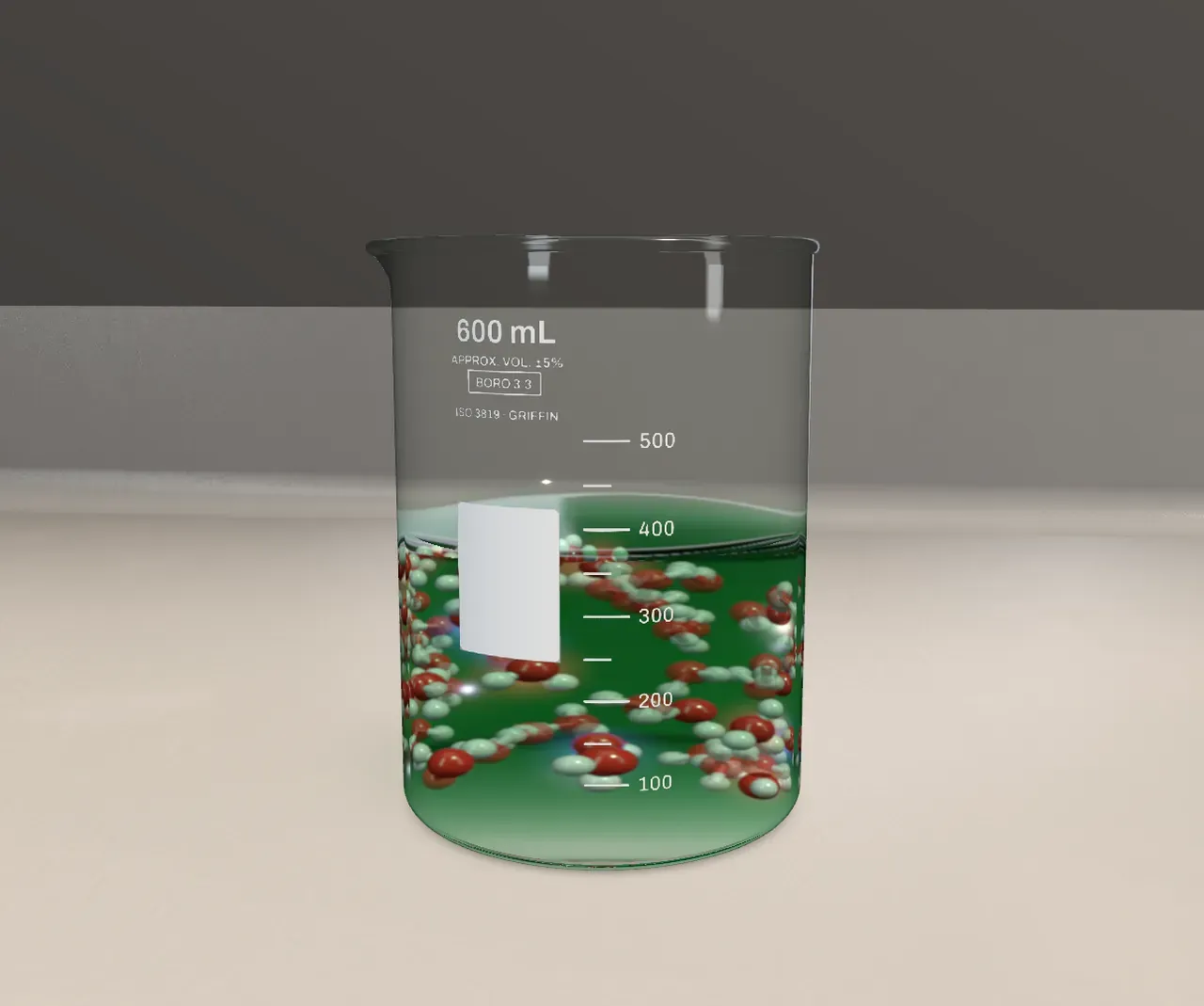
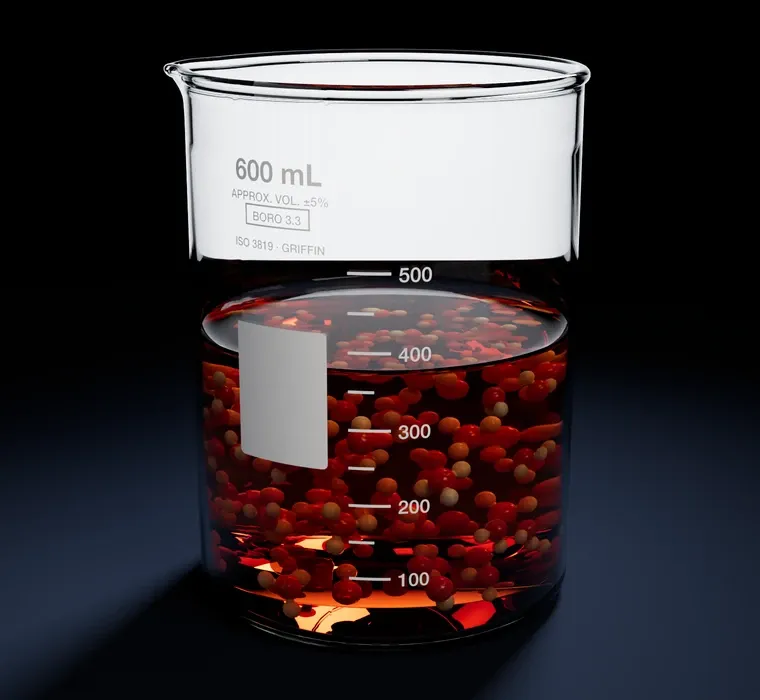
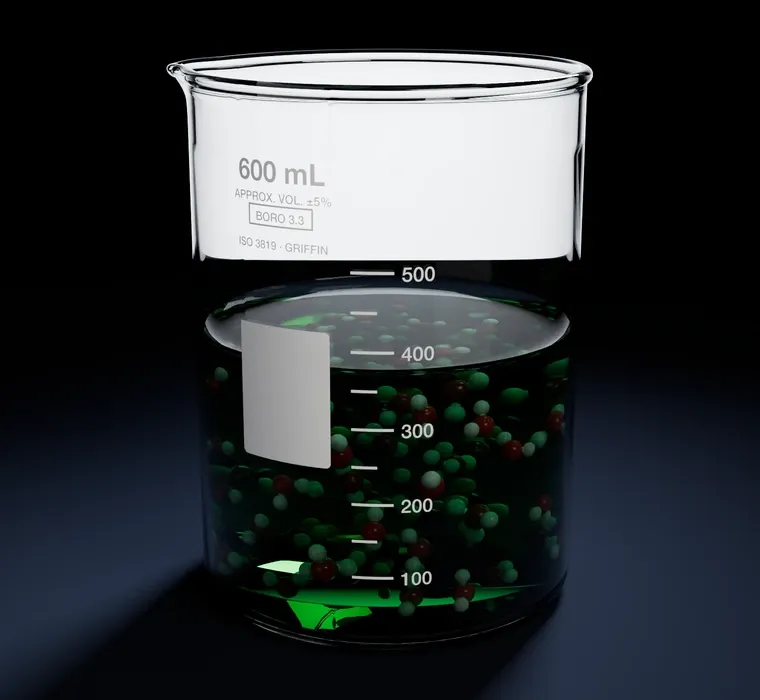
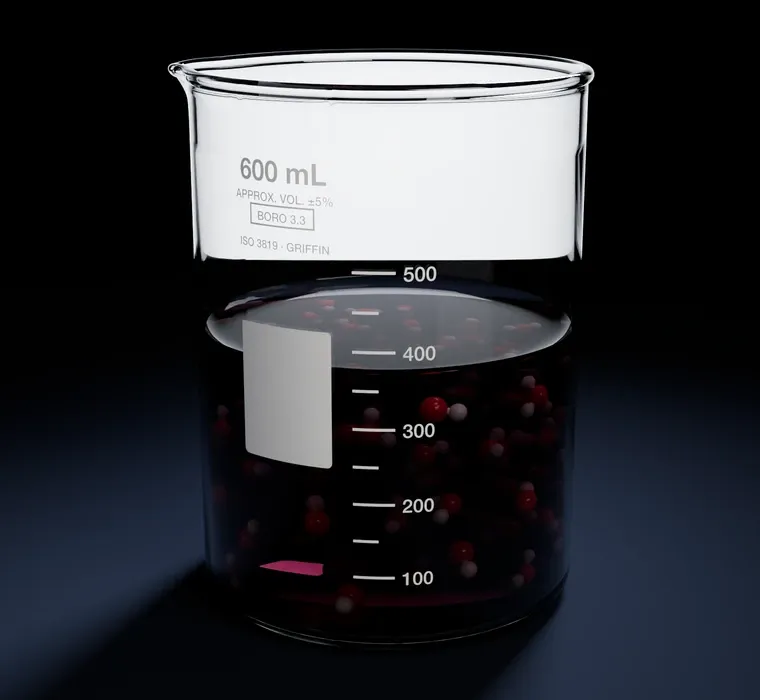
Try it: choose Lemon juice, then Pure water, then Bleach. Watch the red-glowing hydronium give way to blue-glowing hydroxide, and the indicator turn from red through green to violet. The chart puts the two concentrations on a scale of powers of ten. Choose On under Fade the water to see the ions more clearly.
Neutralisation
When a hydronium ion meets a hydroxide ion, the extra proton jumps across and two ordinary water molecules are left: H₃O⁺ + OH⁻ → 2H₂O. It is one of the fastest reactions known, and each flash in the beaker is one. In pure water it is balanced by water splitting again elsewhere. Add a base to an acid and the two ions mop each other up, which is how an antacid tablet calms excess stomach acid.
An indicator is a dye whose colour depends on the pH. Universal indicator mixes several dyes to give a rainbow from red in strong acid to violet in strong base. The juice of red cabbage does something similar on its own.
What this model leaves out
Drawn to scale, the beaker would hold hundreds of millions of water molecules for every ion, so the model shows ion numbers on a log scale and lets the colour carry the real change. Protons in real water do not travel as hydronium lumps; they hop from molecule to molecule, which is why the reaction is so fast. Neutral is pH 7 only at 25 °C: hotter water splits more, and boiling water is neutral at about pH 6.1. The model also does not tell strong acids from weak ones.