A tensile test on steel, aluminium, carbon fibre and a shape-memory alloy: Hooke's law, yielding and the stretch that stays, a brittle but strong material, specific strength, and an alloy that springs back.
Step 1 of 5 · Stress and strain
Step 1 of 5
Stress and strain
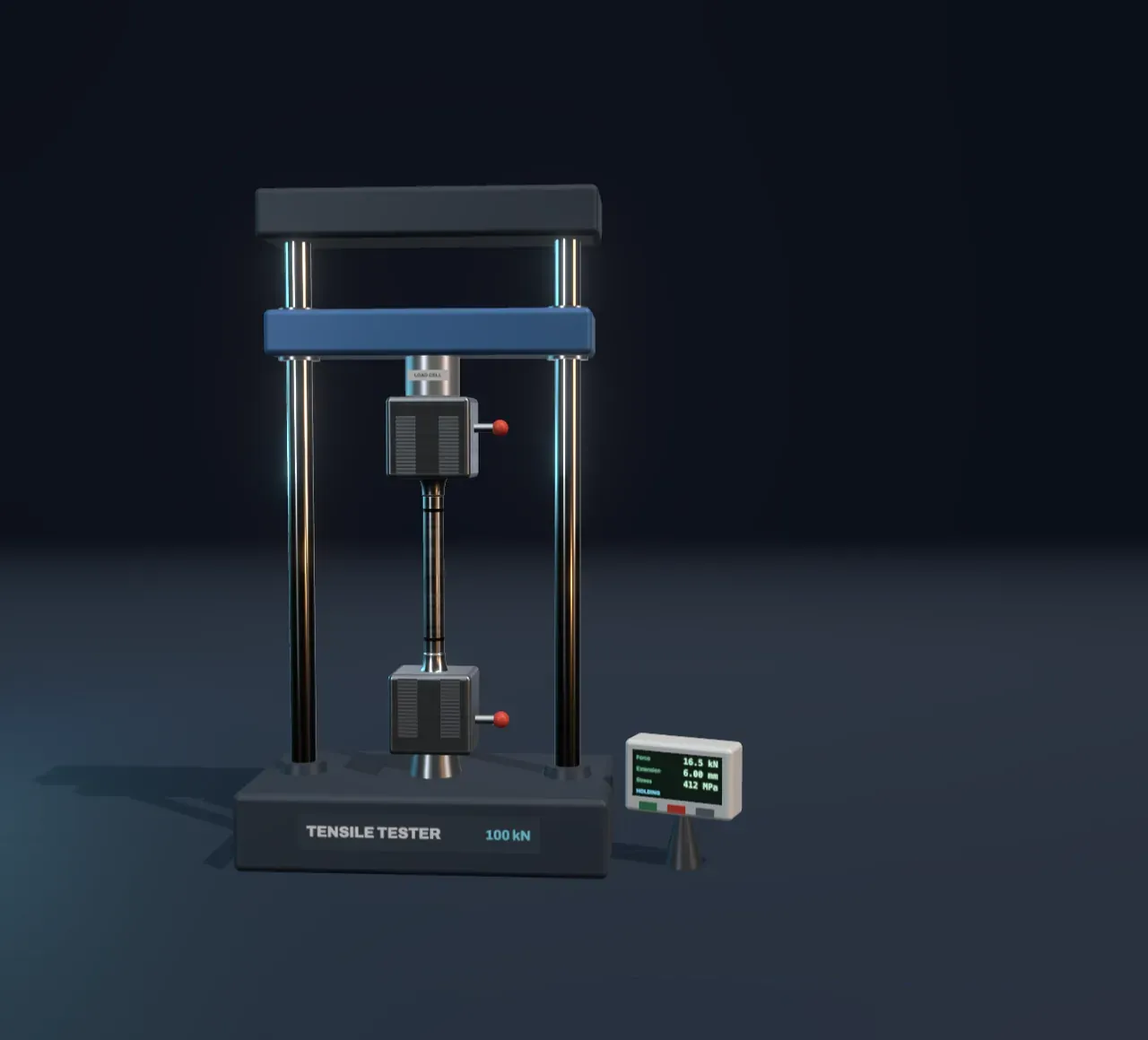
In the Unit on bonding and structure we saw that layers of atoms in a metal slip over each other, and that foreign atoms of another size stop the slipping. Engineers test a material in a tensile testing machine: it stretches a standard specimen and measures how hard it resists.
Two numbers describe the test. Strain is how far the specimen has stretched, as a percentage of its length. Stress is the force on each unit of its cross-section, in pascals: a megapascal, MPa, is a newton on every square millimetre. At first they are in proportion, as in a spring: that is Hooke’s law, , and , Young’s modulus, says how stiff the material is. For mild steel E = 200 GPa.
In the Scene Mild steel is stretched by 0.1%. What is the stress in it?
Step 2 of 5
Past the yield
Beyond a certain stress, about 275 MPa for mild steel, the metal yields: the grains of its crystal start to slip, and it stretches on without much more force. In the Scene the steel has been stretched by 12%. Predict what happens when you set Grips to Let go.
Step 3 of 5
Brittle but strong
A composite is built of two materials: stiff fibres that carry the pull, and a polymer glue that shares it out between them. The Scene shows Carbon fibre. Try raising Stretch past 1%, then compare with Mild steel: the carbon fibre snaps all at once, with no warning, while the steel stretches by more than a quarter of its length before it breaks.
Step 4 of 5
Strength for weight
Tensile strength is the highest stress a material can take. In an aircraft, a bicycle or a car the weight matters too, so engineers compare specific strength: the tensile strength divided by the density. For mild steel it is about 55 kN·m/kg, that is 430 MPa divided by 7.85 g/cm³.
Step 5 of 5
Springing back
NiTi, an alloy of nickel and titanium, behaves differently. Zoom inside is at Inside. When it is stretched, the rows of atoms in its crystals switch from a cubic structure to another, longer and sheared, so it stretches up to about 6% without any atoms slipping. In the Scene it has been stretched by 5%. Predict what happens when you set Grips to Let go.
Loading the interactive version…
Loading the interactive version…
Each step sets up the Scene for you, and a control marked “fixed” stays put for that step.
Practice · Calculate
Mild steel has E = 200 GPa. What is the stress in the specimen when it is stretched by 0.1%?
Practice · Calculate
Mild steel has E = 200 GPa. What is the stress in the specimen when it is stretched by 0.1%?
Practice · Predict, then look
The steel has been stretched by 12%, far past its yield. What happens when the grips let go?
Practice · Predict, then look
The steel has been stretched by 12%, far past its yield. What happens when the grips let go?
Practice · Choose
Carbon fibre snaps all at once at about 1.1% stretch, and mild steel stretches 28% before it breaks. Which is stronger?
Practice · Choose
Carbon fibre snaps all at once at about 1.1% stretch, and mild steel stretches 28% before it breaks. Which is stronger?
Practice · Calculate
Carbon fibre’s tensile strength is 1500 MPa, and its density 1.6 g/cm³. What is its specific strength, in kN·m/kg?
Practice · Calculate
Carbon fibre’s tensile strength is 1500 MPa, and its density 1.6 g/cm³. What is its specific strength, in kN·m/kg?
Practice · Predict, then look
The NiTi specimen has been stretched by 5%, more than twenty times what steel can take without yielding. What happens when the grips let go?
Practice · Predict, then look
The NiTi specimen has been stretched by 5%, more than twenty times what steel can take without yielding. What happens when the grips let go?
Lesson complete. Every practice question here is done.