How to write a chemical reaction so that every atom is counted: coefficients in front of formulas, formulas you never change, elements that come in pairs, and a check by counting atoms.
Step 1 of 5 · Coefficients
Step 1 of 5
Coefficients
A chemical equation writes the reactants on the left, an arrow, and the products on the right: hydrogen plus oxygen gives water. But is wrong: two oxygen atoms on the left, one on the right. An equation like that claims an oxygen atom has vanished, and conservation of mass says that does not happen.
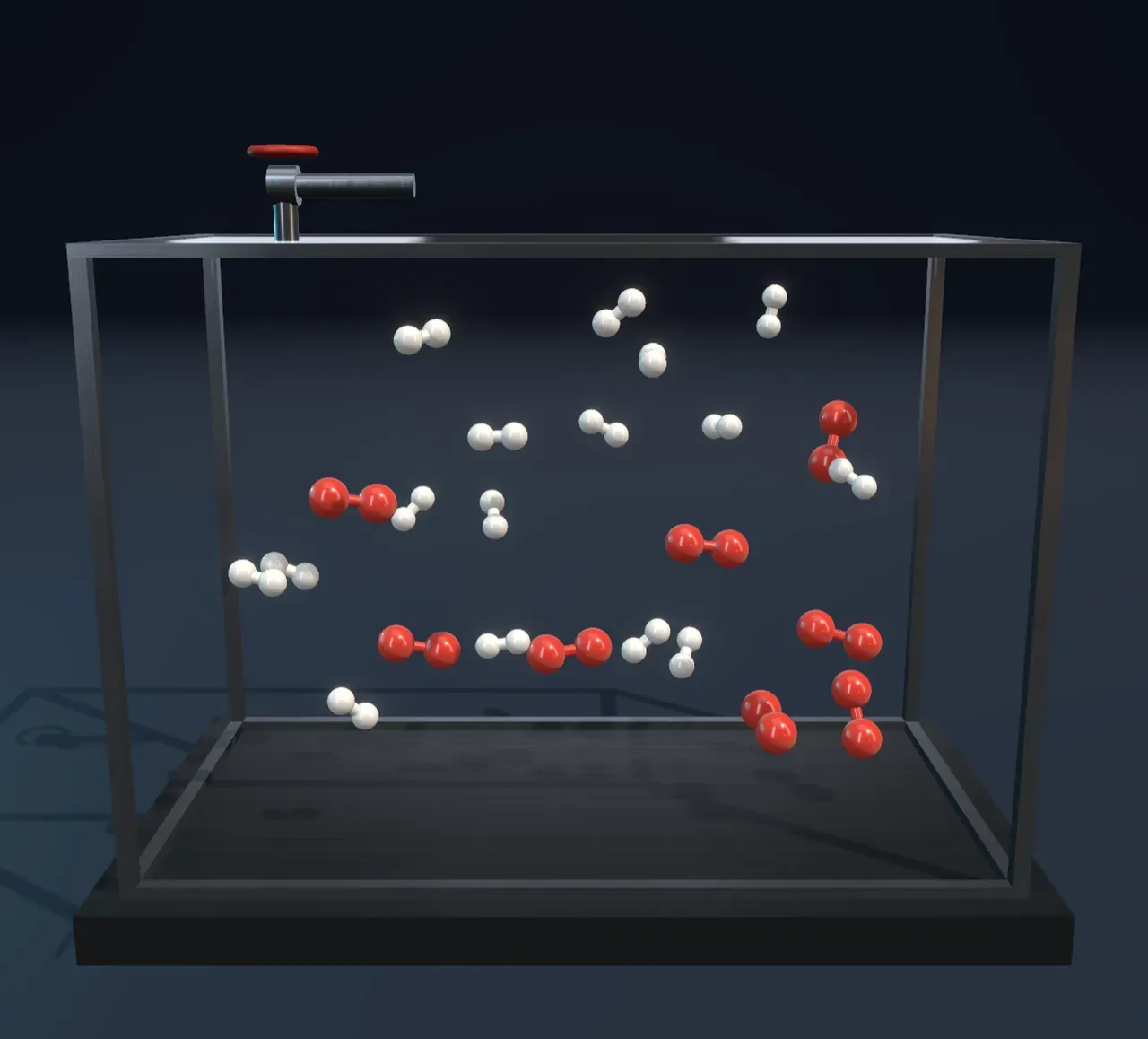
To balance the equation you write coefficients: numbers in front of the formulas that say how many molecules take part. The formulas themselves stay fixed. Move Run the reaction and watch the readings: how many hydrogen molecules disappear for each oxygen molecule?
Step 2 of 5
Two from one
A coefficient can appear on the products’ side too. Hydrogen and chlorine react to hydrogen chloride, , a gas that dissolves in water to make hydrochloric acid. Each molecule holds just one hydrogen atom, and each molecule brings two.
Here Compound, Oxygen or chlorine supplied and Run the reaction are fixed, and the reaction has not started. Count the atoms.
Step 3 of 5
Just enough chlorine
A balanced equation is also a recipe: it says in what ratio the reactants combine. Sodium, a soft metal, and chlorine molecules react by : each chlorine molecule gives two atoms, one for each sodium atom.
Now Compound is fixed at Table salt. Change Oxygen or chlorine supplied, and look for the amount at which the sodium and the chlorine run out together.
Step 4 of 5
Formulas set by charges
You may not balance an equation by changing a formula, because the formula is set by the substance. In salts it is set by the charges of the ions: sodium gives one electron and becomes , magnesium gives two and becomes , and chlorine takes one and becomes . The salt is neutral, so the formulas are and .
Step 5 of 5
Balancing by counting
You can balance almost any equation one way: start from an element that appears in one substance on each side, balance it with a coefficient, move to the next element, and finish by counting each element on each side. A coefficient multiplies the whole formula after it: holds four hydrogen atoms and two oxygen atoms.
The next question has no Scene: the burning of methane, the gas in a cooker.
Loading the interactive version…
Loading the interactive version…
Each step sets up the Scene for you, and a control marked “fixed” stays put for that step.
Practice · Choose
The equation is not balanced: two oxygen atoms on the left, one on the right. Which equation balances it correctly?
Practice · Choose
The equation is not balanced: two oxygen atoms on the left, one on the right. Which equation balances it correctly?
Practice · Calculate
The tank holds molecules and molecules, exactly enough. Each molecule holds one hydrogen atom and one chlorine atom. How many molecules will form?
Practice · Calculate
The tank holds molecules and molecules, exactly enough. Each molecule holds one hydrogen atom and one chlorine atom. How many molecules will form?
Practice · Reach the target
The tank holds sodium atoms, and they react by . Right now there is twice the chlorine needed, and some is left over. Change Oxygen or chlorine supplied until nothing but salt is left when the reaction ends, then press Check.
Practice · Reach the target
The tank holds sodium atoms, and they react by . Right now there is twice the chlorine needed, and some is left over. Change Oxygen or chlorine supplied until nothing but salt is left when the reaction ends, then press Check.
Practice · Choose
Magnesium gives up two electrons to form the ion , and chlorine takes one to form . What is the balanced equation for magnesium and chlorine?
Practice · Choose
Magnesium gives up two electrons to form the ion , and chlorine takes one to form . What is the balanced equation for magnesium and chlorine?
Practice · Calculate
Cooking gas is mostly methane. Balance its burning: . What is the coefficient of ?
Practice · Calculate
Cooking gas is mostly methane. Balance its burning: . What is the coefficient of ?
Lesson complete. Every practice question here is done.