From a balanced equation to grams: relative molecular mass, the fixed ratio by mass between reactants, and the three steps from grams to moles, through the coefficients, and back to grams.
Step 1 of 5 · Relative molecular mass
Step 1 of 5
Relative molecular mass
The coefficients in an equation count particles: molecules, atoms or units of a salt. In the lab you weigh grams. To go from one to the other you need to know how much each particle weighs.
A substance’s relative molecular mass is the sum of the relative atomic masses of every atom in its formula. It is also the molar mass, in grams per mole: one mole of the substance weighs that number of grams.
Step 2 of 5
Gram for gram
Because every unit of a compound is built from the same atoms, the ratio by mass between its elements is fixed too. That is the law of definite proportions: in every sample of , from any source, there are the same grams of chlorine for each gram of magnesium.
The readings beside the Scene show that ratio on their last line. Use it.
Step 3 of 5
The product’s mass
Conservation of mass works in grams too: every gram of magnesium and every gram of chlorine that reacted is now in the salt.
Step 4 of 5
Through moles
The ratio in the readings works for one compound. The general way, for any reaction, goes through moles, in three steps:
- Grams of the known substance, over its molar mass, give moles: .
- The coefficients in the equation say how many moles of the substance you want match them.
- Moles of the substance you want, times its molar mass, give grams: .
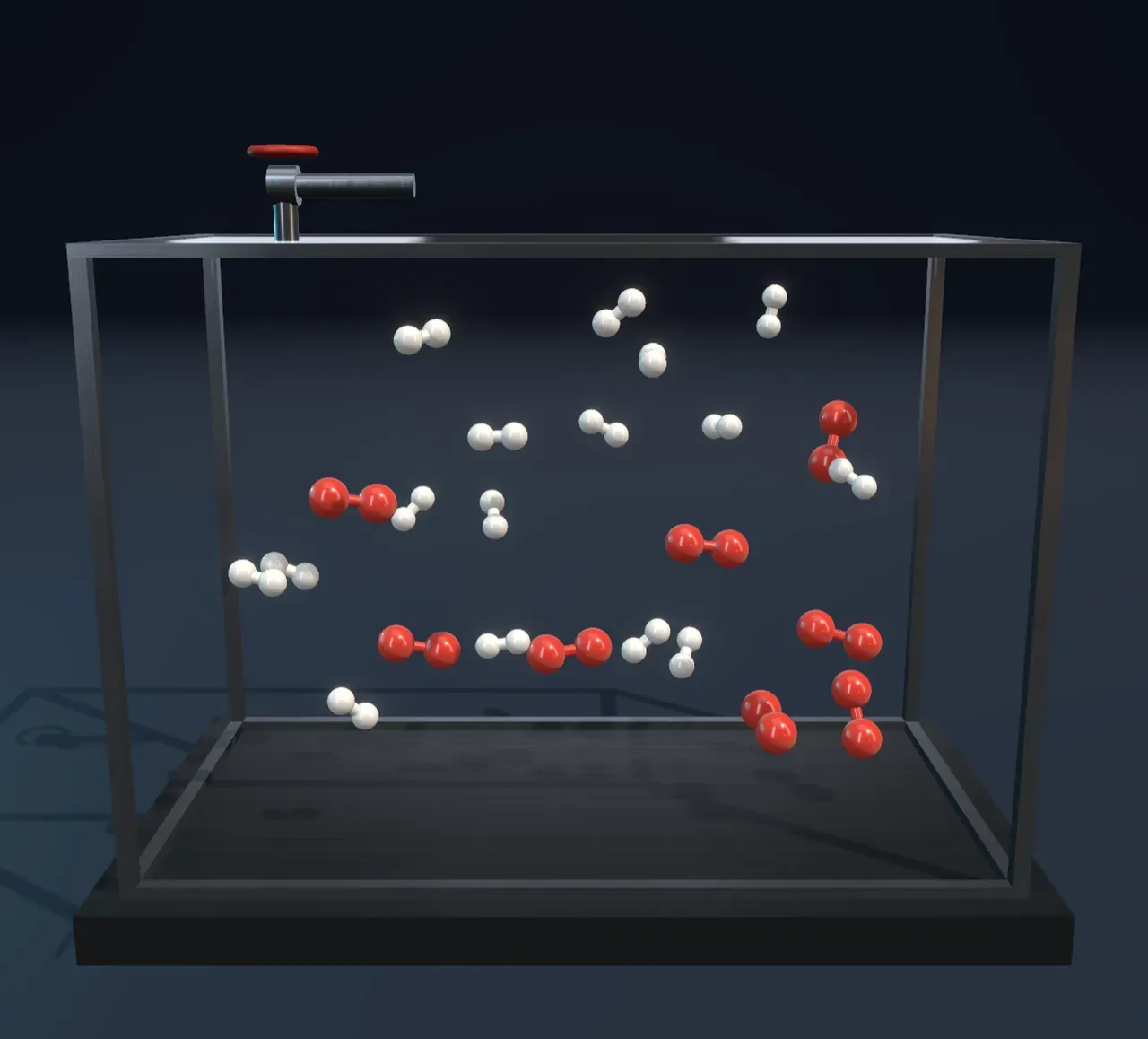
Compound is now fixed at Water: .
Step 5 of 5
The other way round
The same three steps work from the product back to the reactants: start from the mass you want to make, and work back to how much you need.
Loading the interactive version…
Loading the interactive version…
Each step sets up the Scene for you, and a control marked “fixed” stays put for that step.
Practice · Calculate
The relative atomic mass of hydrogen is 1.008, and of oxygen 15.999. What is the relative molecular mass of water, ?
Practice · Calculate
The relative atomic mass of hydrogen is 1.008, and of oxygen 15.999. What is the relative molecular mass of water, ?
Practice · Calculate
The readings beside the Scene show how many grams of chlorine combine with one gram of magnesium. A 12 g magnesium ribbon burns in chlorine until all of it is . How many grams of chlorine reacted?
Practice · Calculate
The readings beside the Scene show how many grams of chlorine combine with one gram of magnesium. A 12 g magnesium ribbon burns in chlorine until all of it is . How many grams of chlorine reacted?
Practice · Calculate
The same 12 g magnesium ribbon has all become . How many grams of salt formed?
Practice · Calculate
The same 12 g magnesium ribbon has all become . How many grams of salt formed?
Practice · Calculate
4.0 g of hydrogen burn in plenty of oxygen by . How many grams of water form? (, , in g/mol.)
Practice · Calculate
4.0 g of hydrogen burn in plenty of oxygen by . How many grams of water form? (, , in g/mol.)
Practice · Calculate
How many grams of hydrogen does it take to make 90 g of water?
Practice · Calculate
How many grams of hydrogen does it take to make 90 g of water?
Lesson complete. Every practice question here is done.