Which runs out first and what is left in excess, why more of one reactant does not always give more product, and how to compare what you got in the lab with what you should have got.
Step 1 of 6 · Which runs out first
Step 1 of 6
Which runs out first
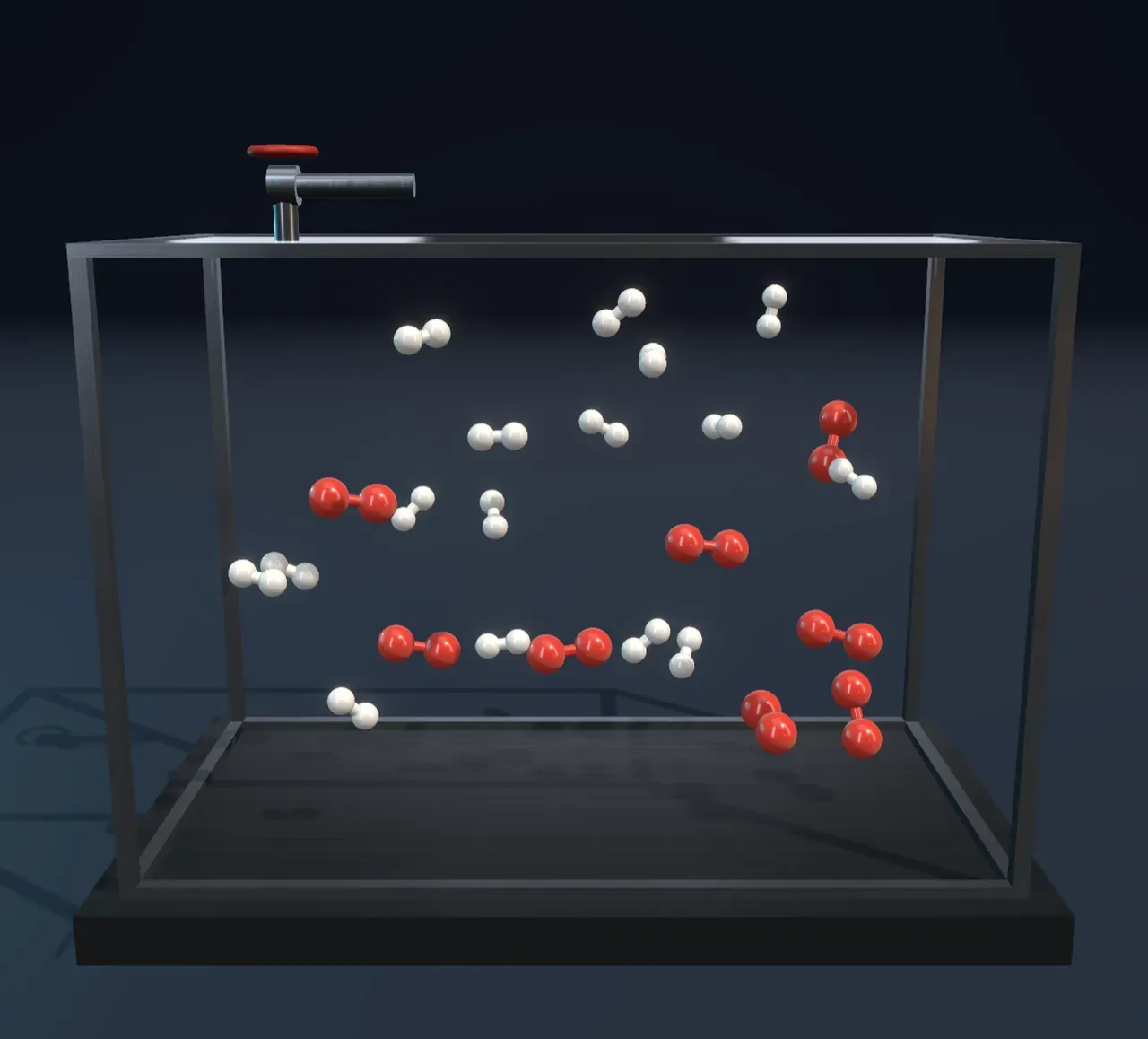
In the lab and in industry reactants are almost never mixed in exactly the ratio of the equation. One runs out first, and the reaction stops. It is called the limiting reagent: it decides how much product forms. What is left of the other is called the excess.
Here Oxygen or chlorine supplied is fixed at 1.5 × what is needed: oxygen molecules against hydrogen molecules. Predict, then run it.
Step 2 of 6
What is left
To find the limiting reagent, work out how much each reactant needs of the other, by the coefficients, and compare with how much there is. Then you can work out the excess too: what there was, minus what reacted.
Step 3 of 6
The excess stays in excess
What happens when you keep adding the reactant that is already in excess? Here there is twice the chlorine needed. Predict, then run it.
Step 4 of 6
Setting the amount of product
If the limiting reagent decides how much product forms, you can choose the amount you want through it. Compound is now fixed at Hydrogen chloride, , with hydrogen molecules, and Run the reaction is fixed at Reaction over. Change Oxygen or chlorine supplied and watch the readings.
Step 5 of 6
The theoretical yield
The most product the limiting reagent allows is called the theoretical yield. In grams you work it out with the three steps of the last Lesson, but first you need to know which reactant limits, so you turn both reactants into moles and compare them by the coefficients.
Step 6 of 6
Percentage yield
In the lab you almost always get less than the theoretical yield: some product sticks to the glassware or is lost in filtering, some reactant does not react completely, and sometimes side reactions run. Atoms do not vanish; they just do not all reach the jar.
The percentage yield compares the two:
Loading the interactive version…
Loading the interactive version…
Each step sets up the Scene for you, and a control marked “fixed” stays put for that step.
Practice · Predict, then look
The tank holds hydrogen molecules and oxygen molecules, and they react by . Which runs out first?
Practice · Predict, then look
The tank holds hydrogen molecules and oxygen molecules, and they react by . Which runs out first?
Practice · Calculate
This time the tank holds hydrogen molecules and oxygen molecules. How many oxygen molecules will be left when the reaction is over?
Practice · Calculate
This time the tank holds hydrogen molecules and oxygen molecules. How many oxygen molecules will be left when the reaction is over?
Practice · Predict, then look
magnesium atoms, and this time twice the chlorine needed: molecules. What will the tank hold when the reaction is over?
Practice · Predict, then look
magnesium atoms, and this time twice the chlorine needed: molecules. What will the tank hold when the reaction is over?
Practice · Reach the target
The tank holds hydrogen molecules, and right now twice the chlorine needed, so molecules form. Change Oxygen or chlorine supplied so that exactly molecules form, then press Check.
Practice · Reach the target
The tank holds hydrogen molecules, and right now twice the chlorine needed, so molecules form. Change Oxygen or chlorine supplied so that exactly molecules form, then press Check.
Practice · Calculate
You mix 8.0 g of hydrogen with 32 g of oxygen and light it. What is the greatest mass of water that can form? (, , , in g/mol.)
Practice · Calculate
You mix 8.0 g of hydrogen with 32 g of oxygen and light it. What is the greatest mass of water that can form? (, , , in g/mol.)
Practice · Calculate
A 12 g magnesium ribbon should give 47.0 g of . In the lab you collected 40.0 g. What is the percentage yield? (Answer in per cent.)
Practice · Calculate
A 12 g magnesium ribbon should give 47.0 g of . In the lab you collected 40.0 g. What is the percentage yield? (Answer in per cent.)
Lesson complete. Every practice question here is done.