What happens to atoms in a chemical reaction: they change partners and none is lost, so in a sealed vessel the mass does not change. And why a candle gets lighter as it burns.
Step 1 of 5 · Atoms change partners
Step 1 of 5
Atoms change partners
In a chemical reaction substances turn into other substances: hydrogen and oxygen, two gases, become water. But what goes on there, at the level of the atoms?
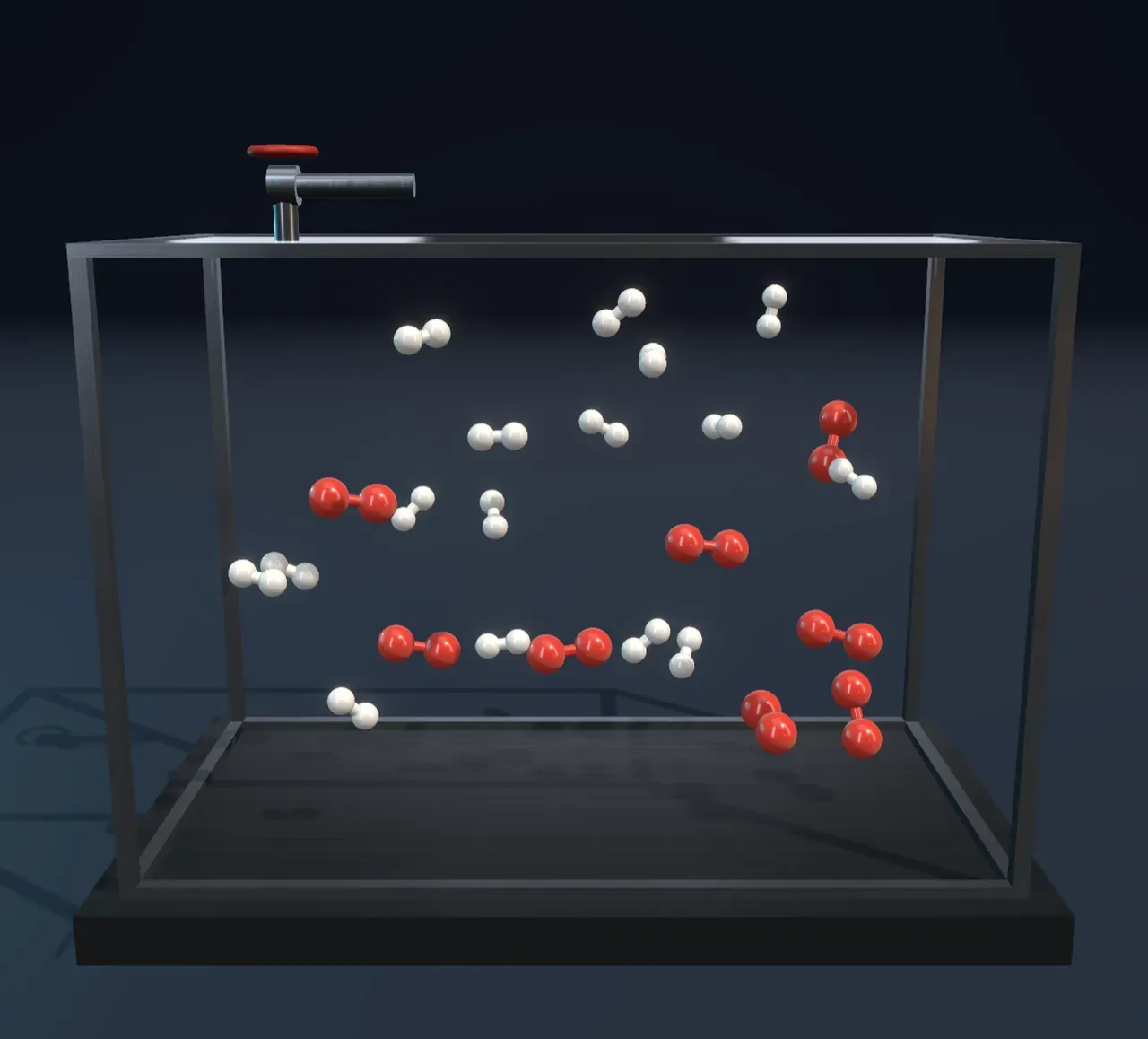
In the Scene a sealed tank is full of hydrogen and oxygen. Each ball is an atom: the white ones are hydrogen, the red ones oxygen, and each bonded pair is a molecule, or . Move Run the reaction from Elements apart to Reaction over, and follow one oxygen atom. The readings beside the Scene count what the tank holds at each moment.
Step 2 of 5
Counting atoms
The reaction is over. Each water molecule is one oxygen atom and two hydrogen atoms, : the small number after a symbol says how many atoms of that element the molecule holds. No number means one.
The readings show molecules. Count the atoms.
Step 3 of 5
Weighing the tank
A substance’s mass is the sum of the masses of its atoms. Atoms weigh very little, so they are measured in atomic mass units, u: a hydrogen atom weighs 1.008 u, and an oxygen atom 15.999 u.
Now the tank holds twice the oxygen needed. Before you run the reaction, predict what will happen to the mass of everything inside.
Step 4 of 5
Open or sealed
This rule, that in a chemical reaction the products weigh what the reactants weighed, is called the law of conservation of mass. Antoine Lavoisier showed it in the 1770s, weighing reactions in sealed vessels.
But in an open vessel the law sometimes seems to break: burnt wood leaves a small heap of ash, and rusting iron gets heavier. The secret is the gases, which come in from the air and go out into it.
Step 5 of 5
A metal that gains weight
When a metal reacts with a gas, the gas binds to it. Here magnesium, a greyish metal, burns in chlorine, a greenish gas, and becomes a white salt, . Because every atom stays, the salt weighs more than the metal: it weighs the metal plus the chlorine that bound to it.
Loading the interactive version…
Loading the interactive version…
Each step sets up the Scene for you, and a control marked “fixed” stays put for that step.
Practice · Choose
The tank holds hydrogen and oxygen. What happens to the atoms when they react and make water?
Practice · Choose
The tank holds hydrogen and oxygen. What happens to the atoms when they react and make water?
Practice · Calculate
The tank started with molecules and molecules, and the reaction is over: the readings beside the Scene show molecules. How many hydrogen atoms are in the tank now?
Practice · Calculate
The tank started with molecules and molecules, and the reaction is over: the readings beside the Scene show molecules. How many hydrogen atoms are in the tank now?
Practice · Predict, then look
The sealed tank holds hydrogen molecules and oxygen molecules, and its contents weigh 544.2 u (atomic mass units). The gases will make liquid water, and some oxygen will be left over. How much will the tank’s contents weigh when the reaction is over?
Practice · Predict, then look
The sealed tank holds hydrogen molecules and oxygen molecules, and its contents weigh 544.2 u (atomic mass units). The gases will make liquid water, and some oxygen will be left over. How much will the tank’s contents weigh when the reaction is over?
Practice · Choose
A burning candle stands on an open balance, and the reading keeps falling. Why?
Practice · Choose
A burning candle stands on an open balance, and the reading keeps falling. Why?
Practice · Calculate
Now the tank holds magnesium atoms and molecules, and they have reacted completely to units of . A Mg atom weighs 24.3 u and a Cl atom 35.45 u. How much does all the salt formed weigh, in u?
Practice · Calculate
Now the tank holds magnesium atoms and molecules, and they have reacted completely to units of . A Mg atom weighs 24.3 u and a Cl atom 35.45 u. How much does all the salt formed weigh, in u?
Lesson complete. Every practice question here is done.