All matter is made of particles that never stop moving: how their arrangement and motion make a solid, a liquid and a gas, and why a gas takes a thousand times more room.
Step 1 of 5 · Three states
Step 1 of 5
Three states
Ice, water and steam are the same substance, , in three states of matter: solid, liquid and gas. A solid keeps its shape and its volume. A liquid flows and takes the shape of its container, but its volume is fixed. A gas spreads out to fill any container, and it can be squeezed.
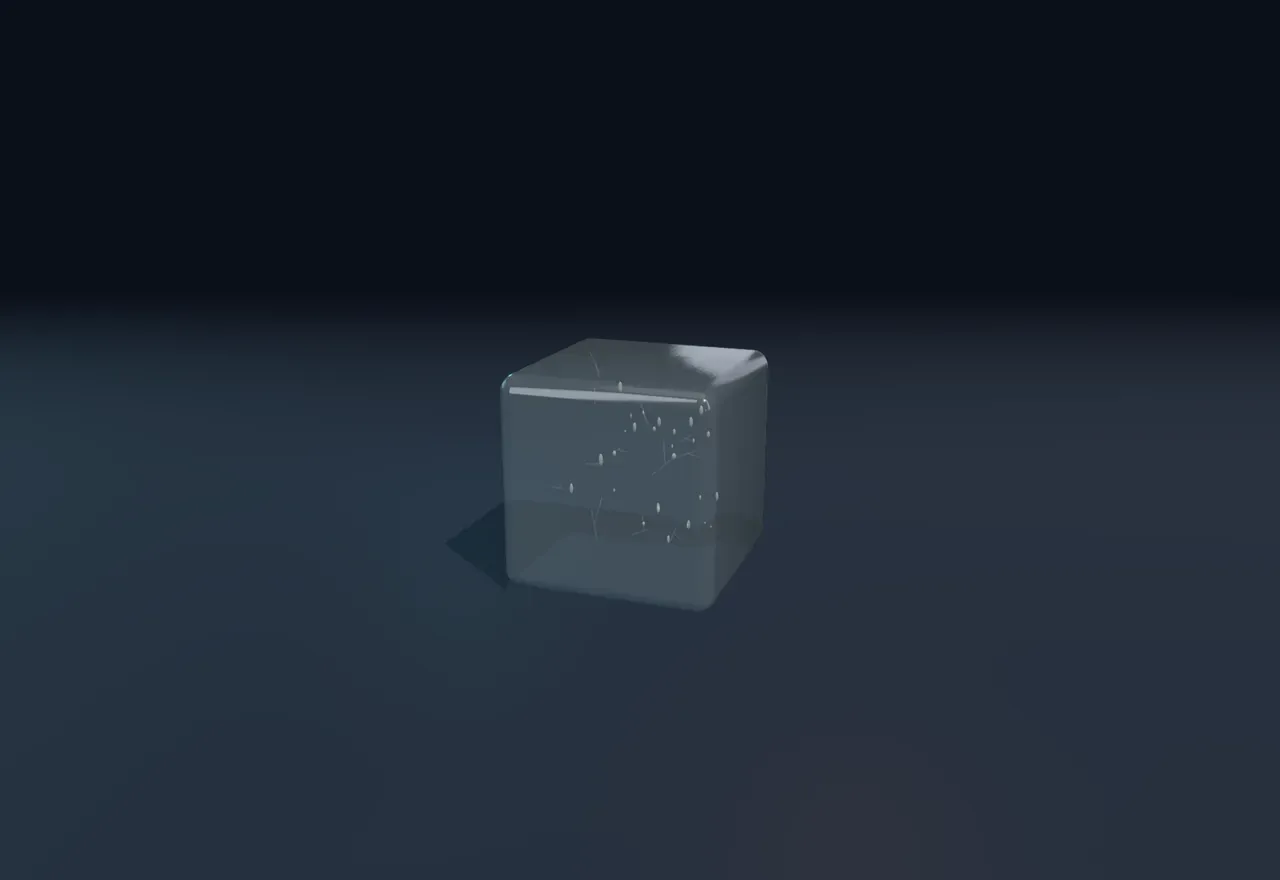
The Scene shows a cube of ice at 253 K, that is −20 °C. To explain how the states differ, chemistry uses the particle model: all matter is made of tiny particles, atoms or molecules, which are always moving and attract one another.
Step 2 of 5
Inside the ice
In a solid the attraction between the particles is strong enough to hold each one in a fixed place, in a regular arrangement called a lattice. But anything above absolute zero has energy, so the particles are not frozen still.
Zoom to the molecules will take the Scene from Surface to Molecules. Before you switch it, guess what you will see.
Step 3 of 5
Kelvin and Celsius
The Scene measures temperature in kelvin. The kelvin scale starts at absolute zero, −273 °C, the temperature at which particles almost stop moving. One kelvin is the same step as one degree Celsius, so
Chemistry works in kelvin because it measures the motion from a true zero: at 600 K the particles carry twice the average kinetic energy they do at 300 K.
Step 4 of 5
Melt it
As a solid is heated, its particles vibrate harder and harder. At the melting point the vibration is strong enough to shake them out of their fixed places: they are still close together, but they slide past one another. That is a liquid.
Zoom to the molecules is at Molecules, so you can watch the particles while the ice melts. In the Scene melting is spread over about 20 degrees above 0 °C so that you can see it; real ice melts entirely at 0 °C.
Step 5 of 5
Far apart
At 393 K the water is a gas. The molecules fly all over the box, far from each other, hitting the walls and one another. Between hits they move in straight lines, because at that distance the attraction between them is very weak.
Notice that the molecules themselves have not changed: the same size, the same shape. Only their speed and the distance between them have changed.
Loading the interactive version…
Loading the interactive version…
Each step sets up the Scene for you, and a control marked “fixed” stays put for that step.
Practice · Choose
Which state of matter has a fixed volume but no fixed shape: it takes the shape of whatever holds it?
Practice · Choose
Which state of matter has a fixed volume but no fixed shape: it takes the shape of whatever holds it?
Practice · Predict, then look
The ice in the Scene is at −20 °C. What are the water molecules inside it doing? Choose, and the Scene will zoom in on them.
Practice · Predict, then look
The ice in the Scene is at −20 °C. What are the water molecules inside it doing? Choose, and the Scene will zoom in on them.
Practice · Calculate
The Scene shows the temperature in kelvin: it is now 293 K. How much is that in degrees Celsius?
Practice · Calculate
The Scene shows the temperature in kelvin: it is now 293 K. How much is that in degrees Celsius?
Practice · Reach the target
The ice is frozen at 253 K. Change Temperature until the whole sample is liquid: no ice and no vapour. Then press Check.
Practice · Reach the target
The ice is frozen at 253 K. Change Temperature until the whole sample is liquid: no ice and no vapour. Then press Check.
Practice · Choose
Steam takes up about 1700 times the volume of the water it came from. Why?
Practice · Choose
Steam takes up about 1700 times the volume of the water it came from. Why?
Lesson complete. Every practice question here is done.