Melting, boiling, evaporation, condensation and sublimation: what happens to the particles in each change, where the energy goes, and why the temperature stands still while water boils.
Step 1 of 5 · Six changes
Step 1 of 5
Six changes
Every change between the states has a name. Heating: a solid melts into a liquid (melting), a liquid turns into gas (evaporation, and at the boiling point boiling). Cooling: a gas condenses into a liquid (condensation), a liquid freezes into a solid (freezing). Some substances skip the liquid: a solid that turns straight into gas sublimes, and a gas that turns straight into a solid undergoes deposition.
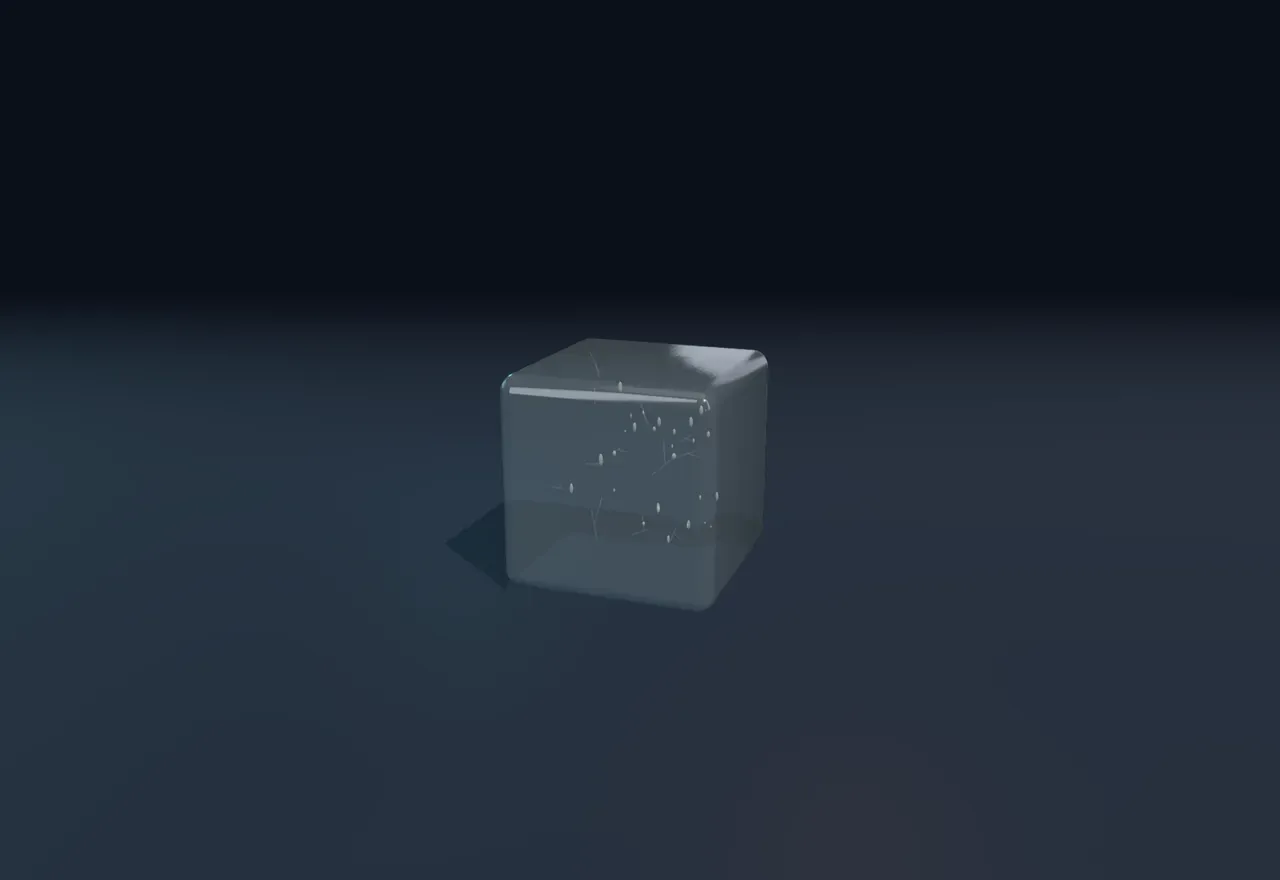
In all of these the molecules stay the same molecules. A change of state is a physical change: only the arrangement and motion of the particles change. Change Temperature in the Scene, and watch the ice melt and the water boil away.
Step 2 of 5
Melting takes energy
To free a particle from the lattice, work has to be done against the pull of its neighbours. So melting takes in energy even while the temperature does not rise: ice and water together stay at 0 °C until all the ice has melted. All the energy goes into pulling apart, none into speeding up. When water freezes, the same energy is given back.
The amount is bigger than you might think. Compare it with the energy that warms water.
Step 3 of 5
Boiling
Evaporation happens at the surface of a liquid, at any temperature. Boiling is evaporation from all through the liquid: at the boiling point the molecules move fast enough to form bubbles of gas deep in the water, and the bubbles rise and burst at the surface.
In the Scene the water is at 373 K, 100 °C. Look at the bubbles.
Step 4 of 5
The temperature stands still
As in melting, in boiling the energy goes into pulling the molecules apart. So as long as there is water in the pan, it stays at the boiling point, 100 °C at one atmosphere. If you record the temperature of water over a flame, the graph rises, levels off in a flat line for as long as it boils, and rises again only once all the water has turned to steam.
The boiling point depends on the pressure: in a pressure cooker water boils at about 120 °C, and at the top of Everest at about 70 °C.
Step 5 of 5
Evaporation without boiling
At 323 K, 50 °C, the water is far from boiling, and yet it evaporates. Zoom to the molecules is at Molecules: the temperature sets the average speed, but at any moment some molecules are much faster than that. Such a molecule, near the surface, can escape into the air.
Because it is the fast molecules that escape, the liquid left behind cools down. That is how sweat cools the skin.
Loading the interactive version…
Loading the interactive version…
Each step sets up the Scene for you, and a control marked “fixed” stays put for that step.
Practice · Choose
Dry ice, solid carbon dioxide, turns straight into gas at room temperature without passing through a liquid. What is this change called?
Practice · Choose
Dry ice, solid carbon dioxide, turns straight into gas at room temperature without passing through a liquid. What is this change called?
Practice · Calculate
Melting 1 kg of ice at 0 °C takes 334 kJ, and after melting the water is still at 0 °C. Warming 1 kg of water by one degree takes 4.18 kJ. By how many degrees would that same energy warm 1 kg of liquid water? Answer in degrees.
Practice · Calculate
Melting 1 kg of ice at 0 °C takes 334 kJ, and after melting the water is still at 0 °C. Warming 1 kg of water by one degree takes 4.18 kJ. By how many degrees would that same energy warm 1 kg of liquid water? Answer in degrees.
Practice · Choose
What are the big bubbles rising from a pan of boiling water made of?
Practice · Choose
What are the big bubbles rising from a pan of boiling water made of?
Practice · Choose
A pan of water is boiling over a flame at sea level. You turn the flame up and wait five more minutes, and there is still water in the pan. What is the water’s temperature?
Practice · Choose
A pan of water is boiling over a flame at sea level. You turn the flame up and wait five more minutes, and there is still water in the pan. What is the water’s temperature?
Practice · Choose
A puddle dries up on a 25 °C day, far below the boiling point. How does the water leave?
Practice · Choose
A puddle dries up on a 25 °C day, far below the boiling point. How does the water leave?
Lesson complete. Every practice question here is done.