Lesson 3 of 5
Pressure and the gas laws.
Where a gas’s pressure comes from, and three laws that follow from the particles: half the volume gives twice the pressure, twice the kelvin temperature gives twice the pressure, and twice the gas gives twice the pressure.
Step 1 of 6 · What pressure is
Step 1 of 6
What pressure is
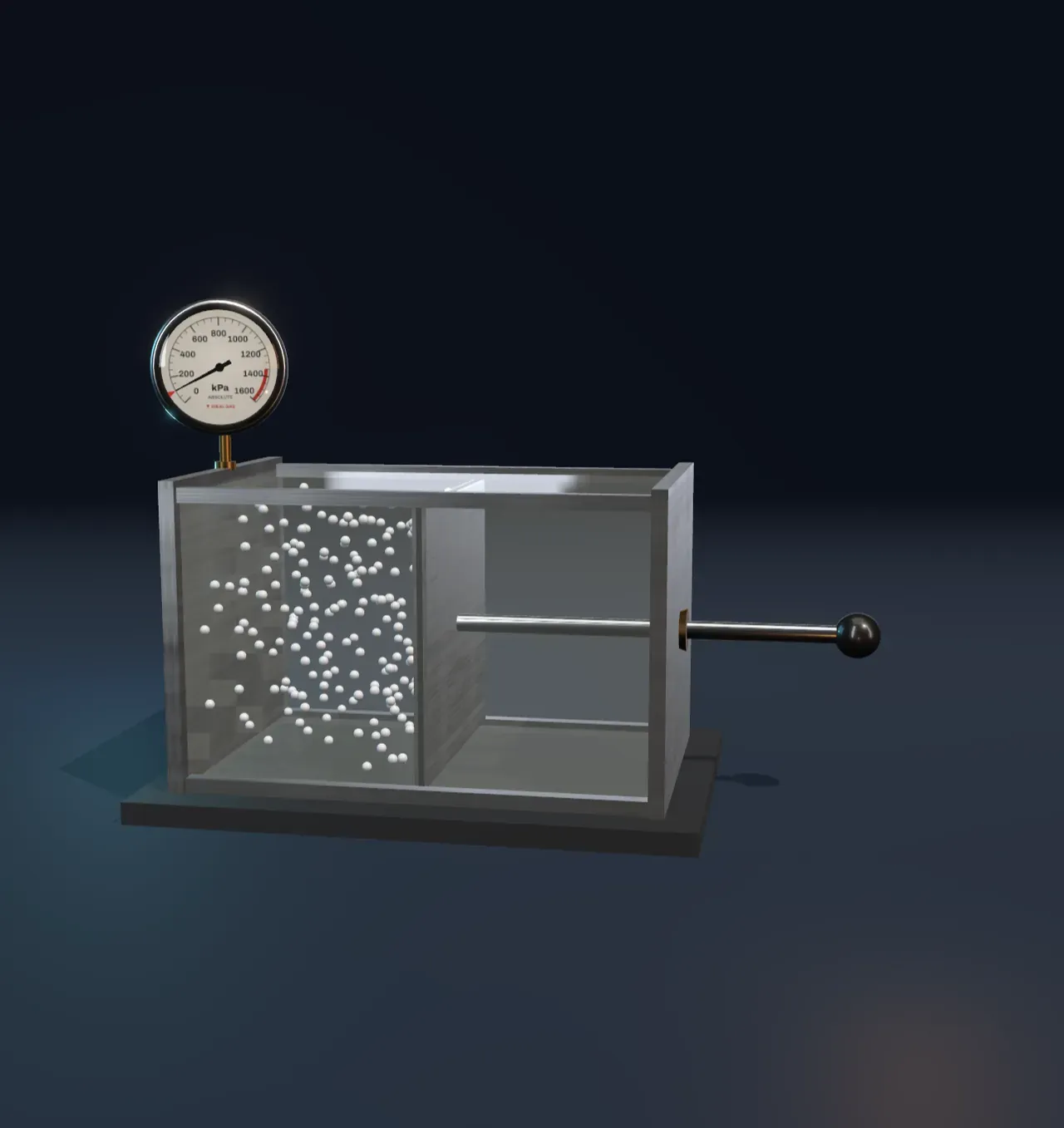
The Scene shows a sealed glass box with a wall you can move, holding 200 particles of nitrogen at 300 K. Each particle stands for an enormous number of real molecules, so the box behaves like 2 L of air: the gauge on the fixed end shows a pressure of one atmosphere, about 101 kPa.
Pressure is force per unit area, , and its unit is the pascal: a newton per square metre. Watch the particles hitting the walls.
Step 2 of 6
Squeeze
When the volume shrinks, each particle crosses the box sooner and reaches the wall more often. The same particles, at the same speed, hit more: the pressure rises.
Temperature and Amount of gas are now fixed. Guess what the gauge will show when you push Volume from 2 L to 1 L.
Step 3 of 6
Boyle’s law
At constant temperature and a fixed amount of gas, pressure and volume are inversely related: when one grows some number of times, the other shrinks by the same number. Their product does not change:
That is Boyle’s law. Now the wall is at 1.6 L: work out the pressure yourself first, and only then look at the gauge.
Step 4 of 6
Heat it
When a gas is heated, its particles move faster: each hit is harder, and the hits come more often. At constant volume the pressure rises, in proportion to the absolute temperature:
That is Gay-Lussac’s law. If the gas is heated at constant pressure instead, it expands in the same ratio, : Charles’s law. Volume and Amount of gas are now fixed, and Temperature is free.
Step 5 of 6
Why kelvin
These ratios only work in kelvin. A gas at 0 °C still has a pressure, so you cannot divide by degrees Celsius: warming from 10 °C to 20 °C doubles nothing. The zero of the kelvin scale is where the pressure of an ideal gas would reach zero.
Step 6 of 6
More gas
The third way to raise the pressure is to add particles: each extra particle adds hits. Temperature and Volume are now fixed, and Amount of gas is free. Together the three laws make one equation, the ideal gas equation:
where is the number of moles and is the gas constant.
Loading the interactive version…
Loading the interactive version…
Each step sets up the Scene for you, and a control marked “fixed” stays put for that step.
Practice · Choose
Where does the pressure a gas puts on the walls of its box come from?
Practice · Choose
Where does the pressure a gas puts on the walls of its box come from?
Practice · Predict, then look
The box holds gas at one atmosphere, in 2 L. Temperature and amount of gas are fixed. What will the pressure be when you push the wall in to 1 L?
Practice · Predict, then look
The box holds gas at one atmosphere, in 2 L. Temperature and amount of gas are fixed. What will the pressure be when you push the wall in to 1 L?
Practice · Calculate
At 2 L the pressure was one atmosphere. Now the wall is at 1.6 L, at the same temperature and with the same gas. What is the pressure?
Practice · Calculate
At 2 L the pressure was one atmosphere. Now the wall is at 1.6 L, at the same temperature and with the same gas. What is the pressure?
Practice · Reach the target
The box is at 300 K and one atmosphere. Volume and Amount of gas are fixed. Change Temperature until the pressure is exactly 2 atm, then press Check.
Practice · Reach the target
The box is at 300 K and one atmosphere. Volume and Amount of gas are fixed. Change Temperature until the pressure is exactly 2 atm, then press Check.
Practice · Calculate
A sealed, rigid can holds gas at 27 °C and one atmosphere. It is heated to 127 °C. What is the pressure now?
Practice · Calculate
A sealed, rigid can holds gas at 27 °C and one atmosphere. It is heated to 127 °C. What is the pressure now?
Practice · Predict, then look
The box holds 200 particles at 300 K in 2 L: one atmosphere. What happens to the pressure if you double Amount of gas to 400 particles, without changing temperature or volume?
Practice · Predict, then look
The box holds 200 particles at 300 K in 2 L: one atmosphere. What happens to the pressure if you double Amount of gas to 400 particles, without changing temperature or volume?
Lesson complete. Every practice question here is done.