How many moles the box holds, how much room one mole of gas takes, and why a mole of hydrogen and a mole of carbon dioxide fill the same balloon.
Step 1 of 5 · Counting moles
Step 1 of 5
Counting moles
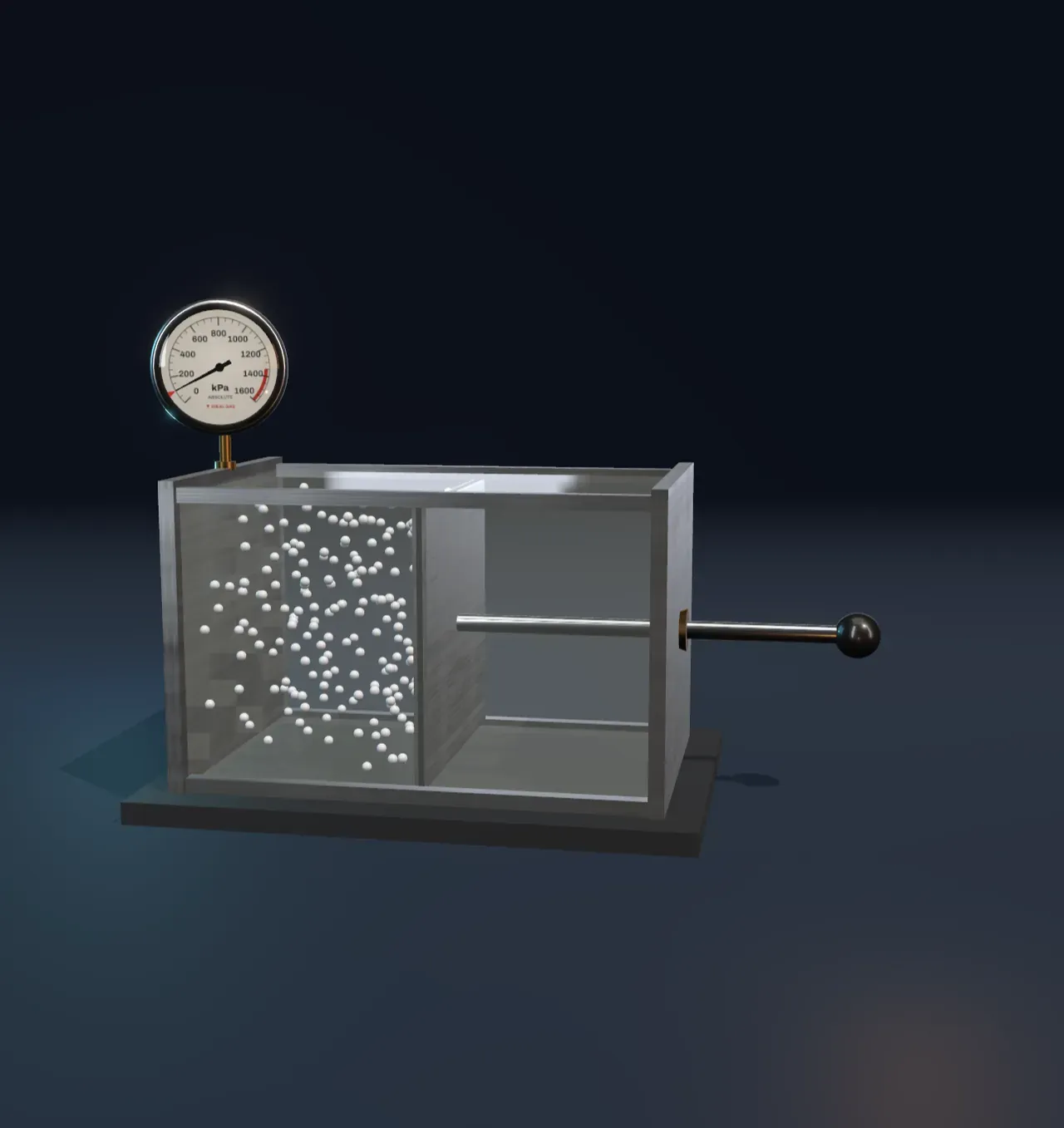
For a gas it is easier to measure volume than mass. The ideal gas equation, , links the volume to the number of moles, , so you can count the molecules of a gas with a pressure gauge, a thermometer and a ruler.
To use it with , every quantity has to be in SI units: pressure in pascals, volume in cubic metres, and temperature in kelvin. The box in the Scene is at 300 K, 2 L and one atmosphere.
Step 2 of 5
One mole
The molar volume, , is the volume one mole of gas takes up: . From the equation, , so it depends only on temperature and pressure, not on which gas it is.
Step 3 of 5
Standard conditions
At 0 °C and one atmosphere, standard conditions, the molar volume is 22.4 L/mol. At room temperature, 20–25 °C, it is about 24 L/mol. The box has now been cooled to 273 K, and the pressure has dropped.
Step 4 of 5
Avogadro’s law
Notice that the kind of gas never came into the working. In 1811 Amedeo Avogadro proposed that equal volumes of different gases, at the same temperature and pressure, hold equal numbers of particles. The reason is that the molecules are tiny compared with the gaps between them: their size hardly matters. And a heavy molecule moves more slowly but hits harder, so the pressure comes out the same.
Show the speed curve is at Speed curve: this is how the speeds of the nitrogen spread at 300 K.
Step 5 of 5
From grams to litres
Now you can go from the mass of a gas to its volume in two steps: from mass to moles with the molar mass, , and from moles to volume with the molar volume, .
Loading the interactive version…
Loading the interactive version…
Each step sets up the Scene for you, and a control marked “fixed” stays put for that step.
Practice · Calculate
The box is at 300 K, 2 L and one atmosphere, 101 325 Pa. How many moles of gas does it hold? Use with .
Practice · Calculate
The box is at 300 K, 2 L and one atmosphere, 101 325 Pa. How many moles of gas does it hold? Use with .
Practice · Calculate
In the same box, 0.0812 mol fills 2 L at 300 K and one atmosphere. What volume would one mole of gas take up under these conditions?
Practice · Calculate
In the same box, 0.0812 mol fills 2 L at 300 K and one atmosphere. What volume would one mole of gas take up under these conditions?
Practice · Reach the target
The box has been cooled to 273 K, 0 °C, at 2 L, and the pressure has dropped below one atmosphere. Temperature and Volume are fixed. Add gas with Amount of gas until the pressure is back to one atmosphere, then press Check.
Practice · Reach the target
The box has been cooled to 273 K, 0 °C, at 2 L, and the pressure has dropped below one atmosphere. Temperature and Volume are fixed. Add gas with Amount of gas until the pressure is back to one atmosphere, then press Check.
Practice · Choose
One balloon holds a mole of hydrogen, (2 g), and another a mole of carbon dioxide, (44 g), at the same temperature and pressure. Which balloon is bigger?
Practice · Choose
One balloon holds a mole of hydrogen, (2 g), and another a mole of carbon dioxide, (44 g), at the same temperature and pressure. Which balloon is bigger?
Practice · Calculate
A bottle of fizzy drink releases 11 g of (molar mass 44 g/mol) at room temperature, where the molar volume is 24 L/mol. What volume of gas came out?
Practice · Calculate
A bottle of fizzy drink releases 11 g of (molar mass 44 g/mol) at room temperature, where the molar volume is 24 L/mol. What volume of gas came out?
Lesson complete. Every practice question here is done.