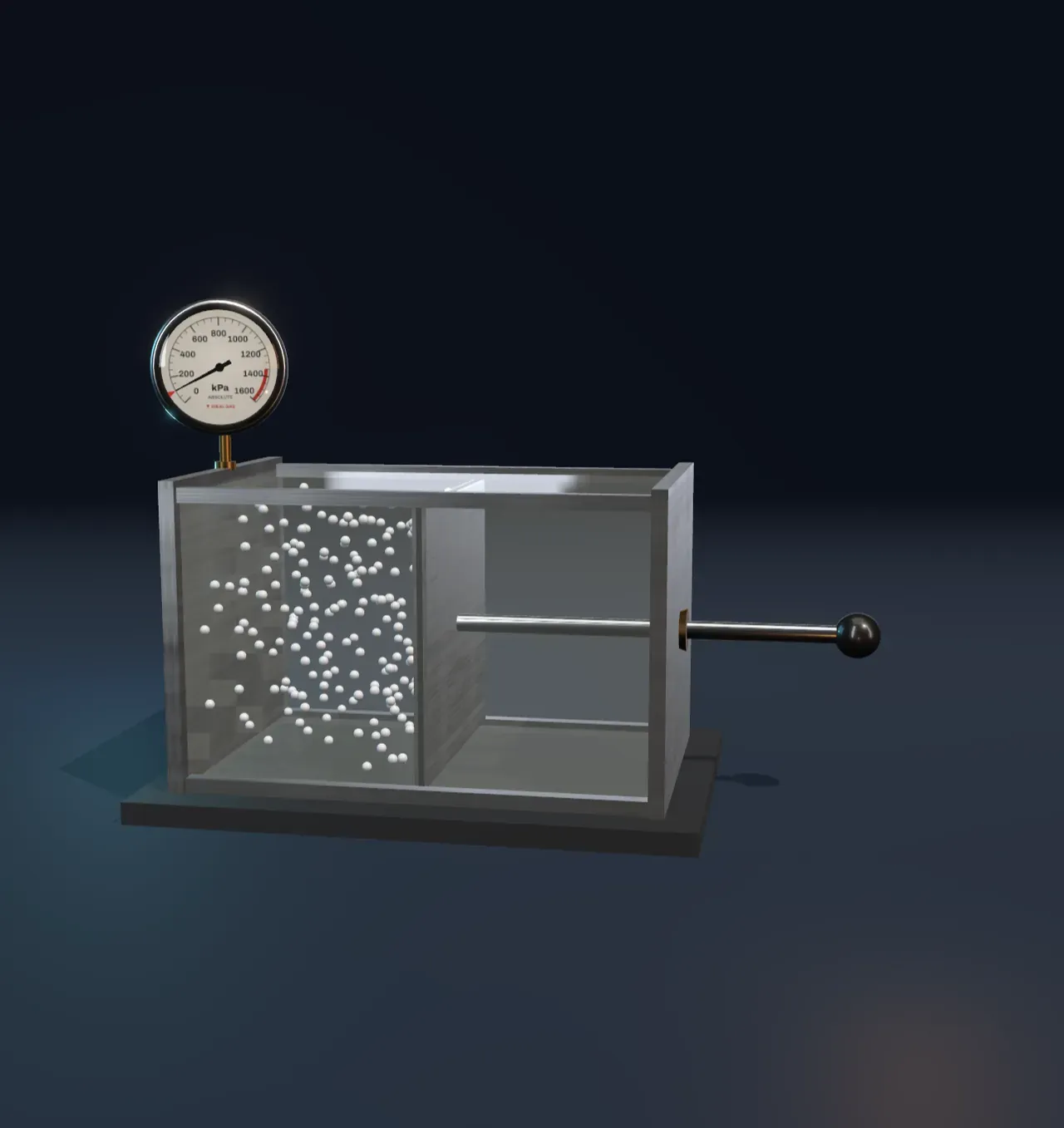
A box full of bounces
Blow up a balloon and it stays round. Nothing solid holds it out: the air inside is pushing on the rubber, everywhere at once. Seal a tin can and heat it, and that push grows until the can bulges. Squeeze a bicycle pump with your thumb over the end and the push grows again.
A gas is made of molecules flying about in straight lines, far apart compared with their size, that bounce off each other and off the walls. In the box above, 200 particles stand in for the nitrogen molecules in 2 litres of air. Each time one hits a wall it bounces back, and the bounce gives the wall a tiny shove. Billions upon billions of shoves every second add up to a steady push on every square centimetre. That push per area is the pressure.
The gauge on the left end of the box adds up those shoves. It does not work the pressure out from a formula: it counts the hits the particles make, how hard each one lands, and how much wall there is, and averages over a couple of seconds. At the start it reads about 101 kilopascals, one atmosphere, the pressure of the air around you.
Three ways to push harder
There are only three ways to make the walls feel more push, and the box has a control for each.
Less room. Slide the wall in and every particle reaches a wall sooner, so each one hits more often. Halve the volume and the hits come twice as often: the pressure doubles. Pressure times volume stays the same while the temperature and the amount of gas stay put. This is Boyle’s law.
More particles. Twice as many particles in the same box make twice as many hits, so twice the pressure. A tyre pump works this way.
Hotter gas. Heating does not add particles. It makes the ones there move faster, so each one hits more often and lands harder. Each effect grows in step with the speed, so together they grow with the square of the speed, and the square of the speed grows in step with the absolute temperature, measured in kelvin from absolute zero. So in a box that cannot change size, the pressure is proportional to the temperature in kelvin: from 300 K to 600 K, it doubles. This is the pressure law, also called Gay-Lussac’s law.
Try it: slide Volume down to 1 L. The wall slides to half the space and the gauge climbs to about 200 kPa. Then slide Temperature down to 100 K and watch it fall to a third of that.
One law for all of it
The three rules are one rule. Pressure grows with the number of particles and with the temperature, and falls with the volume:
Here is the pressure, the volume, the number of molecules, the temperature in kelvin, and is Boltzmann’s constant, 1.38 × 10⁻²³ joules per kelvin, the same for every gas. This is the ideal gas law. Chemists often write it as , counting the gas in moles instead of molecules, with J/(mol·K).
It is called ideal because it pretends the molecules take up no room and do not pull on each other. For air at everyday temperatures and pressures, that is true to within a fraction of a percent. Hold the pressure steady instead of the volume, as a balloon does, and the same law says the volume grows in step with the kelvin temperature: Charles’s law.
Many speeds at one temperature
Now slide Show the speed curve halfway. The particles take on colours by speed: slow ones blue, middling ones pale, fast ones orange and red. They are not all moving at the same speed, and they never will be. Every collision shares energy unevenly: one particle comes away faster, the other slower.
The chart beside the experiment sorts the particles into bars by speed, counted again and again as they fly. Slide Show the speed curve all the way and a curve appears over the bars: the Maxwell–Boltzmann distribution, worked out by James Clerk Maxwell in 1860 and Ludwig Boltzmann after him. Few particles are almost still, few are very fast, and most crowd around a typical speed. The bars wobble, because 200 particles are a small sample, but over a few seconds they settle onto the curve.
At room temperature, nitrogen molecules average about 480 metres per second, faster than a passenger jet. Heat the box and the whole curve stretches to the right and flattens: the speeds grow with the square root of the temperature, so four times hotter means twice as fast.
Try it: with Show the speed curve at the end, slide Temperature up to 1000 K. The curve slides right and spreads out, and the dashed average moves from about 480 to about 870 m/s.
What temperature is
This is the deepest idea of kinetic theory. The temperature of a gas is not a substance poured in: it is a measure of how fast its molecules move. The average kinetic energy of a molecule moving about is
about 6.2 × 10⁻²¹ joules at room temperature, and it is the same for every gas at the same temperature. Light molecules make up for their small mass by moving faster: hydrogen molecules at room temperature average about 1,800 metres per second, nearly four times faster than nitrogen.
So both readings the box gives are averages over countless collisions. Pressure is the average push of the hits; temperature is the average energy of the movement. Neither belongs to one molecule. A single particle has a speed, not a temperature.
What this model leaves out
- Size and scale. Each particle stands for about 2.4 × 10²⁰ molecules and is drawn many millions of times bigger than a nitrogen molecule, 0.36 nanometres across. Real molecules fly about two hundred times their own size between collisions at room pressure; here they are drawn big enough to see and bump into each other only now and then. Because the drawn particles take up a little room, the gauge reads above the ideal mark when the box is crowded: about a tenth above with the most particles squeezed into the smallest box. Real gases do the same at high pressure.
- Slow motion. The particles move several thousand times slower than real molecules, all by the same factor, so the spread of speeds keeps its true shape.
- A bath around the box. The box stays at the temperature you set. Squeeze a real gas quickly and the moving wall speeds up the molecules it hits, so the gas warms up; here the bath takes that heat away at once.
- Real gases. Near the point where it would turn to liquid (nitrogen does at 77 K, −196 °C) or at very high pressure, a real gas strays from , because its molecules do take up room and do pull on each other. The van der Waals equation adds both effects.
- Spinning molecules. Nitrogen molecules also tumble end over end, and that holds energy too. The model shows only their movement from place to place, which is the part that makes pressure. Gravity, which makes the air a tiny bit denser at the bottom of the box, is left out as well.