Every repeating wave is a sum of sines: circles spinning on circles, the square wave’s odd sines and their sizes, the triangle wave that converges fast, and the bump beside a jump that never goes away.
Step 1 of 6 · One circle
Step 1 of 6
One circle
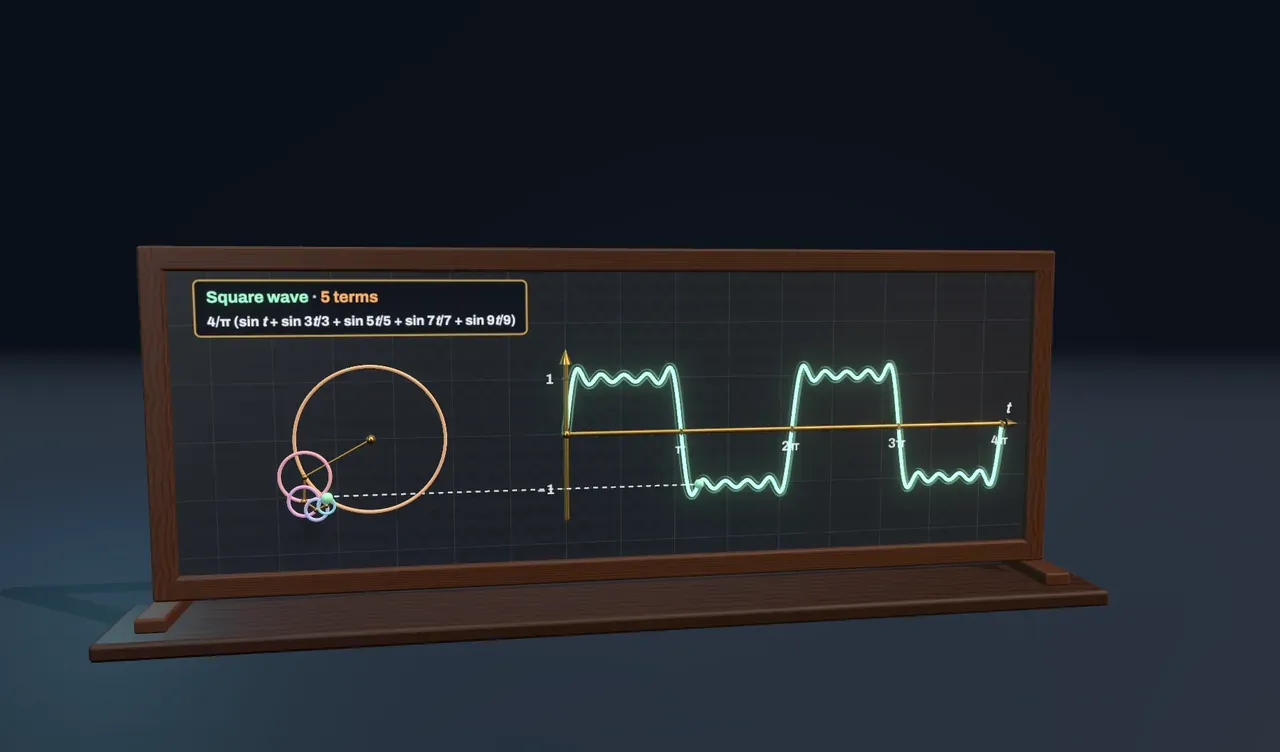
In the trigonometry Unit you saw a point turning on a circle draw a sine wave. In complex numbers: is a point turning times as fast, on a circle of radius , and its height is . Add several of these, each circle on the rim of the last, and the tip of the chain draws a sum of sines. Joseph Fourier claimed that every repeating wave can be built this way:
This is a Fourier series. Here the wave is a square wave, and there is only one circle: the first term of its series, . Work out the circle’s radius.
Step 2 of 6
More circles
The series of the square wave, , has only odd frequencies, and each term shrinks like one over its frequency:
Here there are circles, and Show the sines draws each sine on its own on the graph. Predict what the fifth circle will add.
Step 3 of 6
The triangle wave
With Wave on the triangle, , the terms shrink faster, like one over the square of the frequency:
A smoother wave needs fewer fast sines. Work out the radius of the third circle.
Step 4 of 6
Beside the jump
The square wave jumps all at once from to . A sum of smooth sines cannot jump like that, so beside every jump it rises a little above the wave, then wobbles. Show the sines is now at the end, and the board shows the bump’s height. Predict what will happen to it as you add Terms.
Step 5 of 6
No jump
The bump belongs to jumps, not to the wave itself. Try all three choices of Wave, then answer.
Step 6 of 6
The highest point
Under Show the sines you see the sum up close beside the jump.
Loading the interactive version…
Loading the interactive version…
Each step sets up the Scene for you, and a control marked “fixed” stays put for that step.
Practice · Calculate
Terms is : one circle, and the square wave’s first sine, with . What is the circle’s radius, , as a decimal?
Practice · Calculate
Terms is : one circle, and the square wave’s first sine, with . What is the circle’s radius, , as a decimal?
Practice · Predict, then look
There are circles of the square wave: they spin , , and times as fast as the first. How many turns will the fifth circle make while the first turns once?
Practice · Predict, then look
There are circles of the square wave: they spin , , and times as fast as the first. How many turns will the fifth circle make while the first turns once?
Practice · Calculate
Wave is the triangle, with terms. Term has size , with odd only. What is the radius of the third circle?
Practice · Calculate
Wave is the triangle, with terms. Term has size , with odd only. What is the radius of the third circle?
Practice · Predict, then look
Beside each jump of the square wave the sum rises above the wave, by about of the jump, with terms. What will happen to this bump as you add terms, up to ?
Practice · Predict, then look
Beside each jump of the square wave the sum rises above the wave, by about of the jump, with terms. What will happen to this bump as you add terms, up to ?
Practice · Choose
Try all three Wave shapes with terms, and drag Show the sines all the way. In which wave does the sum not rise above the wave?
Practice · Choose
Try all three Wave shapes with terms, and drag Show the sines all the way. In which wave does the sum not rise above the wave?
Practice · Calculate
Wave: Square, and Terms . The wave jumps from to , and beside each jump the sum rises above the wave by about of the size of the jump. What is the highest value the sum reaches?
Practice · Calculate
Wave: Square, and Terms . The wave jumps from to , and beside each jump the sum rises above the wave by about of the size of the jump. What is the highest value the sum reaches?
Lesson complete. Every practice question here is done.