Why a test that is $90\%$ accurate is wrong about most of its positives when the disease is rare: count the false positives, find when a positive is half and half, and see what a better test does and does not do.
Step 1 of 5 · A rare disease
Step 1 of 5
A rare disease
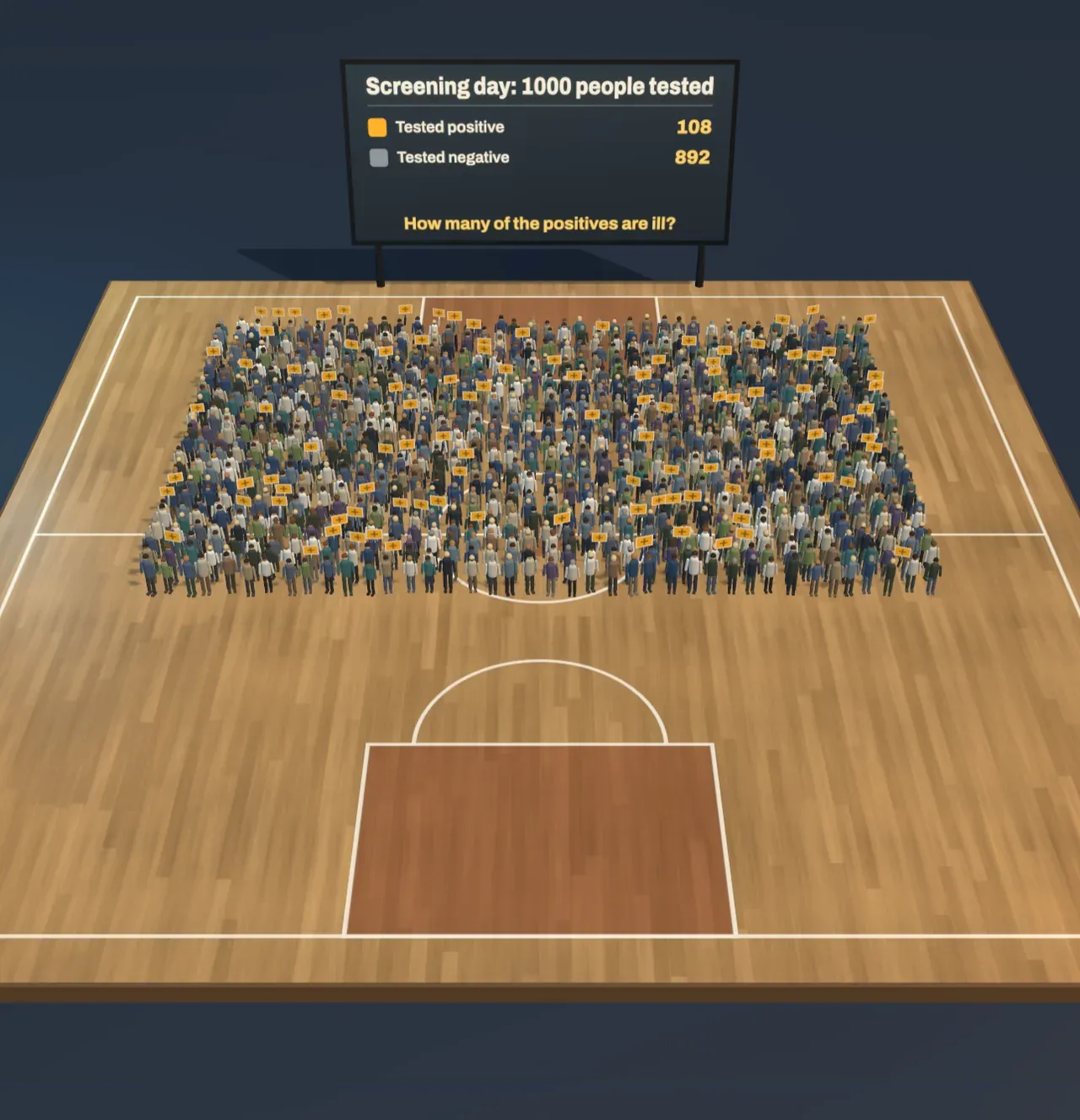
In the last Lesson of the hall were ill. Many diseases are much rarer. Here How common the disease is is : a hall of holds only ill people. This rate, how common the disease is before anyone is tested, is called the base rate.
The test is still accurate. Predict, then the board will sort the positives.
Step 2 of 5
Counting false alarms
The right-hand mat is far more crowded than the left. Everyone on it is a false alarm: a healthy person the test flagged.
Step 3 of 5
Half and half
At , only about of the positives are ill. At , in the last Lesson, half. The answer depends on the base rate as much as on the test.
Step 4 of 5
A better test
If the base rate matters so much, perhaps a better test solves the problem? The test is accurate now, and it is about to be swapped for a one.
Step 5 of 5
Rarer still
The same excellent test, , for a disease that affects one person in a thousand. Doctors meet exactly this in screening. Work it out before you open the board.
The mistake of reading the accuracy as the chance of being ill is called base-rate neglect. It is very common, doctors included.
Loading the interactive version…
Loading the interactive version…
Each step sets up the Scene for you, and a control marked “fixed” stays put for that step.
Practice · Predict, then look
A disease affects of people, and the test is accurate. Someone has tested positive. What is the chance they are really ill?
Practice · Predict, then look
A disease affects of people, and the test is accurate. Someone has tested positive. What is the chance they are really ill?
Practice · Calculate
In the same hall, ill and a accurate test: how many of the positives are healthy?
Practice · Calculate
In the same hall, ill and a accurate test: how many of the positives are healthy?
Practice · Reach the target
The test stays accurate. Change How common the disease is until half the positives are really ill, then press Check.
Practice · Reach the target
The test stays accurate. Change How common the disease is until half the positives are really ill, then press Check.
Practice · Predict, then look
Back to ill. The test is replaced by one that is accurate. What is the chance now that a positive is ill?
Practice · Predict, then look
Back to ill. The test is replaced by one that is accurate. What is the chance now that a positive is ill?
Practice · Calculate
And a rarer disease still, in (), with the same test? What is the chance a positive is ill? Give it as a per cent, the number only, to one decimal place.
Practice · Calculate
And a rarer disease still, in (), with the same test? What is the chance a positive is ill? Give it as a per cent, the number only, to one decimal place.
Lesson complete. Every practice question here is done.