The prisoner's dilemma: why betrayal pays in a single round even when cooperation is better for both, what happens when strategies compete over generations, and why a long game rewards tit for tat.
Step 1 of 4 · The prisoner's dilemma
Step 1 of 4
The prisoner’s dilemma
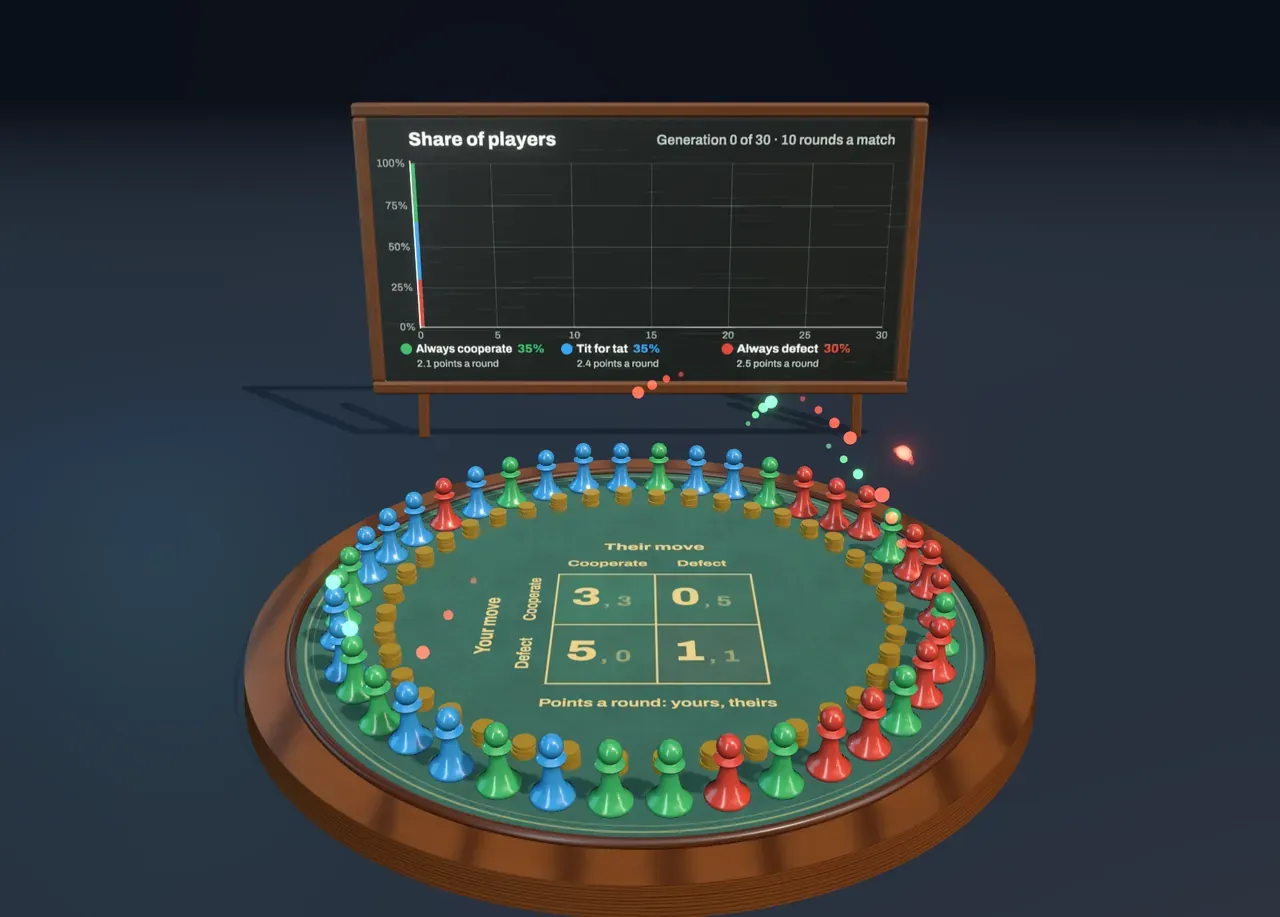
Game theory studies decisions among several players, where what is best for one depends on what the others do. In the prisoner’s dilemma each player chooses in secret: cooperate or betray. Mutual cooperation gives each points, and mutual betrayal . When one betrays and the other cooperates, the betrayer gets and the betrayed .
Step 2 of 4
Average against the table
In the scene three strategies share a table: unconditional cooperators in green, unconditional defectors in red, and tit for tat in blue: it cooperates in the first round, and from then on does what the other did in the round before. Every player plays everyone else, and each strategy’s coin stack is its average points a round.
Defectors at the start are , and of the rest half play tit for tat. All the settings are fixed now.
Step 3 of 4
Generation after generation
Now the tournament is ecological: after each generation, each strategy’s share of the table grows in proportion to the points it collected. No one decides anything; strategies that do well simply become more common. The Generations slider runs generations.
Step 4 of 4
A repeated game
When the same players meet again and again, a move today has a price tomorrow: whoever betrays now may be betrayed in the next round. Rounds per match sets how many rounds each match between two players lasts.
Try it: after checking, slide it back down to 1 and find how many rounds tit for tat needs to win.
Loading the interactive version…
Loading the interactive version…
Each step sets up the Scene for you, and a control marked “fixed” stays put for that step.
Practice · Choose
A one-round game against a player you do not know. You cannot tell what they will do. What should you do, if you care only about your own points?
Practice · Choose
A one-round game against a player you do not know. You cannot tell what they will do. What should you do, if you care only about your own points?
Practice · Calculate
At the table betray, always cooperate and play tit for tat, and each match is one round. How many points a round does a defector get, on average against the whole table?
Practice · Calculate
At the table betray, always cooperate and play tit for tat, and each match is one round. How many points a round does a defector get, on average against the whole table?
Practice · Predict, then look
This mix plays generation after generation, and each strategy grows in proportion to the points it collects. Each match is still one round. What will be at the table after 30 generations?
Practice · Predict, then look
This mix plays generation after generation, and each strategy grows in proportion to the points it collects. Each match is still one round. What will be at the table after 30 generations?
Practice · Predict, then look
The same mix to start with, but now each match lasts ten rounds. Who will lead after 30 generations?
Practice · Predict, then look
The same mix to start with, but now each match lasts ten rounds. Who will lead after 30 generations?
Lesson complete. Every practice question here is done.