From an atom to the Milky Way in powers of ten: the order of magnitude of a thing, how many times bigger one thing is than another, and how many orders of magnitude lie between the smallest and the largest.
Step 1 of 5 · The atom
Step 1 of 5
The atom
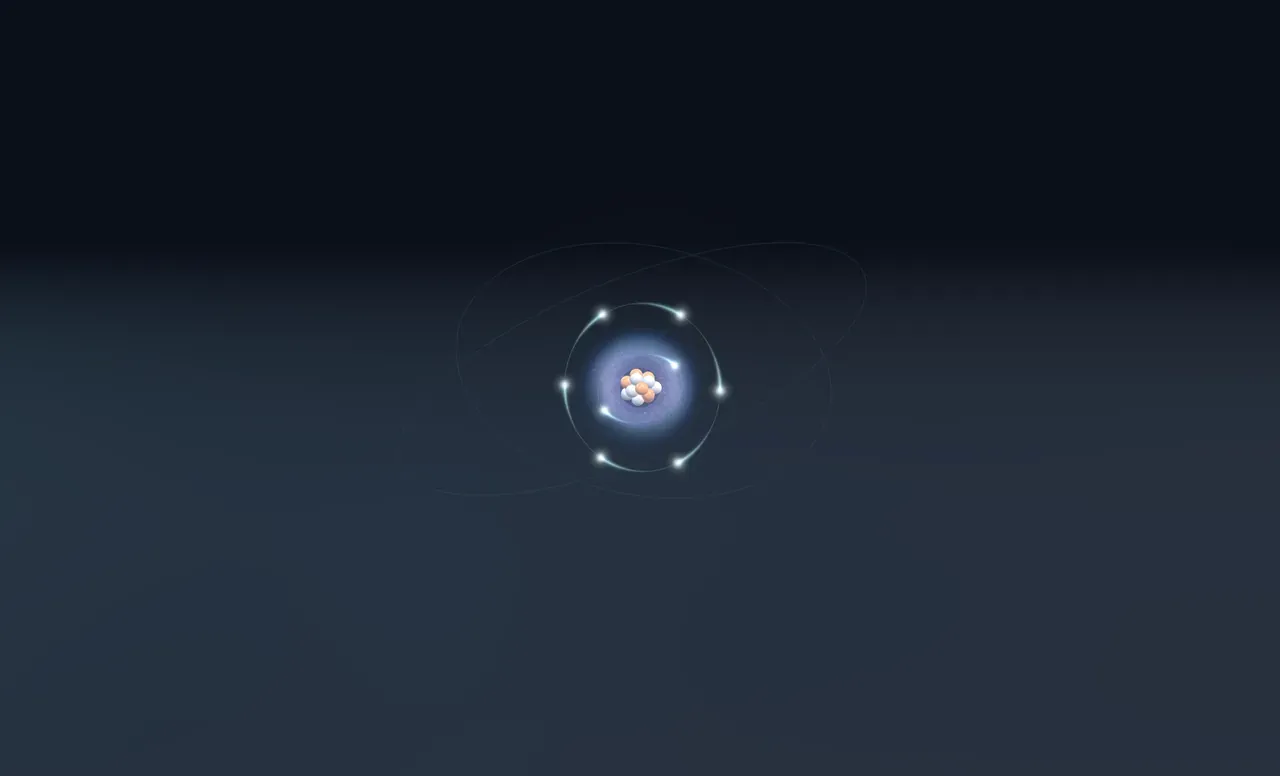
The scene goes through six stops, from an atom to the Milky Way, and draws each stop at a comfortable size for the screen. The real sizes are written in the labels, in words. An atom is about a tenth of a billionth of a metre across: a billionth is , and a tenth of it is another times smaller.
Write the size of the atom as a power of .
Step 2 of 5
From atom to cell
The order of magnitude of a number is the exponent of in its scientific notation. An atom, metres, is of order of magnitude . A cell is about a hundredth of a millimetre across, that is metres. To find how many times bigger one thing is than another you divide, and dividing powers of subtracts their exponents, the small raised numbers.
Predict how many times wider the cell is than the atom, then see the cell.
Step 3 of 5
The Sun
To compare sizes you need the same unit. The Sun’s width is given in kilometres, and each kilometre is metres. Multiplying powers of adds the exponents: .
Step through the stops, and write the Sun’s width in metres.
Step 4 of 5
The galaxy
A light year is the distance light travels in a year, about metres, close to . The Milky Way is about a hundred thousand light years across, light years.
How many metres is that?
Step 5 of 5
The whole ladder
From the atom to the Milky Way: how many orders of magnitude apart are they? On a ladder of powers of , the distance between two things is the difference of their exponents. Watch the atom’s minus sign, as when subtracting a negative number on the number line.
Loading the interactive version…
Loading the interactive version…
Each step sets up the Scene for you, and a control marked “fixed” stays put for that step.
Practice · Calculate
An atom is about a tenth of a billionth of a metre across. Write that as metres. What is ?
Practice · Calculate
An atom is about a tenth of a billionth of a metre across. Write that as metres. What is ?
Practice · Predict, then look
A cell is about metres across, and an atom metres. How many times wider than the atom is the cell?
Practice · Predict, then look
A cell is about metres across, and an atom metres. How many times wider than the atom is the cell?
Practice · Calculate
The Sun is kilometres across. Write that in metres as . What is ?
Practice · Calculate
The Sun is kilometres across. Write that in metres as . What is ?
Practice · Calculate
A light year is about metres, and the Milky Way is about light years across. How many metres is that? Write it as and find .
Practice · Calculate
A light year is about metres, and the Milky Way is about light years across. How many metres is that? Write it as and find .
Practice · Calculate
An atom is metres across and the Milky Way metres. How many orders of magnitude apart are they?
Practice · Calculate
An atom is metres across and the Milky Way metres. How many orders of magnitude apart are they?
Lesson complete. Every practice question here is done.