A linear map moves the whole plane at once, keeping lines straight and parallel: where the unit vectors go, how the rotation matrix is built, where any point goes, and why a shear does not change area.
Step 1 of 7 · The unit vectors
Step 1 of 7
The unit vectors
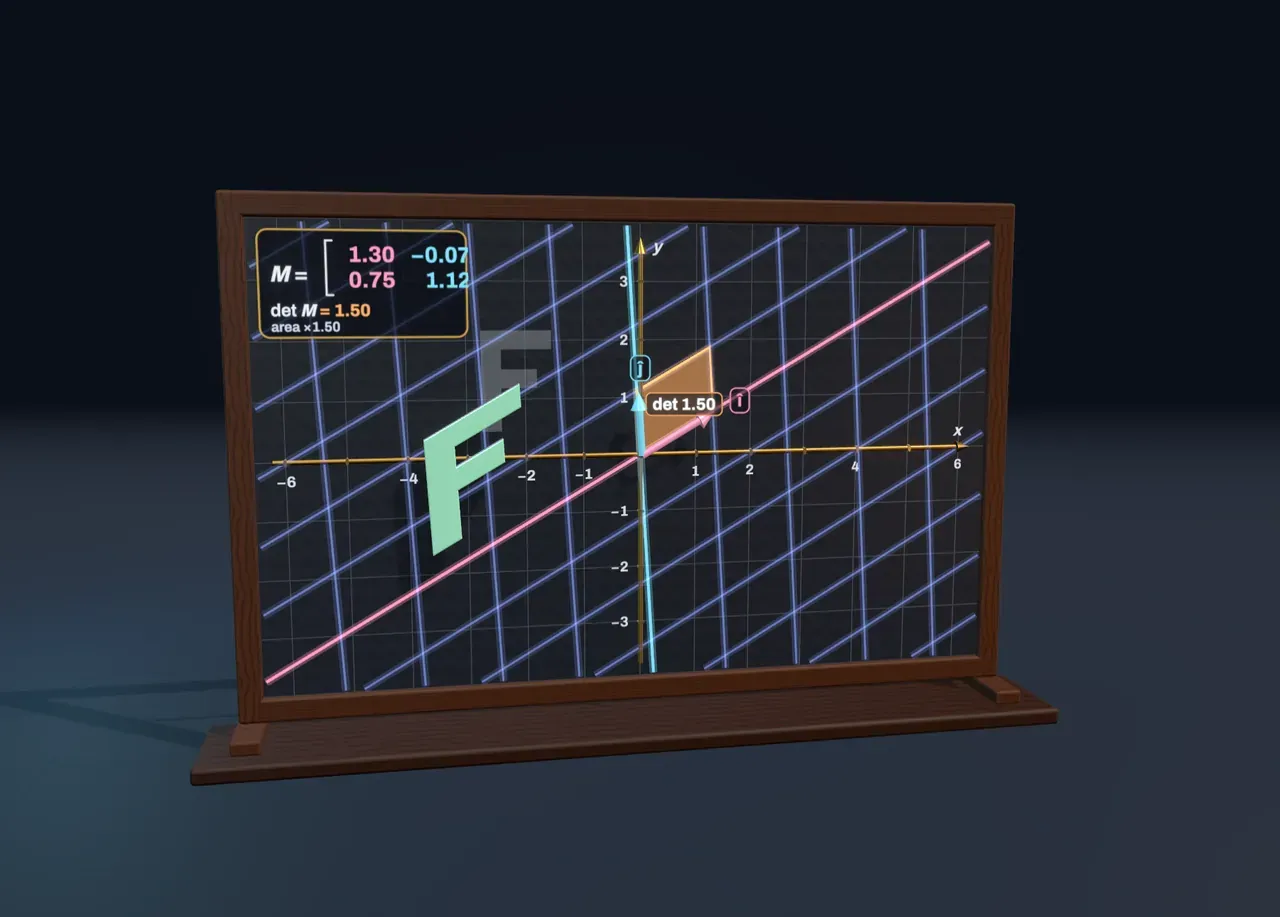
In the trigonometry Unit a vector was an arrow with components. Now we move the whole plane at once. A linear map of the plane sends every point to a new point so that straight lines stay straight and parallel, and the origin stays put. The glowing grid on the board is the plane; the F, mint on top and violet underneath, is a shape with no symmetry, so you can see any flip.
Two arrows are enough to describe such a map: , the pink one, and , the blue one. Every point is , so it is enough to know where they go. Here the map is a turn of . Predict where will land, then watch.
Step 2 of 7
The rotation matrix
The new places of and are written as the columns of a matrix:
In a turn by , lands on , like a point on the unit circle. starts a quarter turn ahead of it, so it lands on . Here Turn is . The card in the corner shows as you drag Apply the transformation: before the map it shows a matrix that moves nothing.
Step 3 of 7
Where any point goes
Once is known, every point goes to the same mix of its columns:
Here Stretch stretches to , and Shear leans over to . The unit square, whose far corner is , becomes a parallelogram. Work out where that corner lands.
Step 4 of 7
Shear
A shear slides every row of the plane sideways, more the higher it is, like a deck of cards pushed into a slant. Here Shear is : stays put, and goes to . Predict the area of the parallelogram the unit square becomes.
Step 5 of 7
Build a matrix
You can also build a matrix from what you want it to do. Stretch, Shear and Turn set , and the card shows it. Here Shear is locked at ; build a map that sends to a given place.
Step 6 of 7
after a turn
The second column of is where the blue arrow, , lands.
Step 7 of 7
The diagonal
Every point is a mix of and , so it lands on the same mix of the columns.
Loading the interactive version…
Loading the interactive version…
Each step sets up the Scene for you, and a control marked “fixed” stays put for that step.
Practice · Predict, then look
Stretch is , Shear and Turn . Where will the pink arrow, , land?
Practice · Predict, then look
Stretch is , Shear and Turn . Where will the pink arrow, , land?
Practice · Calculate
Turn is , with no stretch and no shear. What is the top-right entry of , the horizontal component of where lands? Answer, then drag Apply the transformation all the way.
Practice · Calculate
Turn is , with no stretch and no shear. What is the top-right entry of , the horizontal component of where lands? Answer, then drag Apply the transformation all the way.
Practice · Calculate
Stretch is , Shear and Turn , so . Where does the unit square’s corner land? Give its . Answer, then drag Apply the transformation.
Practice · Calculate
Stretch is , Shear and Turn , so . Where does the unit square’s corner land? Give its . Answer, then drag Apply the transformation.
Practice · Predict, then look
Shear is , with no stretch and no turn: every row slides right by its own height. The unit square becomes a parallelogram. What will its area be?
Practice · Predict, then look
Shear is , with no stretch and no turn: every row slides right by its own height. The unit square becomes a parallelogram. What will its area be?
Practice · Reach the target
Build a matrix that sends to : straight up, length . Shear is locked; change Stretch and Turn, then press Check.
Practice · Reach the target
Build a matrix that sends to : straight up, length . Shear is locked; change Stretch and Turn, then press Check.
Practice · Calculate
Stretch , Shear and Turn . What is the bottom-right entry of , the vertical component of where lands?
Practice · Calculate
Stretch , Shear and Turn . What is the bottom-right entry of , the vertical component of where lands?
Practice · Calculate
Stretch , Shear and Turn . The corner of the unit square turns with the plane. How high, , does it land?
Practice · Calculate
Stretch , Shear and Turn . The corner of the unit square turns with the plane. How high, , does it land?
Lesson complete. Every practice question here is done.