What flows in a wire, voltage as energy per coulomb, Ohm's law, why a battery does not give a fixed current, and the power a bulb takes.
Step 1 of 5 · What flows
Step 1 of 5
What flows
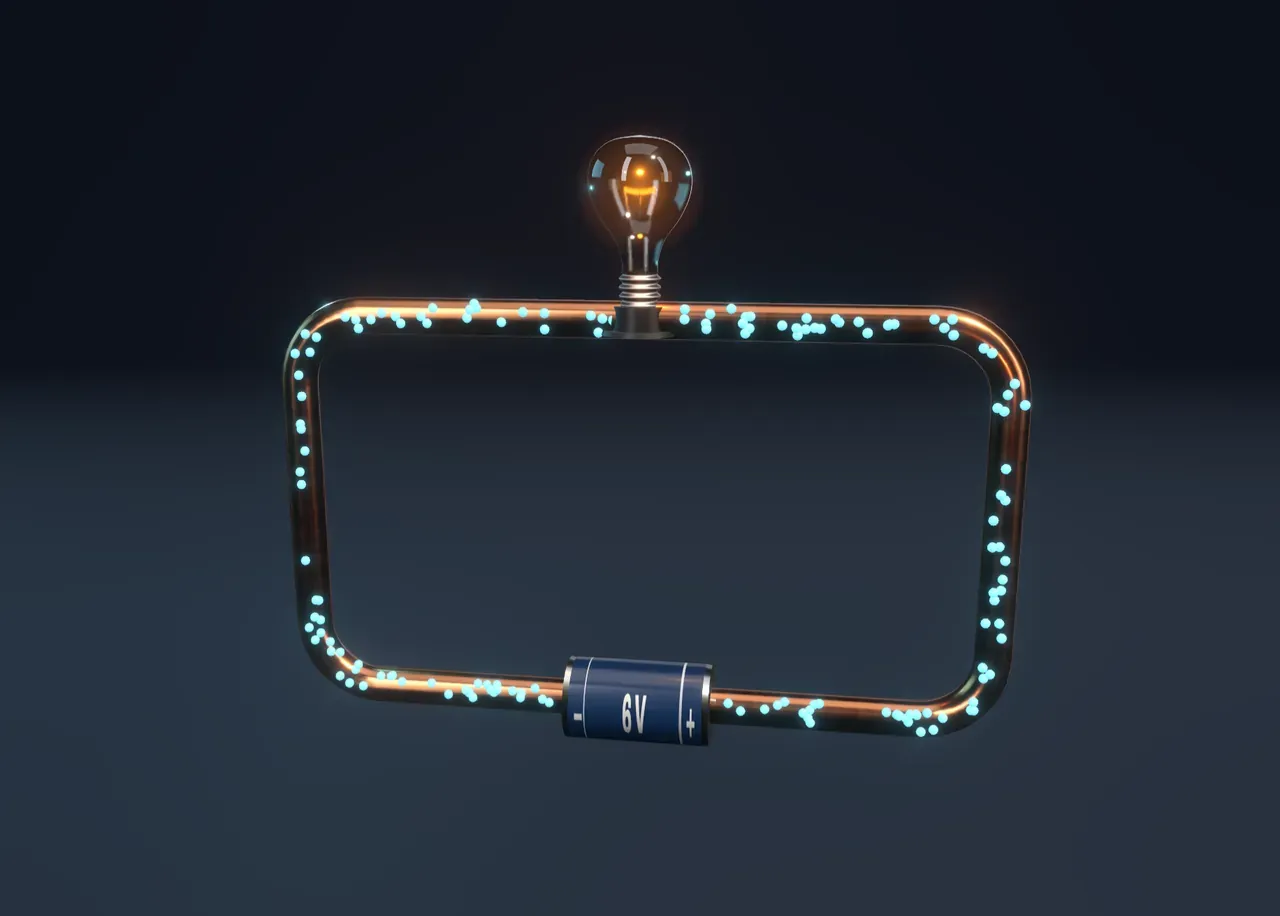
Look inside the wire is at Inside the wire. The metal ions vibrate in place, and between them dart free electrons, of which every metal has a vast number. When the battery is connected, the whole crowd drifts slowly round the loop. That drift is an electric current: the amount of charge that passes a point in the wire each second,
Current is measured in amperes: 1 A is one coulomb per second. By convention, the direction of the current is the way a positive charge would move, from the battery’s positive terminal, round the circuit, to its negative terminal. The electrons, whose charge is negative, drift the opposite way.
What the battery gives is a voltage: the potential difference between its two terminals, the energy each coulomb gains as it passes through it. A 6 V battery gives each coulomb 6 J, and the coulomb hands it over in the bulb.
Predict what will happen to the electrons in the wire when the voltage goes down to zero.
Step 2 of 5
Ohm’s law
Anything the electrons have to squeeze through hinders the current, and that is resistance. The larger the voltage, the larger the current; the larger the resistance, the smaller it is. In Ohm’s law the current equals the voltage divided by the resistance:
Resistance is measured in ohms, Ω: a 1 Ω resistor needs 1 V to pass 1 A. It is a linear equation, and any of the three can be solved for: and .
Voltage and Resistance are now fixed. Work out the current.
Step 3 of 5
Setting the current
Voltage is fixed at 12 V, and with a resistance of 6 Ω a current of 2 A flows. Change Resistance so that a quarter of that flows in the circuit.
Step 4 of 5
A battery does not give a fixed current
The battery sets the voltage, the energy per coulomb. It does not set how many coulombs pass each second: the whole circuit sets that, through its resistance. Voltage is fixed at 6 V, and the resistance is 6 Ω. Predict what will happen to the current when the resistance is doubled.
Step 5 of 5
Power
Power is energy per unit time, , measured in watts, 1 W = 1 J/s. In the circuit, each coulomb hands over joules in the bulb, and coulombs pass through it each second, so the power the bulb takes is
With Ohm’s law it can also be written as or as . The voltage is now 12 V, as in a car battery, and the resistance is 6 Ω. What is the power of the bulb?
Loading the interactive version…
Loading the interactive version…
Each step sets up the Scene for you, and a control marked “fixed” stays put for that step.
Practice · Predict, then look
The voltage is turned down to zero. What will happen to the electrons in the wire?
Practice · Predict, then look
The voltage is turned down to zero. What will happen to the electrons in the wire?
Practice · Calculate
The voltage is 12 V and the resistance 8 Ω. What is the current in the circuit?
Practice · Calculate
The voltage is 12 V and the resistance 8 Ω. What is the current in the circuit?
Practice · Reach the target
The voltage is fixed at 12 V. Change Resistance so that 0.5 A flows in the circuit, and press Check.
Practice · Reach the target
The voltage is fixed at 12 V. Change Resistance so that 0.5 A flows in the circuit, and press Check.
Practice · Predict, then look
The voltage is 6 V and the resistance 6 Ω, so the current is 1 A. The resistance is doubled to 12 Ω. What will the current be?
Practice · Predict, then look
The voltage is 6 V and the resistance 6 Ω, so the current is 1 A. The resistance is doubled to 12 Ω. What will the current be?
Practice · Calculate
The voltage is 12 V and the resistance 6 Ω. What power does the bulb take?
Practice · Calculate
The voltage is 12 V and the resistance 6 Ω. What power does the bulb take?
Lesson complete. Every practice question here is done.